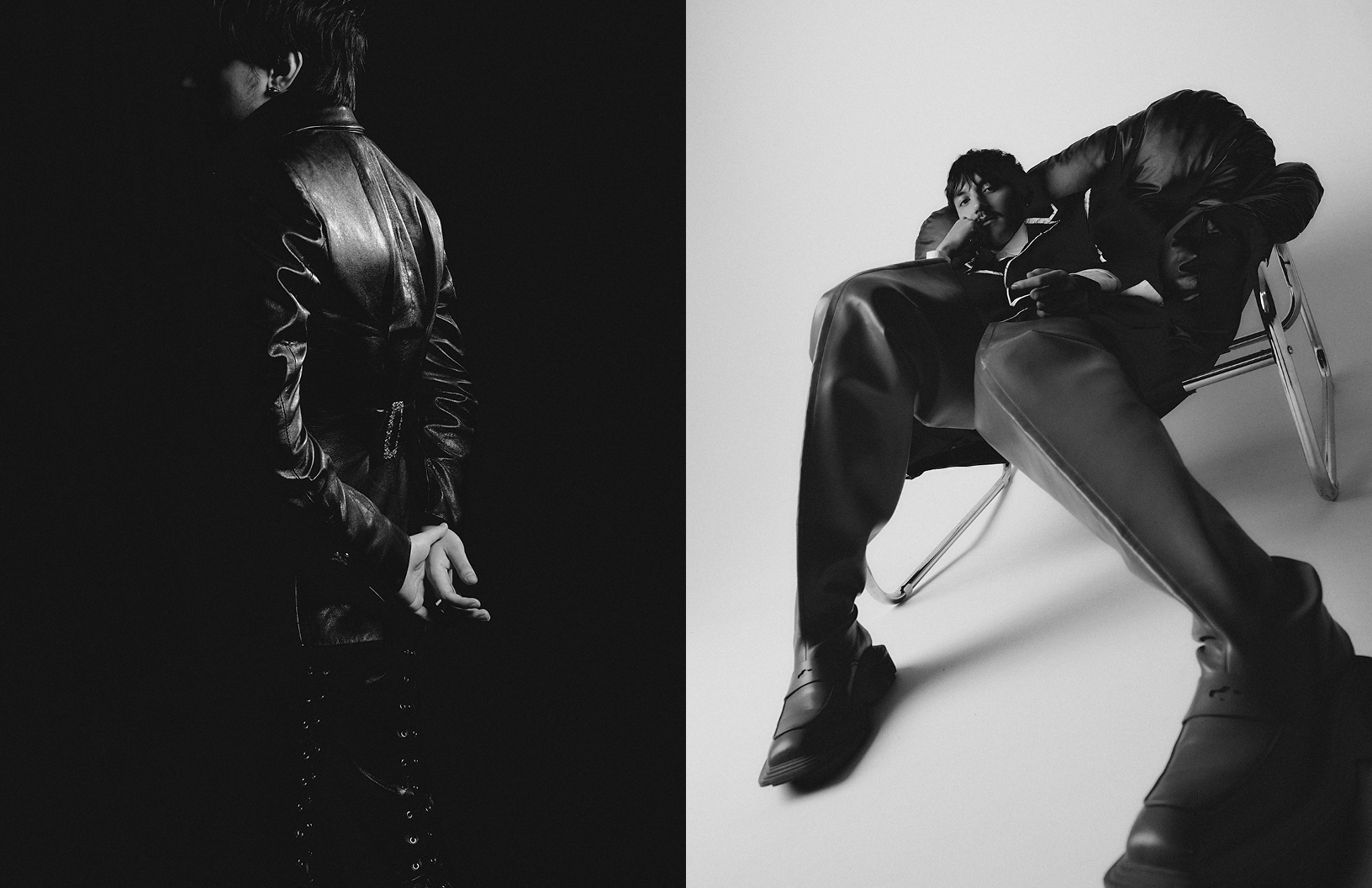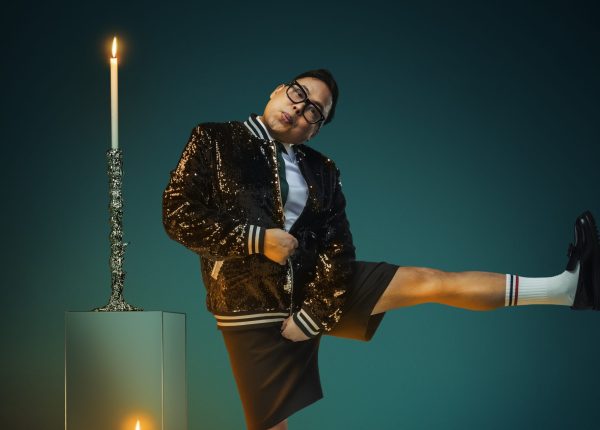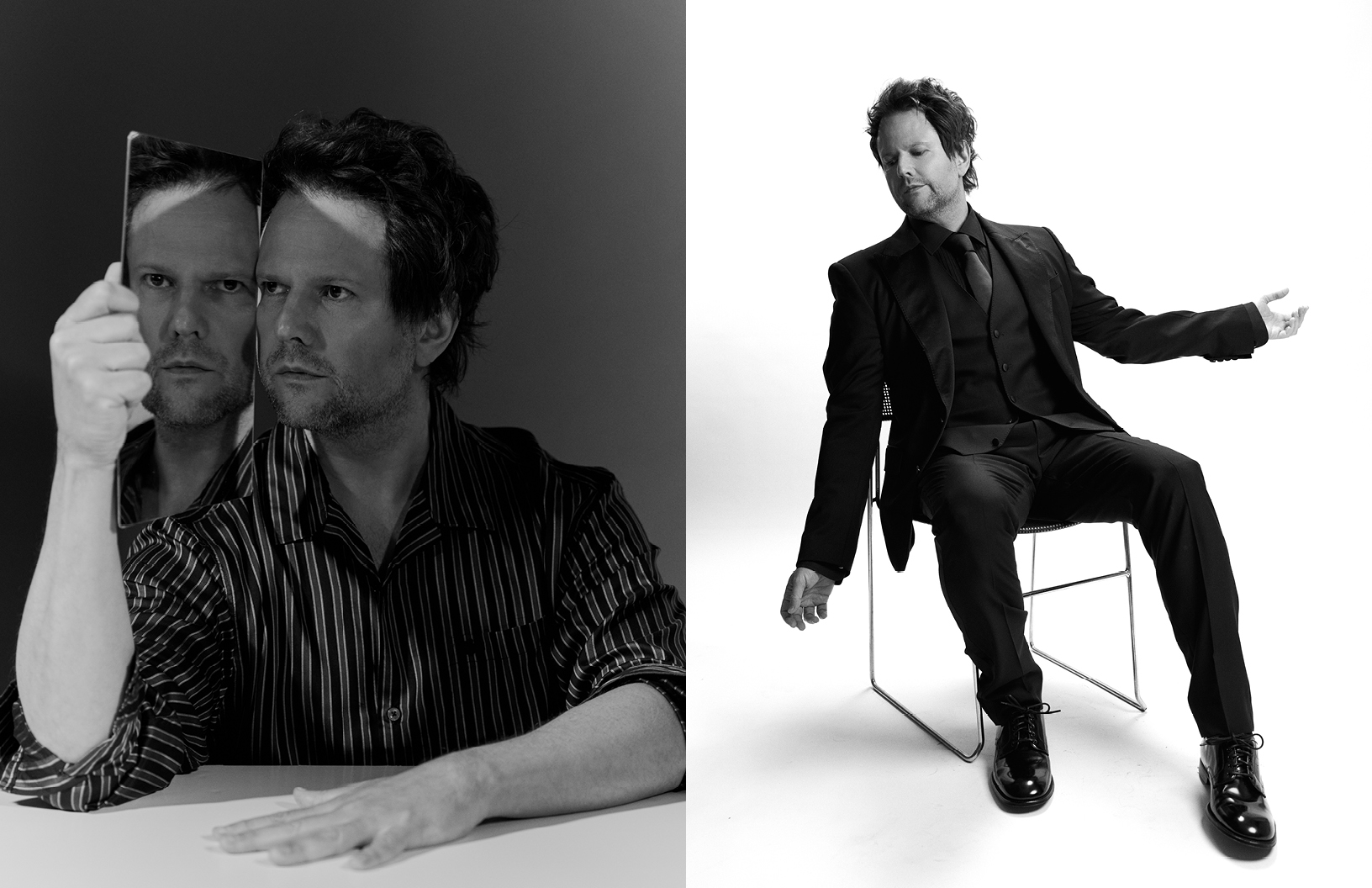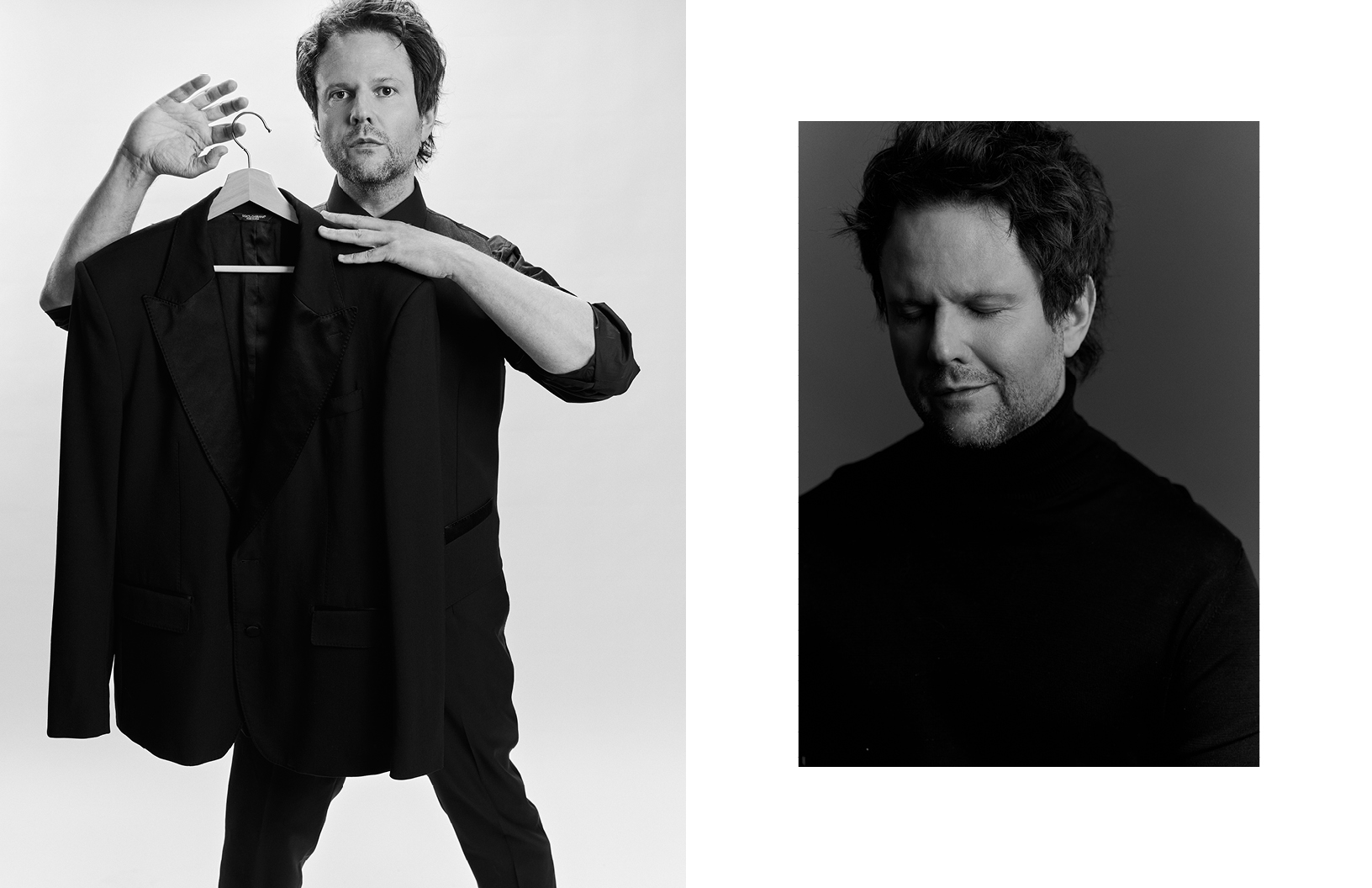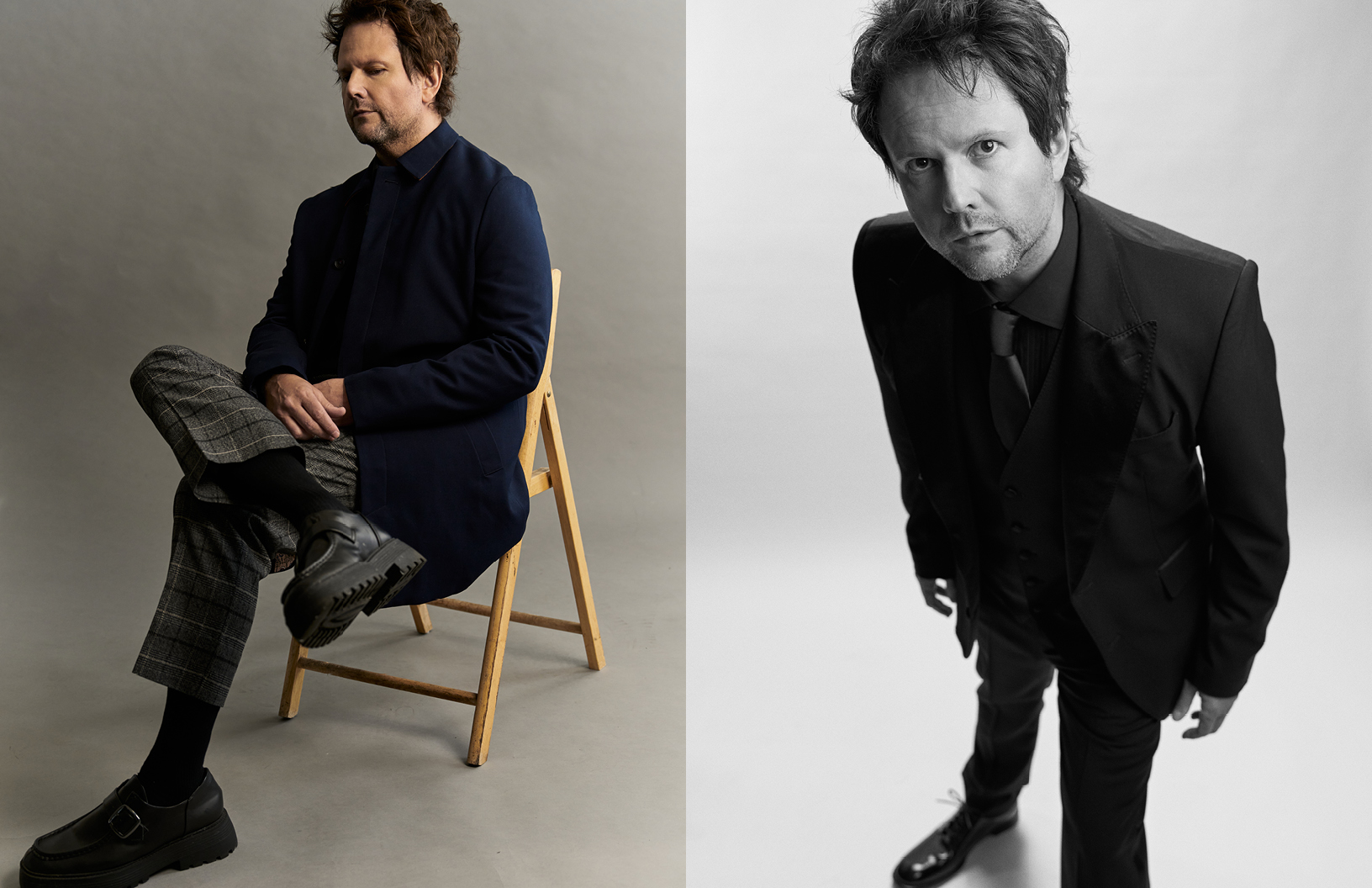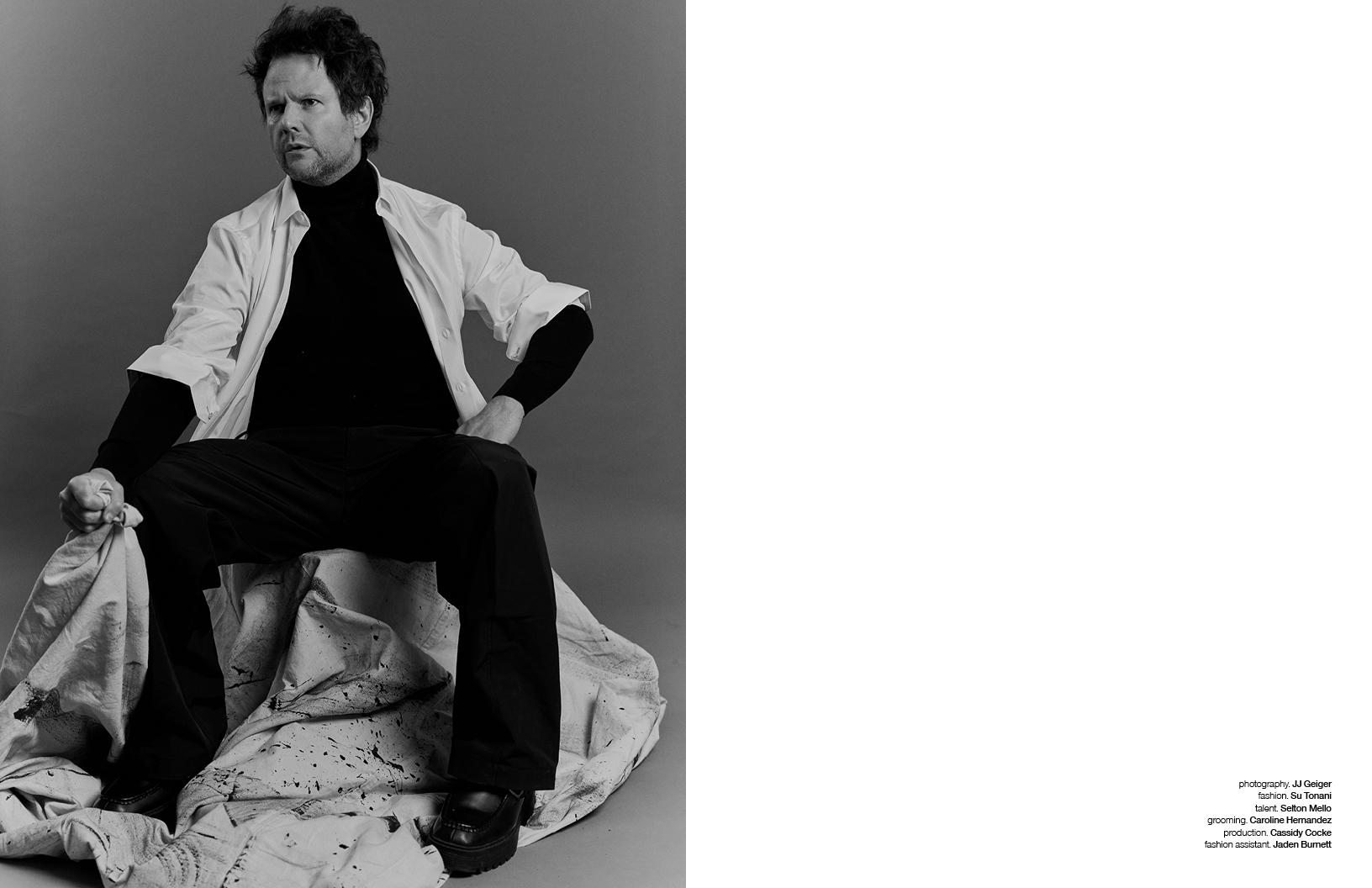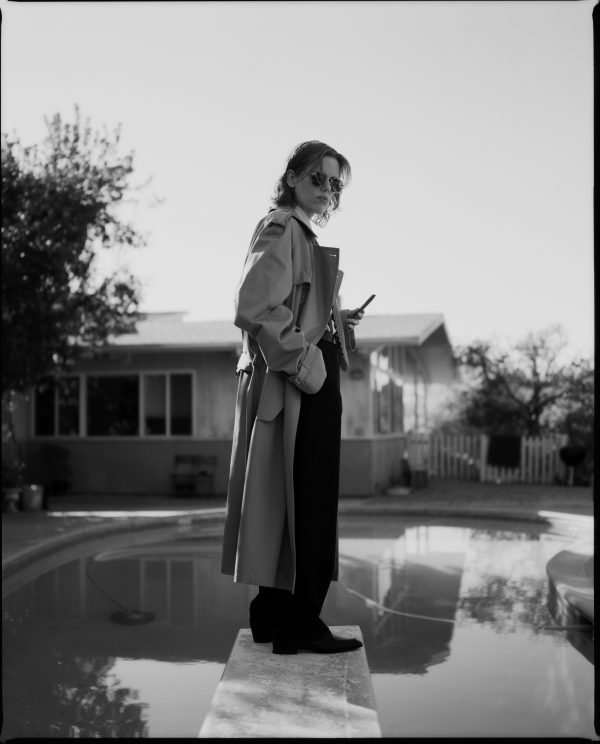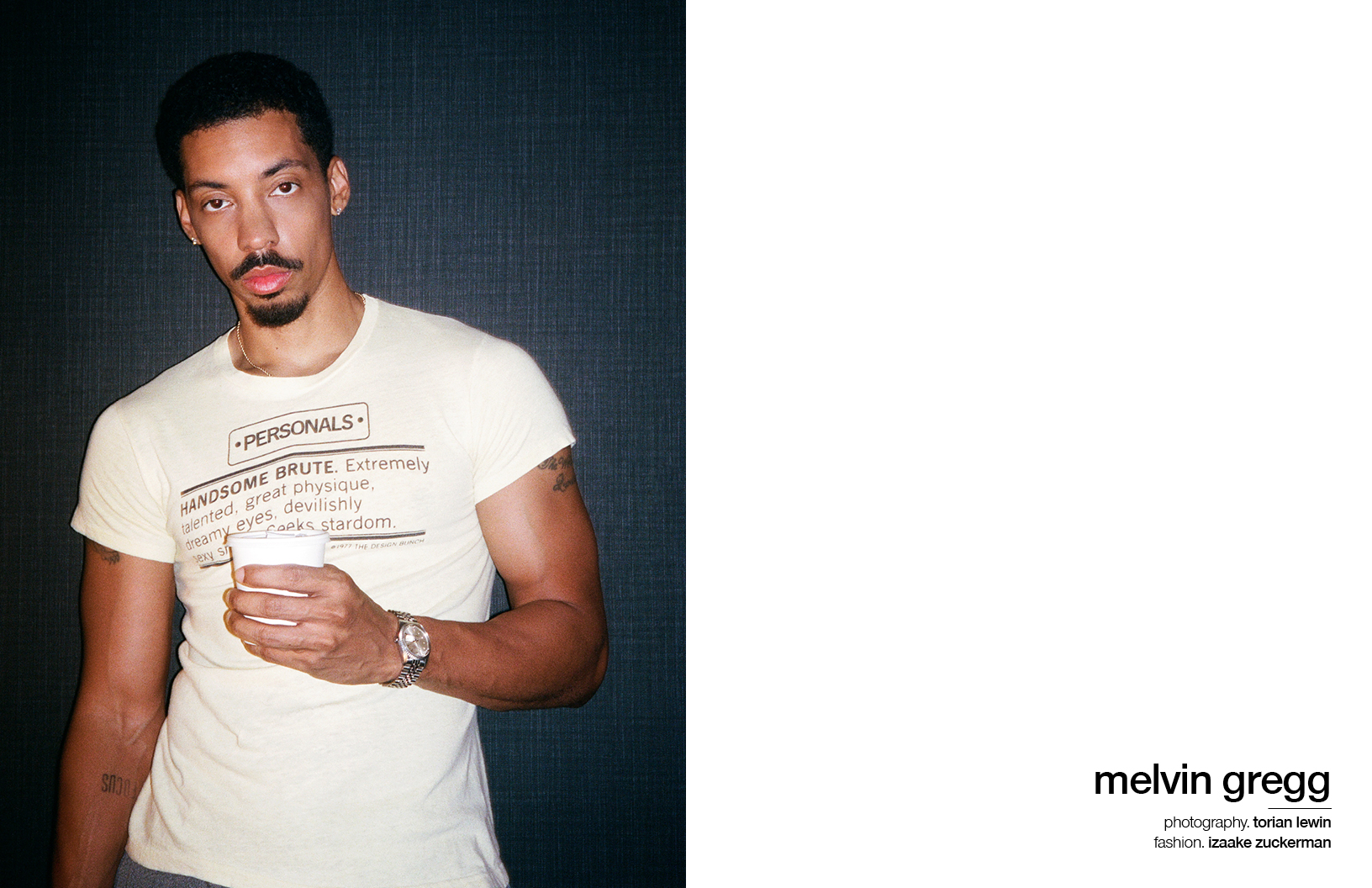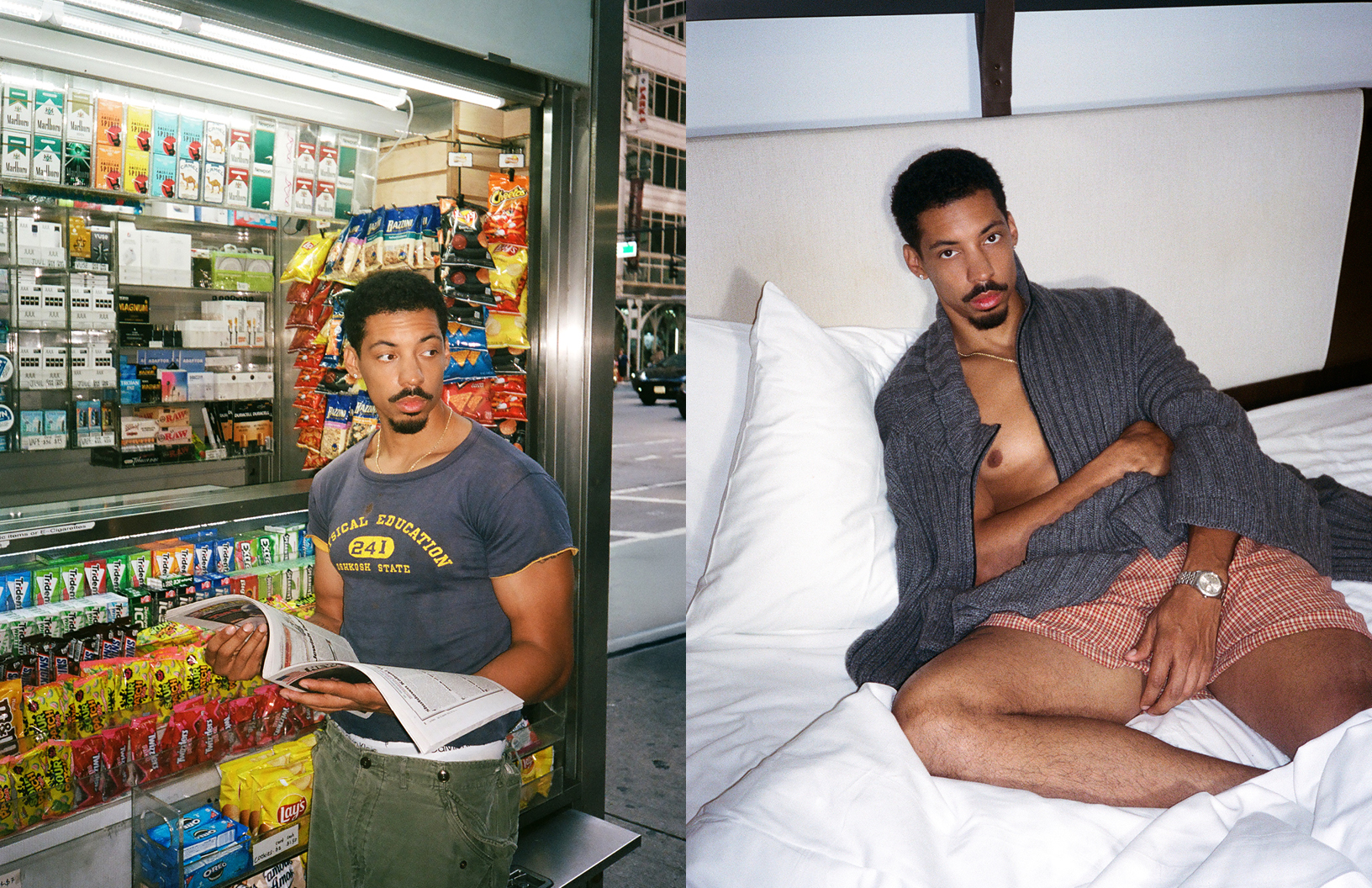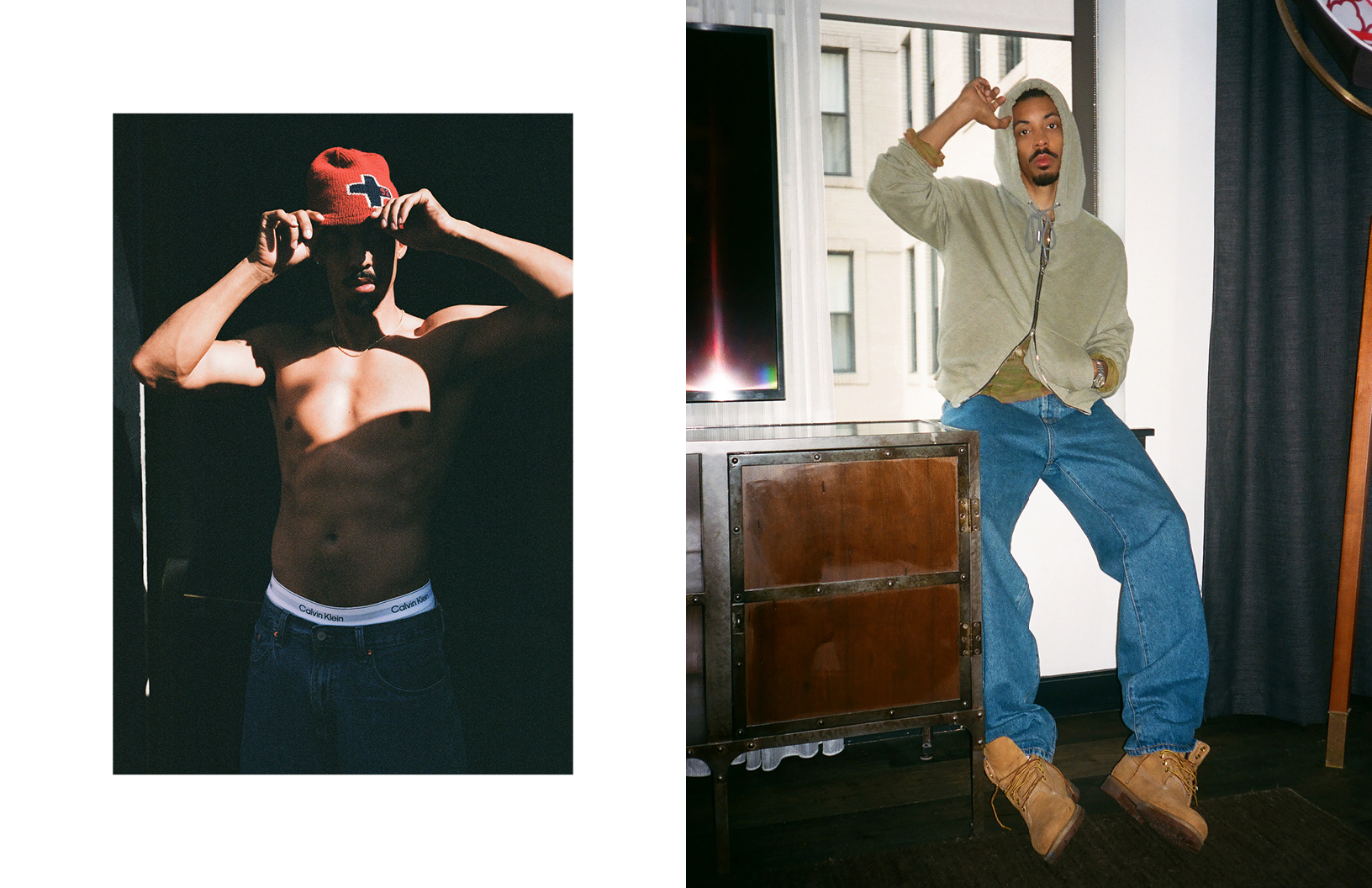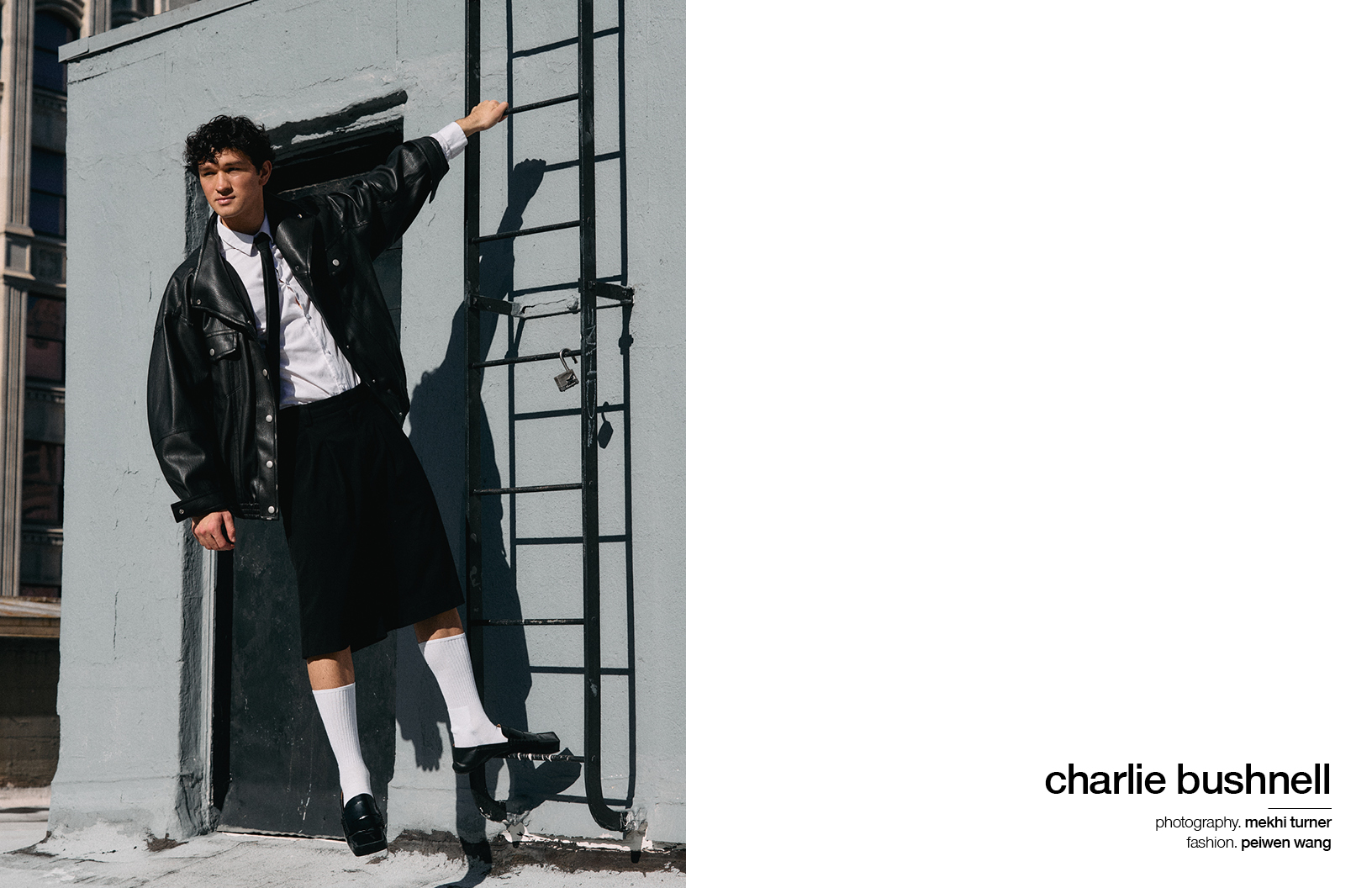
leather jacket. AVVENN
shirt + tie. Calvin Klein
shorts. Jaded London
loafers. Jacquemus
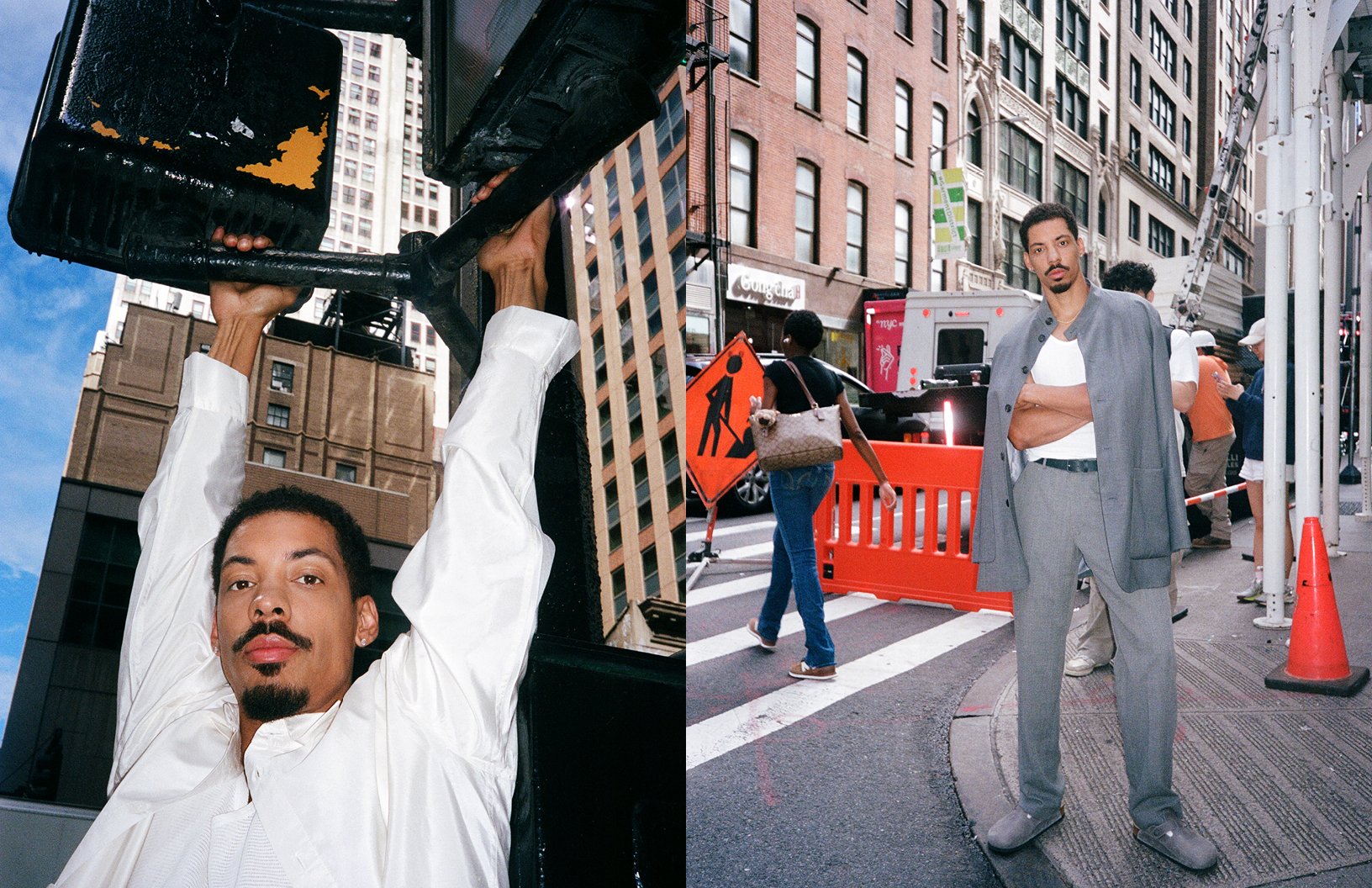
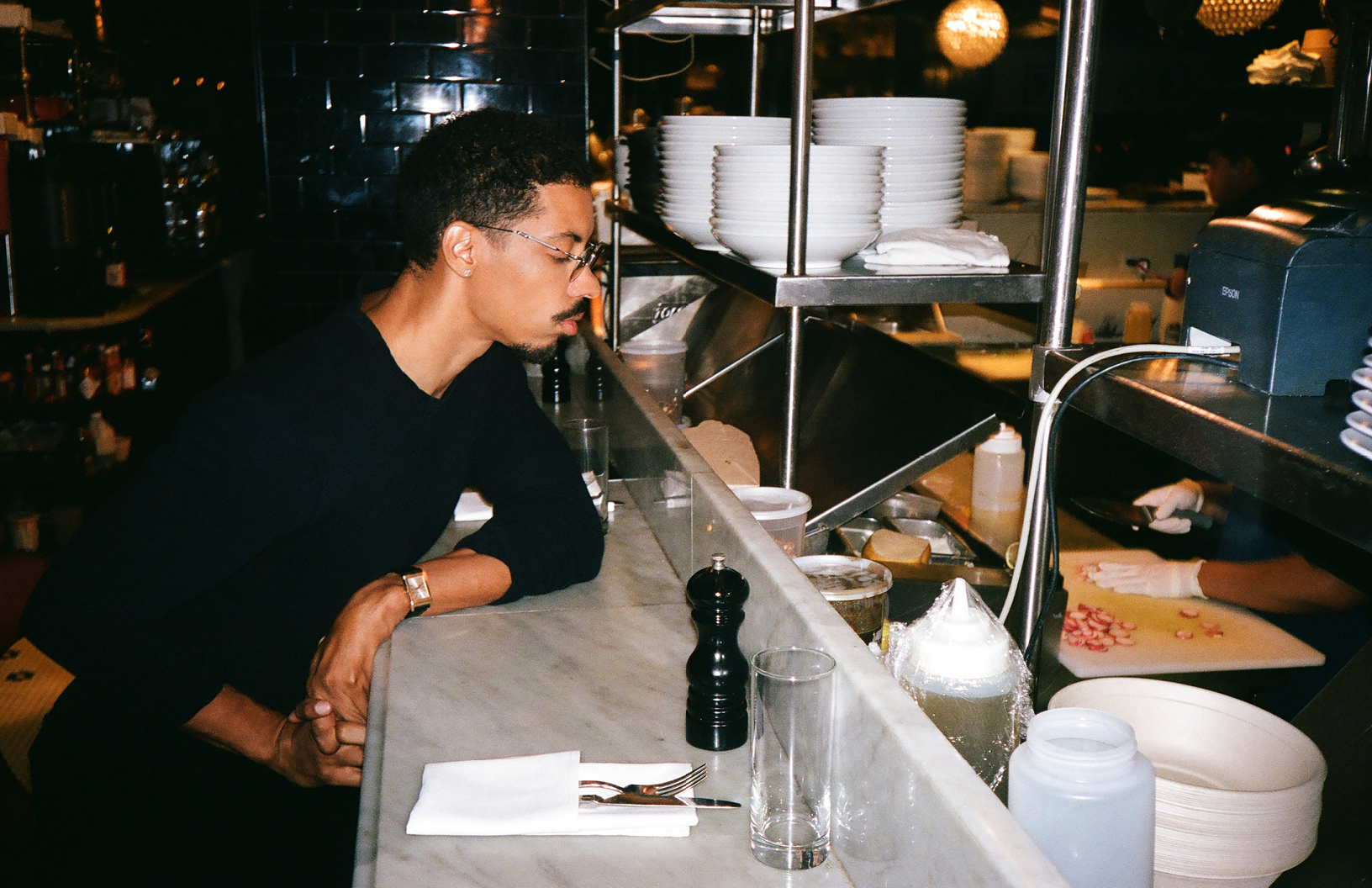
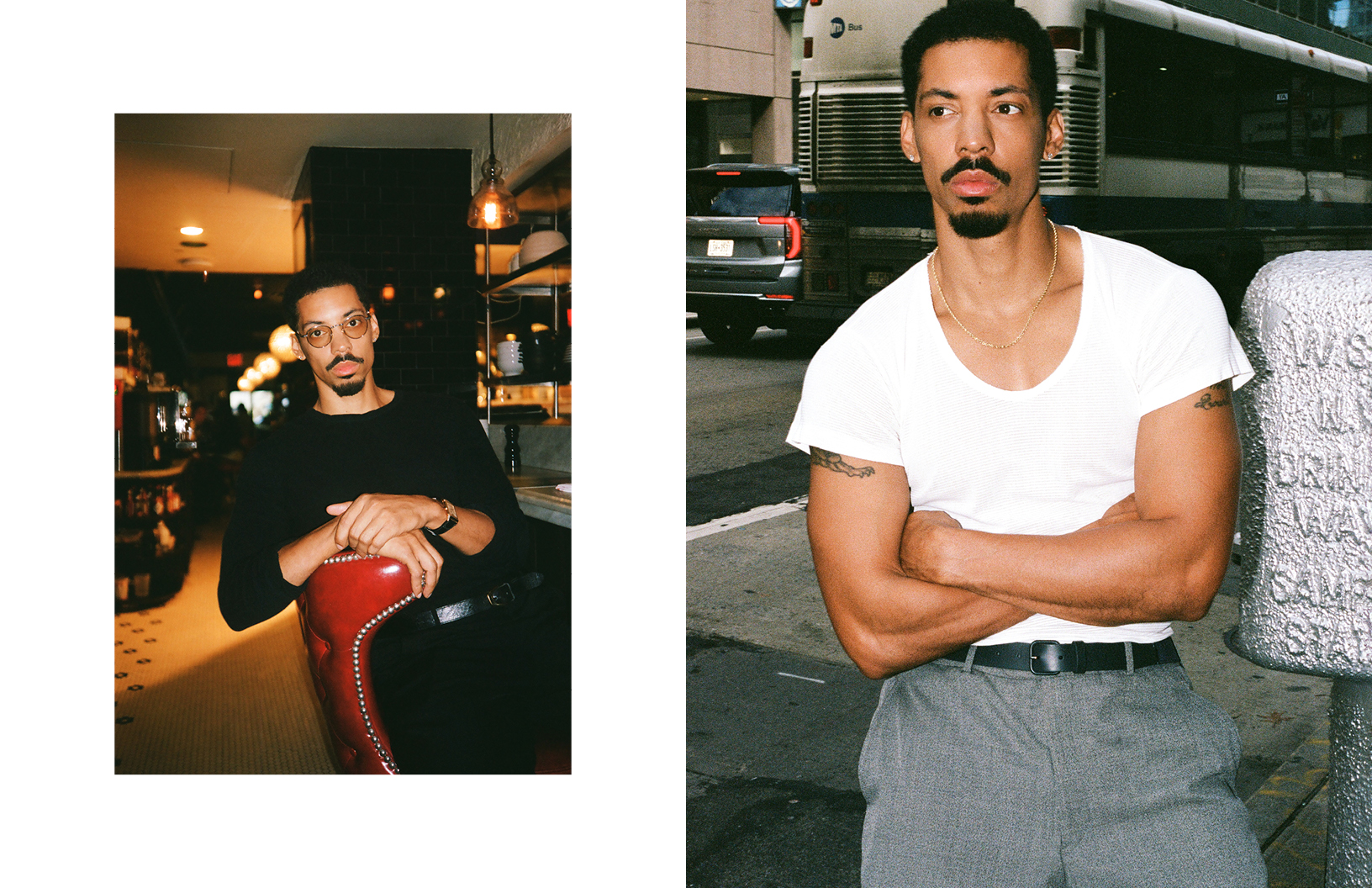
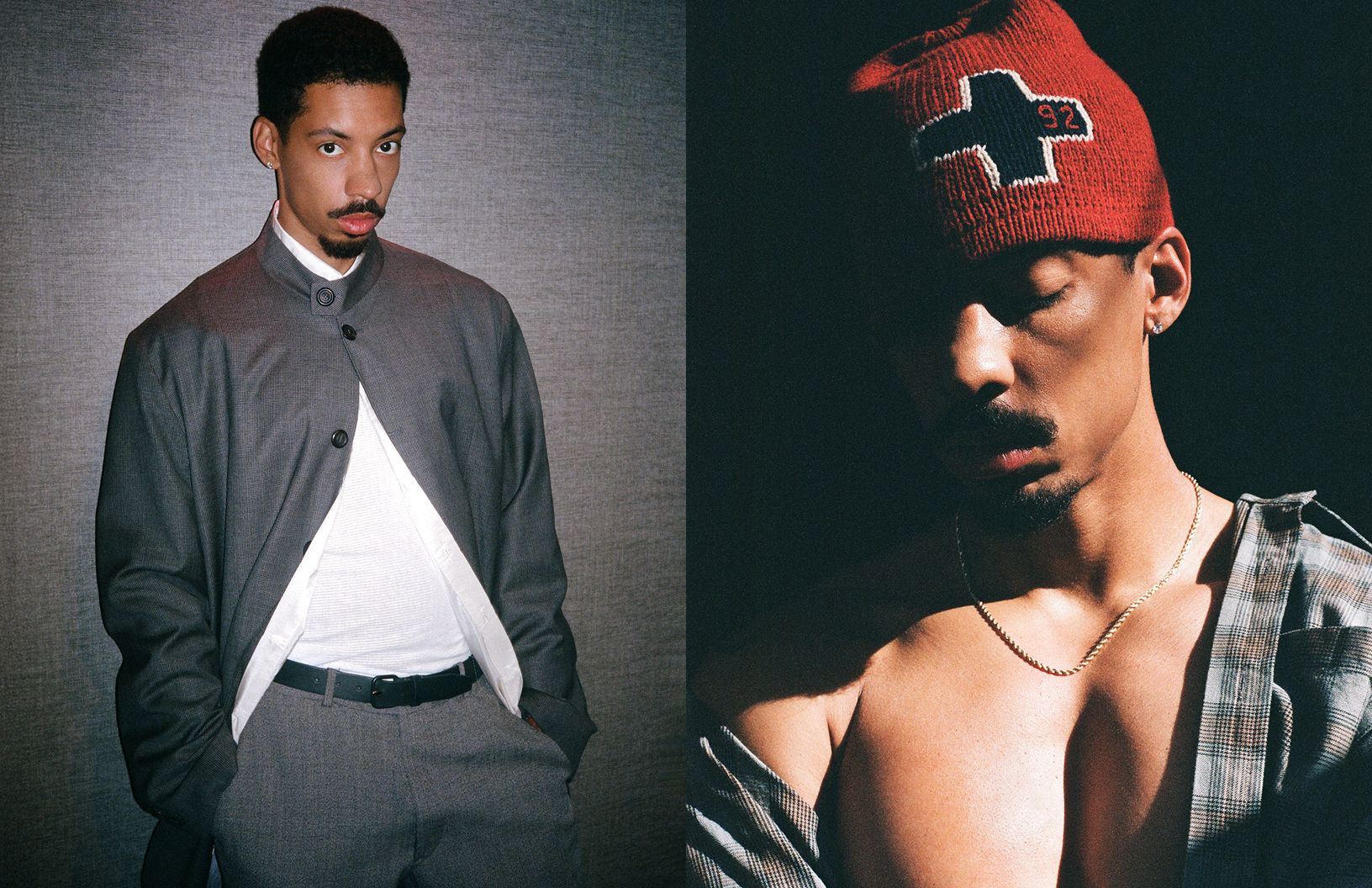
Like a compass finding true north, Charlie Bushnell has been meticulously carving out his own path — one guided by instinct, curiosity, and a deep respect for the craft. From staging makeshift productions in his family’s living room and donning Tweedle Dum’s striped sleeves in middle school, to stepping fully into the shadows as Greek demigod Luke Castellan in ‘Percy Jackson & the Olympians’, Bushnell’s journey has been anything but accidental.
Raised in a creatively charged household, surrounded by music, storytelling, and performance, Bushnell didn’t rush toward the spotlight — he found it on his own terms. What began as playful imagination slowly sharpened into purpose, sparked by watching young actors his own age command the screen. Now, as one of the emotional anchors of Disney+’s epic reimagining, Bushnell brings nuance, physicality, and quiet intensity to a character living in moral grey space.
In conversation with Schön!, he reflects on growing up on set, the power of ensemble work, and why finding stillness — both on and off screen — has become essential to his evolution as an actor.
So you started acting quite young. What drew you to acting?
When I was a little kid, my family always said that I was going to be the actor in the family. My brother and I put on these really crazy shows where we would wear our parents’ clothes or put underwear on our heads, run around the house and play these crazy characters. We would entertain our families the whole night. I would make movies with my toys when I was a kid. I had an iPad or something, and I would just film and create these crazy, big battle scenes with my Legos. I think it was in the cards for me.
The school I went to – elementary through middle school – doing a play was actually part of the curriculum. I would say up until seventh grade, I just wanted to be a very small character. I’d be guard number two and have three lines, and I’d be good with that. I always did enjoy those plays; I thought they were a lot of fun.
It was when I watched Stranger Things for the first time, I was thirteen or fourteen – I watched it a year later than everyone else. Because all the kids were sort of around my age, they were all so good, such talented actors, something just clicked for me in that moment. I realised, “oh, wait, I can do that too. I want to try that.” So I told my parents, and next thing I knew I was in acting classes.
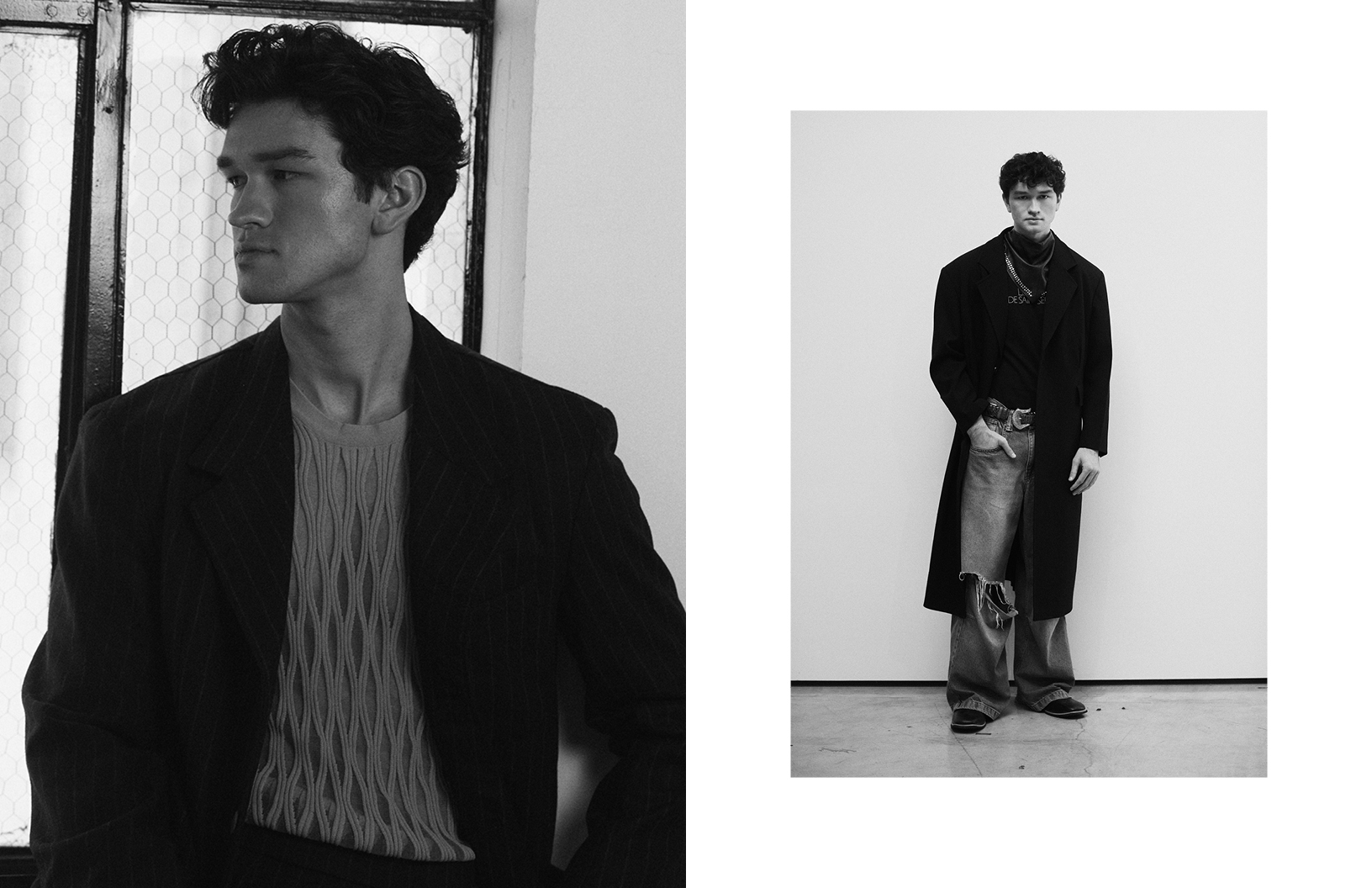
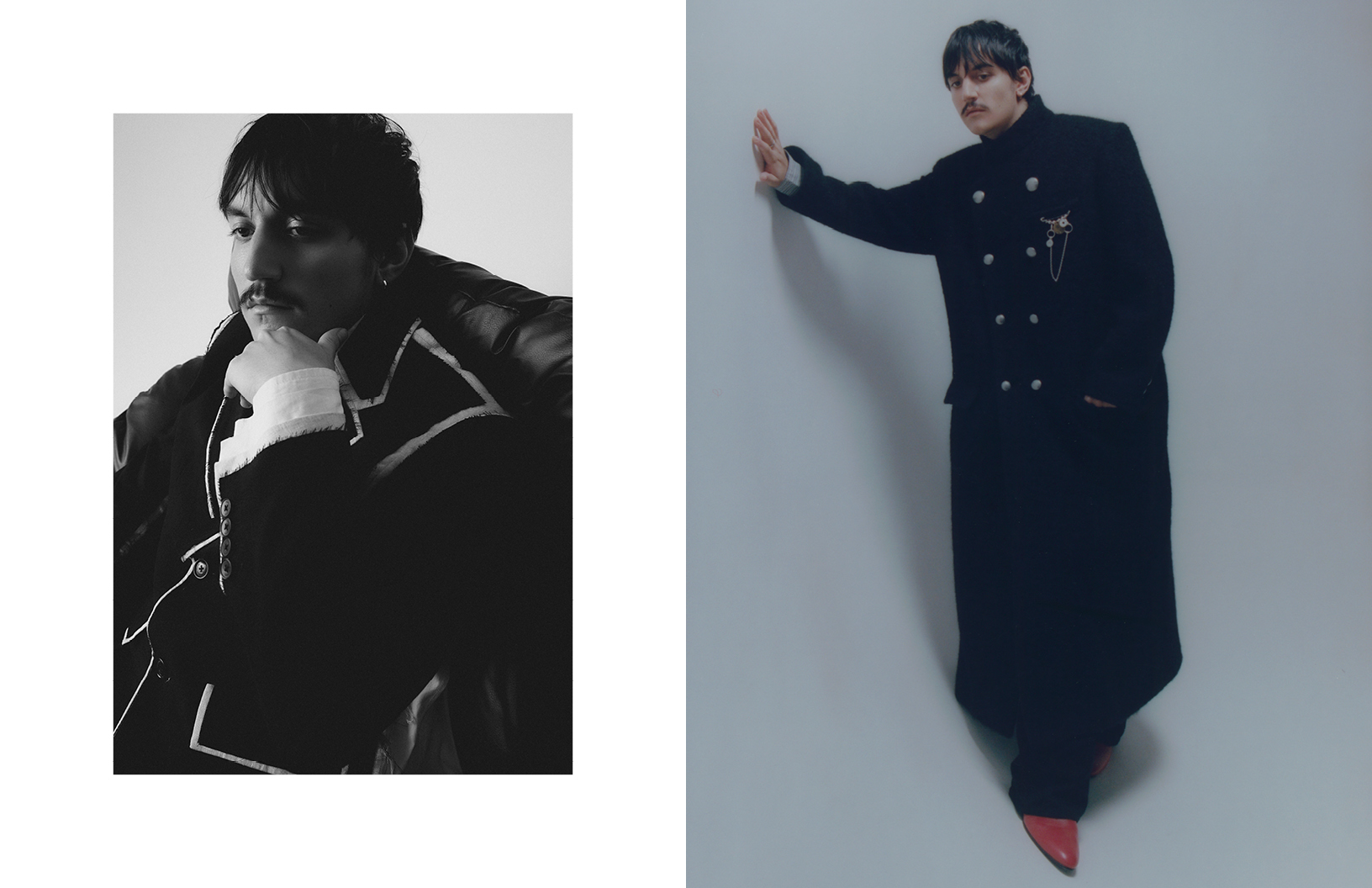
blazer. Sivan
sweater. TAAKK
opposite
coat. SMFK
t-shirt + bandana. Ludovic de Saint Sernin
jeans. Jaded London
boots. COS
belt. Y/Project
What plays were you in?
Oh man, I think seventh grade was ‘A Midsummer Night’s Dream’, I played Lysander, which was really fun. Eighth grade was ‘Alice in Wonderland’, a musical, so we had to sing quite a bit. I was Tweedle Dum, and another good friend of mine was Tweedle Dee. We had a musical number just the two of us, and it was terrible. I had a massive voice crack on stage in front of the whole school, but I was also in eighth grade.
So, coming into that time when it was happening all the time, anyway.
Oh yeah, every other sentence, I was having voice cracks at that point. I think my brother also got it on film. It’s somewhere there. Unfortunately.
You also grew up in a creative household, your dad’s a musician, you’re uncles an actor. Did that make you more inclined into going into a creative career yourself?
Definitely. Something I appreciate about my parents – my whole family is very creative and into the arts. But they never forced me to do anything I didn’t want to do. My dad, when he was a kid, was sort of forced into music. He ended up loving it, so it all worked out, but I think there were times when he had teachers that he really hated and whatnot, so he wanted us to find it ourselves. They never pushed me into it, but I was surrounded by music, creativity, and the arts my whole life, so I’m sure that influenced me in many ways.
At the end of the day, I decided I wanted to become an actor and found that path on my own. I have to give it to my parents; they have sacrificed so much for me. All the times they would drive me all across town to auditions, or come with me to set, and sacrifice so much of their own lives just to be there and support me on my journey. I’m super grateful for that.
That’s super sweet. I hear you also play football, tennis, and the guitar, too. Do these outlets play into your acting at all? Are there any lessons that manifest themselves?
Absolutely. Sports were definitely my first love growing up. I also have a very athletic family. My grandpa on my mom’s side is Costa Rican, so he’s been playing soccer from the moment he could walk, basically. Soccer was my main sport growing up, I did about seven years, and I was on a travel team, it was so much fun. It’s so great for kids to play sports and be on a team when they’re young, because you have to learn to work with others. It really is a team effort, and it’s the same in acting. You’re an ensemble, you’re part of a cast — it’s not just you.
That’s something I was thinking about the other day – the people I work with, or my friends – I love seeing them succeed because if they succeed, we all succeed. It’s such an amazing feeling, and we’re all so supportive; we really root for each other. I think learning how to work with others and be a part of a team and ask for help when you need it, that’s the main thing.
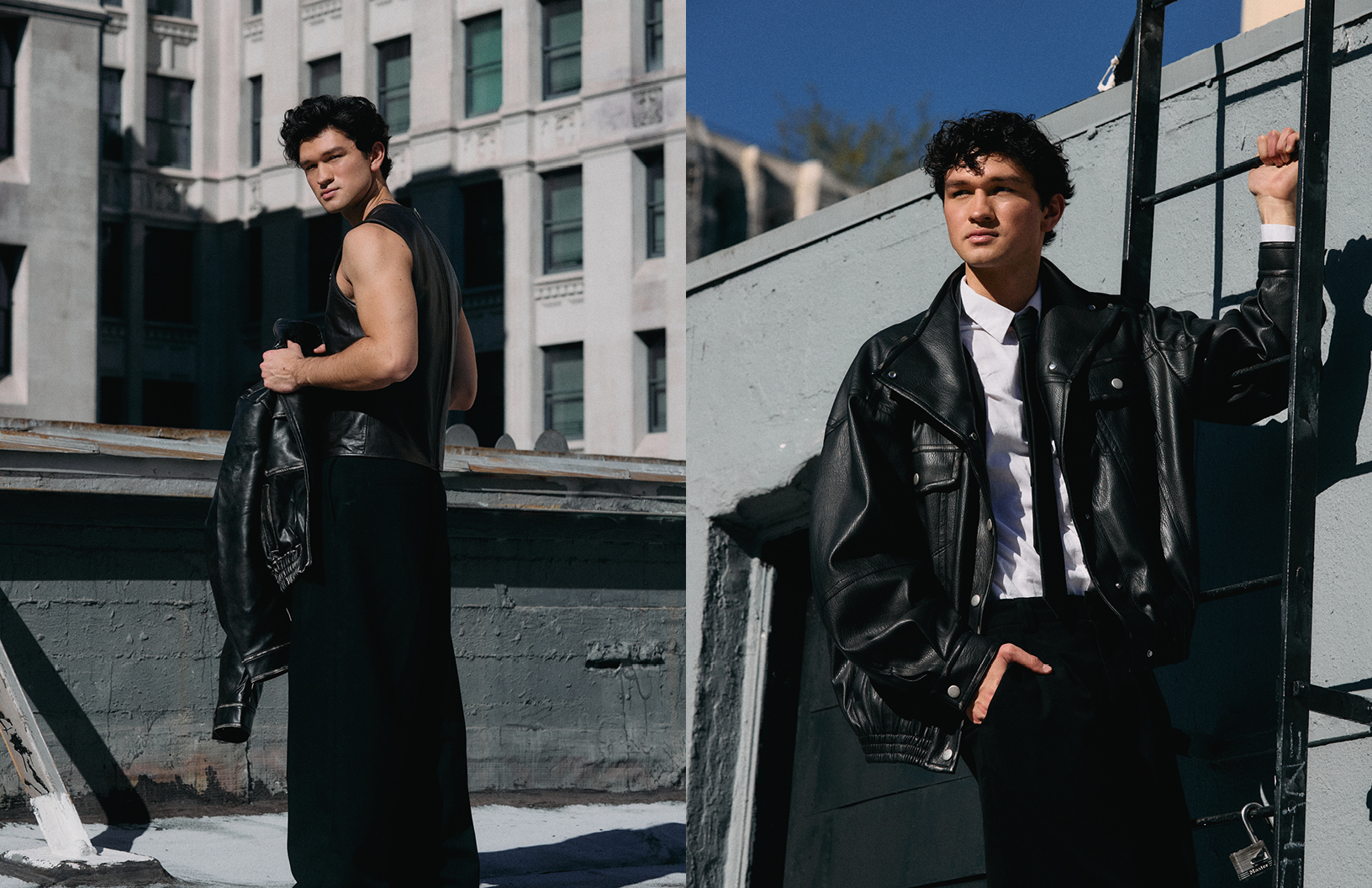
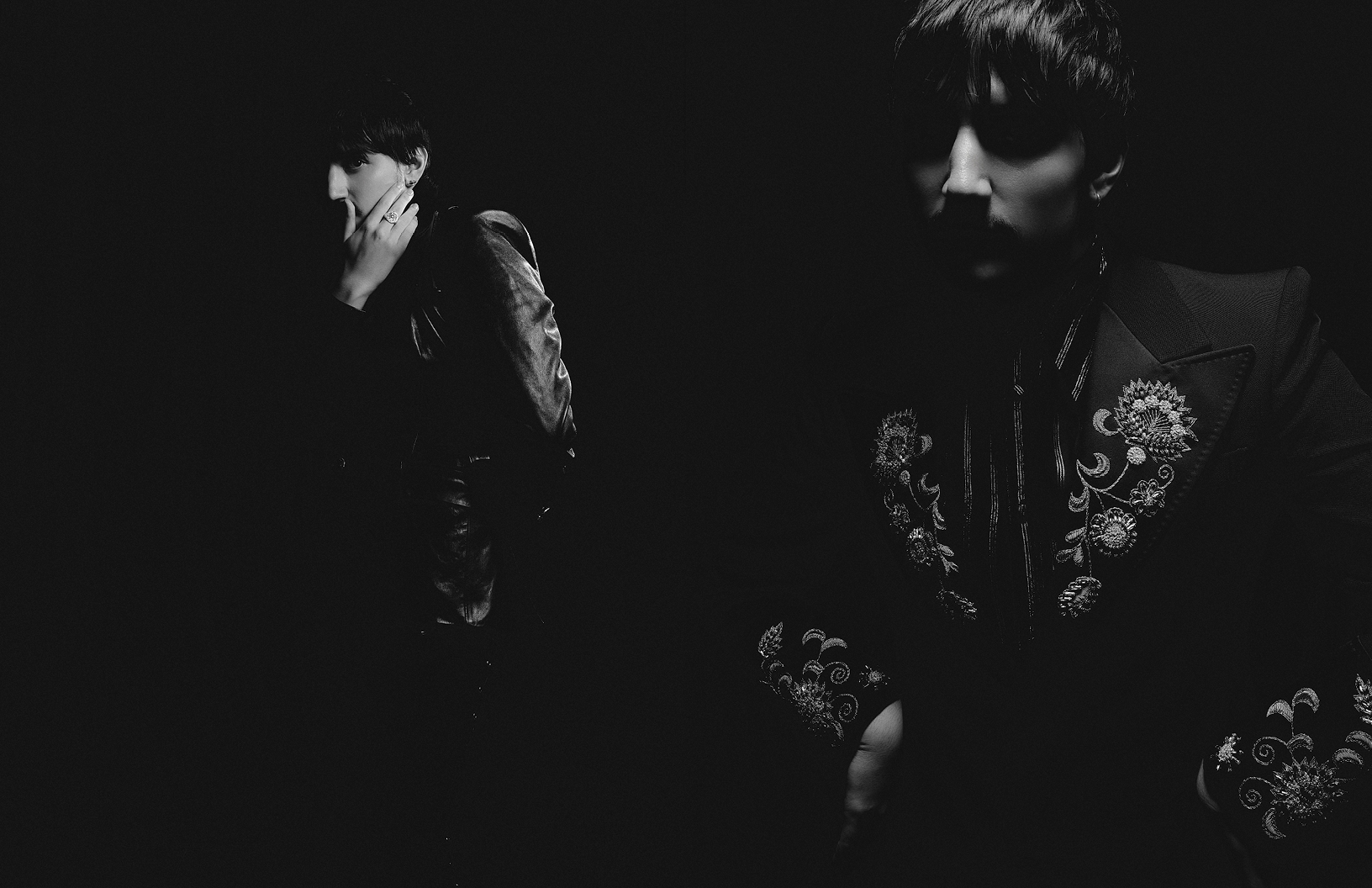
leather jacket. VIBRATE
leather tanktop. Ludovic de Saint Sernin
trousers. COS
opposite
leather jacket. AVVENN
shirt + tie. Calvin Klein
shorts. Jaded London
Interestingly, group sports have played into working with a full cast and team.
It really is a team effort. I have to give it to the people working behind the scenes, because at the end of the day, it’s the final product. You only see the actors on screen, but really, we’re such a minuscule part of it all. The ‘Percy’ crew, they’re the hardest working group of people I’ve ever met. They’re working crazy, long hours every day, and they always show up in good spirits, working at the top of their game. They’re truly the unsung heroes of not only our show, but the industry as a whole; they’re the ones that really bring it to life. So shout out to the crew.
Speaking of ‘Percy Jackson’, tell me a little bit about your role and what you’ve enjoyed most about playing Luke.
Luke is an amazing character. There are so many layers to Luke, which have been really fun to peel back, particularly in season two and as we head into season three. In season one, he was the older brother and mentor figure to Percy at Camp Half-Blood, and really one of the first people to take Percy in.
Of course, there’s a big twist: we find out that [Luke] is the Lightning Thief, the traitor. I like that change — in the book, he tries to take Percy out of the woods and kill him, but in the show, he tries to recruit [Percy] in that moment because Luke, at the end of the day, is doing this for the demigods. He’s trying to create a better world for everyone, in which they can all live harmoniously with the monsters — he doesn’t even use that word — and not be under the control of the gods anymore.
It was really fun to play this darker version of Luke, but also explore the revolutionary that he is. It’s more technical, it was very physical for me — apart from the actual stunts and fight scenes — I had to play two different versions of Luke. I played the current Luke, and then the flashback version when he’s fourteen on the run with Thalia and Annabeth. I tried to stand up straight and powerful, and to find the stillness in current Luke, like he holds the power and he’s working from a more logical point of view. Whereas young Luke is definitely more agitated, emotional and impulsive. You can see that in their physicality and movements.
Luke truly is just trying to make the world a better place, but he still exists in a grey moral area where he’s portrayed as the villain. What parts of him did you find easiest to connect to, and the most challenging?
You said it best, Luke is working from a morally grey area, even though his intentions are in good faith. At the end of the day, the Gods are not good people or parents. So, he truly believes what he’s doing is right and what’s best for everyone. That being said, he’ll do whatever it takes to make this dream of The Golden Age come to life, and that includes hurting people, even those closest to him.
Luke’s not a saint — he does some pretty villainous and unforgivable things. I think that was the challenge. I really had to step into his shoes and understand where he’s coming from. Our acting coach, Andrew, says that we share a nervous system with our characters. I’ve also been playing Luke for such a long time now, and I feel connected to him in a lot of ways.
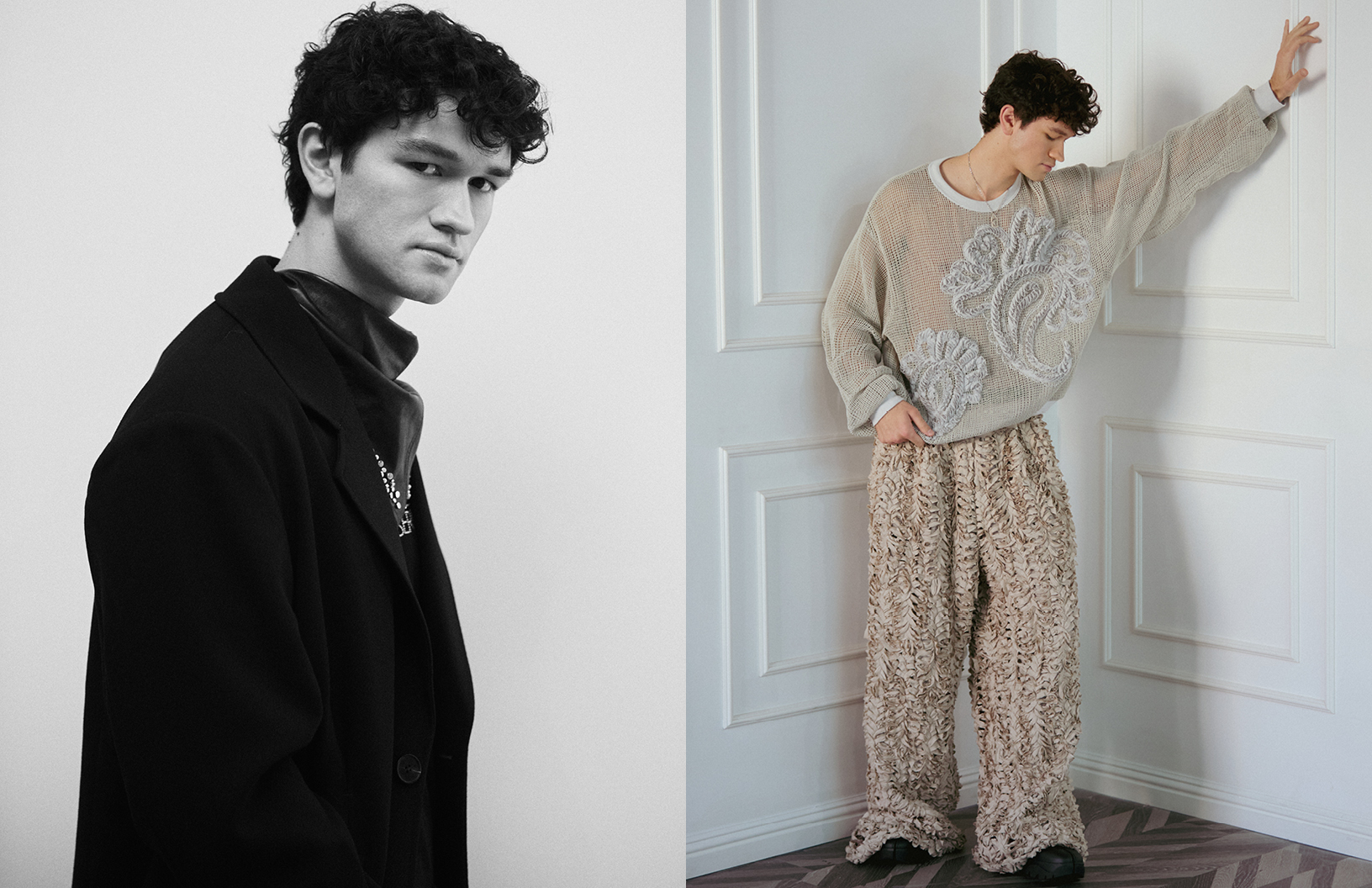
coat. SMFK
t-shirt + bandana. Ludovic de Saint Sernin
opposite
sweater + trousers. TAAKK
boots. Maison Margiela
Were you into Greek mythology before ‘Percy Jackson’?
I’m not a Greek mythology encyclopedia; I couldn’t tell you every little thing about it, but of course. I learned a little bit about Greek mythology in school. I even took a philosophy class in my senior year where we went over all the ancient Greek philosophers. I always found that stuff so interesting.
With ‘Percy Jackson’, because we exist in that world, we have to know about various myths and creatures, what they are, and their back stories. I was thinking about Medusa the other day; her backstory is so sad. She’s made out to be this monster, but really, once again, she’s just a victim of the gods. You can also just learn so many lessons from the Greek myths; I feel like they mirror many human experiences.
And what’s it like when the cameras aren’t rolling? The ‘Percy Jackson’ cast is fairly young, and you’ll seem like quite a close-knit bunch.
Exactly how you guys see us on camera is exactly how we are in real life, too, but even more so. On camera — even when you’re just doing interviews — it feels like you’re playing a little bit of a character of yourself in a way. But we truly are a family at this point. I feel like people say that, but we actually mean it. Especially on this tour, I feel like we grew even closer, which I didn’t even think was possible — they are some of my best friends in the world. We spent almost three weeks seeing each other every day and didn’t get tired of each other once. I’m honestly excited to get back to Vancouver soon and get back to filming with everyone.
I heard some pranks were happening on set. Were you a victim of any, and what kind of role did you take on with the group?
To be honest, when we’re filming, we’re all really professional. Even though this cast is full of pranksters and we’re always making each other laugh, we also realise that we’re there to do a job. Every little second on set is accounted for. Especially with the kids, they can only work a certain number of hours. When you’re working on a show, especially like Percy Jackson, where there are so many moving parts that you have to take into account, there’s not that much time to get everything done. And so, we’re all very prepared and ready to go when we’re on set.
I can’t recall that I was a part of too many pranks during season two. Honestly, I was very locked in. Luke’s energy was just so different from mine that I had to stay in it, and everyone really respected that and respected my space. I really appreciate them for that. But off set, we’re always messing around. Leah is probably one of the biggest pranksters. I’ve learned some funny pranks that she’s done, particularly on Walker and Aryan over the years. That’s a boring answer, but the thing is, we all just love acting and the process. We’re still having an amazing time on set, and then we save all the goofy stuff for when we wrap for the day or hang out on the weekends.
You also recently did some voice work on ‘In The Know’. What was that like?
It was amazing. Oh man, I’m so sad we didn’t get to do another season. It was so much fun getting to work with Mike Judge and Zach Woods – everyone was incredible. Zach, I’m such a huge fan of his. I remember seeing him in ‘The Office’, which is one of my favourites, and I thought he was so hilarious, so getting to work with him was a dream come true. Mike Judge, who created all these incredible, iconic shows — he’s amazing. He’s quite a reserved guy, super nice, super kind. But as soon as we start rolling, he’s able to put so much energy into the characters he plays in an instant. Seeing that was really cool.
What was so fun about that show is we really got to improvise a lot. The whole day, we do a couple of runs where we follow the script, but then they were so open, being like, ‘Let’s stick to the layout of the scene, but play around and say whatever you feel.’ Every take would turn out different. Zach is the king of improv — you would think he wrote these out in advance because they were just so perfectly timed and funny. But no, he’s just that talented.
It’s just cool to do something in the animation world. It’s different from live-action, and you really have to use your imagination a lot more because you don’t have the set, wardrobe, or hair and makeup to rely on to bring the world to life. On the other hand, that can also be nice, because you don’t have to worry about any of the external stuff, and you’re fully present as the character, not worrying about how your hair looks.
Are there any other projects you’re looking forward to, any genres you’d like to do next? What’s next for Charlie Bushnell?
I have this other animated show that I’ve been working on. I couldn’t give you an exact date, but it’s been a lot of fun to work on and has also been a dream of mine. I feel like I’ve really hit the jackpot with everything I’ve gotten to work on so far in my career, and also all the people I’ve gotten to meet, work with, and call my friends and family. At this point, I’m just so grateful. ‘Percy Jackson’ has been the greatest gift of my life, and I really hope we get to continue on that path for as long as we can.
I’d also love to jump into the world of film. I think it’d be cool to do something totally like a slice of life, maybe an indie film. I just rewatched ‘Past Lives’ the other day, and you follow these characters, not really that much happens, but you’re still so invested. It’d be cool to do something like that next. We’ll see. I know I have definitely a few months of filming for Percy coming up in the new year.
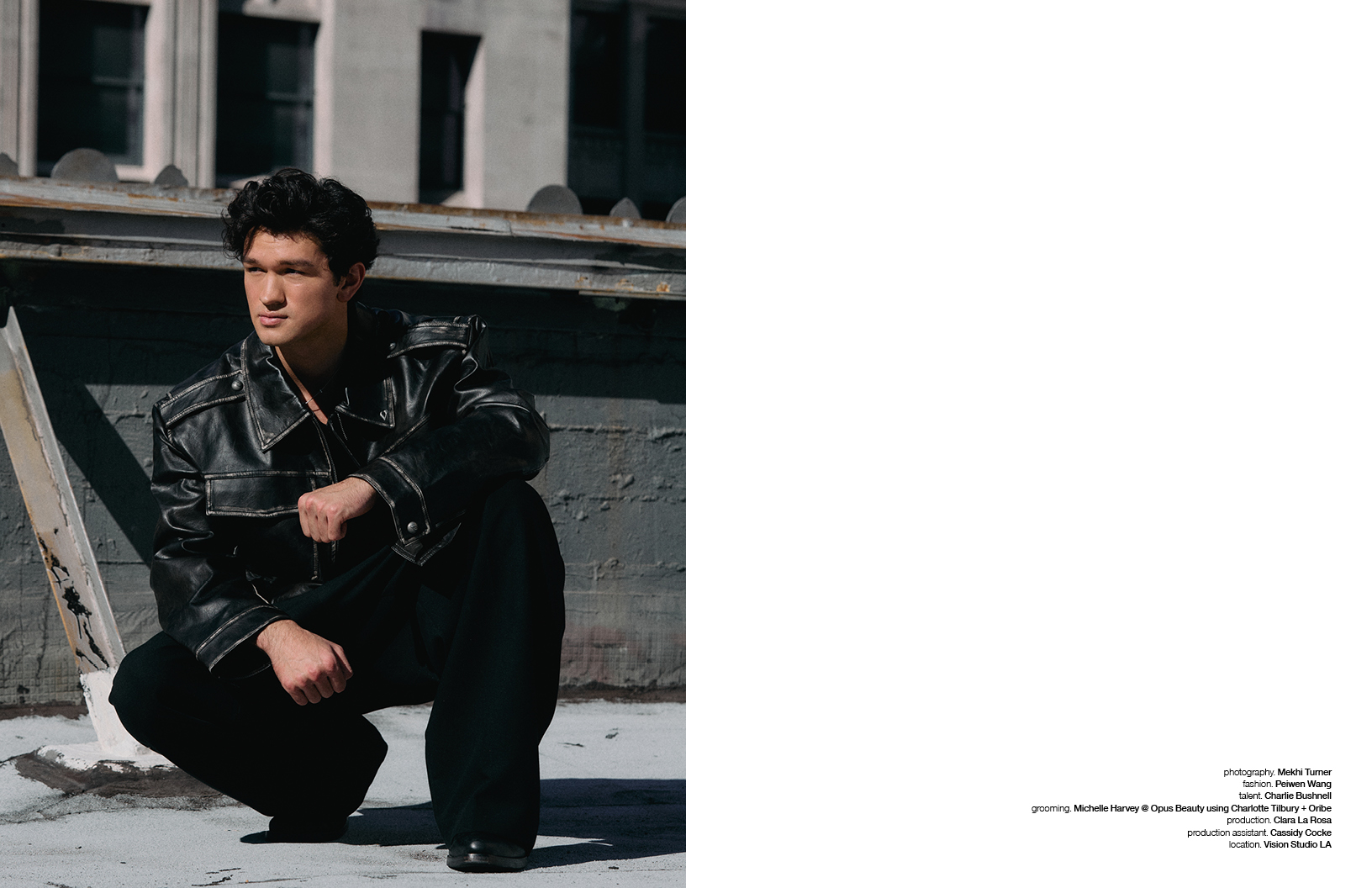
leather jacket. VIBRATE
leather tanktop. Ludovic de Saint Sernin
trousers. COS
Season two of Percy Jackson and the Olympians is streaming now on Disney+.
photography. Mekhi Turner
fashion. Peiwen Wang
talent. Charlie Bushnell
grooming. Michelle Harvey @ Opus Beauty using Charlotte Tilbury + Oribe
production. Clara La Rosa
production assistant. Cassidy Cocke
location. Vision Studio LA
interview. Rhea Lobo