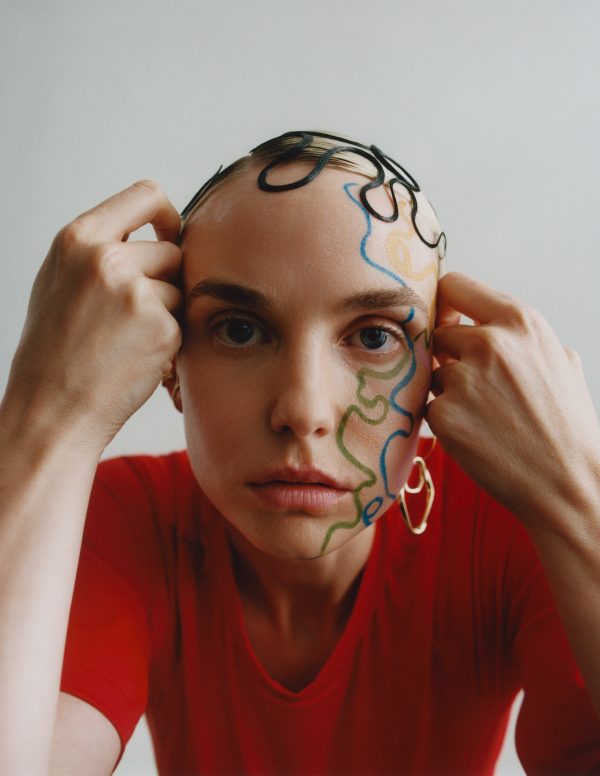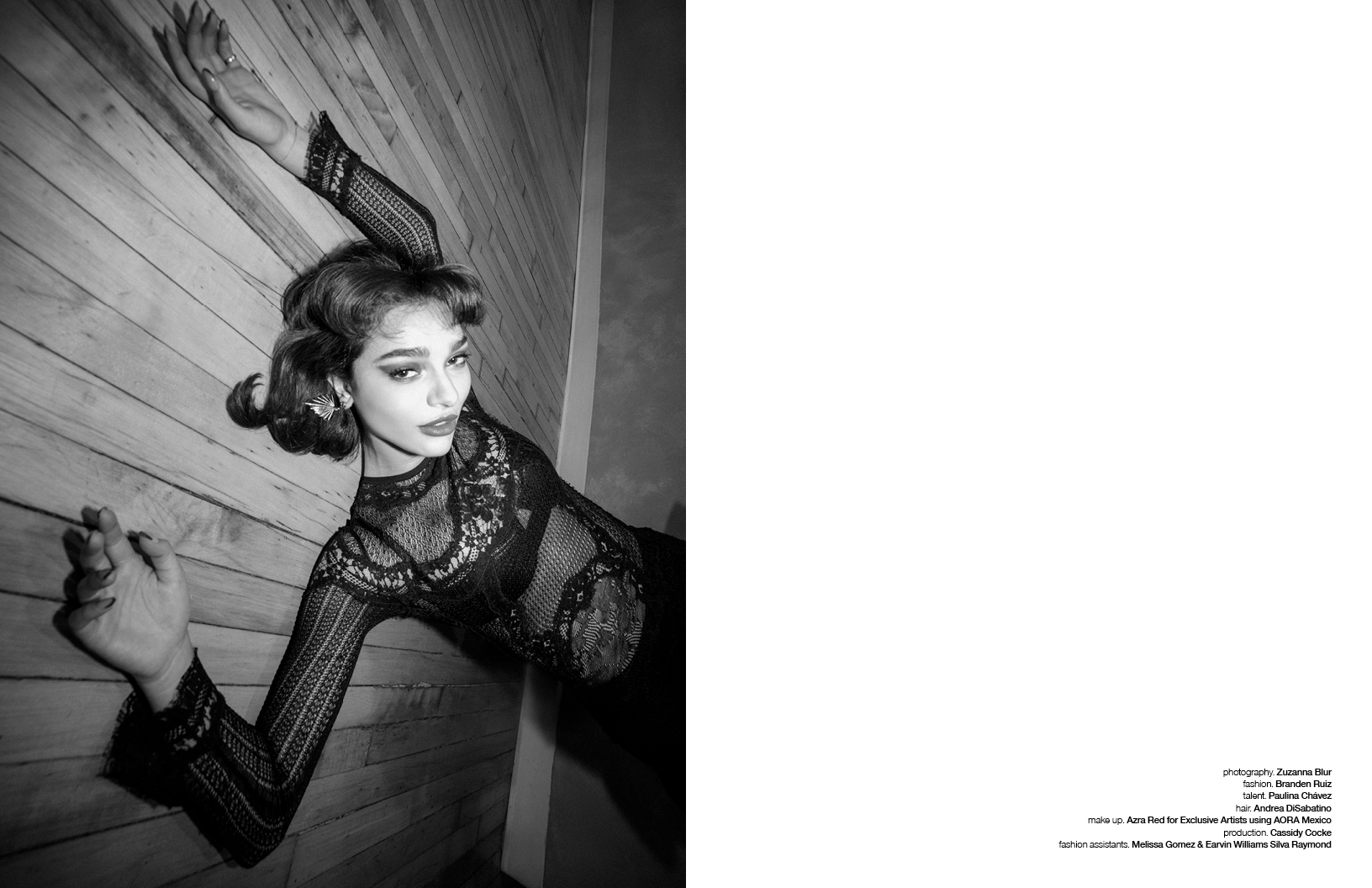


jumpsuit. Marine Serre
earrings. MAM
necklace. Stylist’s own
finger rings. Tareet
belt. Rabanne
What does a club night truly represent? Is it just the rhythm — the pounding basslines and flashing lights — or is it something deeper? For many, the club is a collective space, a site of communion where strangers become kin under the pulse of a shared beat. It is a place to reconnect with the past, through samples and echoes of older sounds, while simultaneously opening ourselves to the possibility of something entirely new.
Toronto-based producer and DJ Bambii has long understood this duality. Through her ‘Infinity Club’ series, she explores how music can build bridges between genres, cultures, and generations, offering a vision of nightlife that is as expansive as it is intimate. Her latest project, ‘Infinity Club II’, pushes that vision further. Where many artists today lean toward algorithm-friendly familiarity, Bambii resists easy categorization.
Schön! sits down with DJ Bambii to discuss her upcoming release, performing, and more.
With ‘Infinity Club II’ building on the first, how did the idea for the club space evolve? What new inspirations or challenges shaped it?
The club space is never static. Every time I step into nightlife, I am reminded that it is a living, breathing thing. It keeps changing because contributions come from many different communities, sometimes unintentionally. ‘Infinity Club II’ is like a time capsule, trying to capture something that can never really be defined. I wanted to approach the way genres and sounds shift and collide even more boldly on this project.
What are some of your main musical influences?
Jungle, dance, dancehall and pop are really at the core of what I do. But there are also drum patterns and motifs that wander into trip hop, baile, grime, breakbeat and lots of other directions and subgenres.

dress + shoes. MM6 Maison Margiela
t-shirt. Kusikohc
necklace + socks. Stylist’s Own
opposite
earrings + necklace. MAM
When you are deep in production, how do you know if a sonic idea goes too far or hits just right?
That is a tough one, but it is mostly intuitive. Sometimes something just feels wrong the more I listen. I try to follow whatever my gut tells me.
Did any guest on this new project shift your storytelling or push you to try something unexpected?
There were so many moments with collaborators that felt inspiring. If I had to choose one, it would be when I received Yaeji’s vocals for “Mirror.” I really wanted to highlight her approach because it felt so fresh. The shift in production on her verse, where she raps in Korean, was not in the original. Hearing her idea inspired me to add those synths.
Was there a moment during the making of the EP when a collaborator taught you something essential?
Working with people always teaches you something. That can be a good lesson or a hard one. Every time I collaborate, I pick up something new in songwriting or production, or I see a different approach to arrangement that I would not have come to on my own.
How do you recreate Toronto’s wild, unified energy in places with very different club cultures?
I think I always try to create a sense of nostalgia before taking people somewhere new. That helps me feel a little bit at home with the crowd. But Toronto is underrated and hard to replicate. We are not really seen as a music hub, but if you find the right scenes, you get this really warm, genuine energy. The way different communities mix together in Toronto does not happen everywhere.

jumpsuit. Louis Gabriel Nouchi
top. Adidas
shoes. Rombaut
cap. Tareet
harness. YVY
opposite
jumpsuit. Louis Gabriel Nouchi
top. Adidas
shoes. Rombaut
cap. Tareet
harness. YVY
You resist being boxed in by genre or identity. Has that changed how your audience connects with you?
In some ways, it has. It can be hard to connect with something that does not have a clear category. Right now, especially with social media and streaming, music discovery feels almost gone. People want their content sorted and labelled for them. So not fitting into a specific box can make it harder for people to find me or describe what I do. I see my musical practice as something always in motion. It is changing and growing with me. The people who support me seem to understand that, and I feel that support most in real life, where it counts.
You have pushed for no-phone policies at your shows. Do you think tech helps or hurts the live experience?
There is a long and complicated conversation to have about phones. For me, at most of my shows, I am aiming for a kind of engagement where phones, especially in large numbers, feel distracting. They do not help people stay present. Right now, it often feels like people care more about proving they were somewhere than actually being there. In small ways, I am trying to bring back that basic human connection in the room.
Playing instruments has changed your process. How has that affected the emotional tone of your work?
Playing instruments has made me way more connected to my songs emotionally. Creating melodies on a laptop can still be moving, but it is not the same as physically holding a bass or playing a piano and hunting for the exact sound in your head. For where I want to go, instruments have been a huge part of getting there.
When you are on the road, do you have any rituals that keep you grounded?
Sleep.
What comes next for you?
A lot more music. A lot more learning. A lot more writing.

dress + shoes. MM6 Maison Margiela
t-shirt. Kusikohc
necklace + socks. Stylist’s Own
opposite
jacket. Y-3
dress + shoes. Casablanca
necklace. Talent’s Own
photography. Alexandra Mavrofridi @ Vision Curate
fashion + production. Alix Taccardo
talent. BAMBII
hair. Kaïzy
make up. Sarah Carlier
assistant. Ambre Amagat
special thanks. Lola Braux
location. Spéos Studio
interview. Alper Kurtel