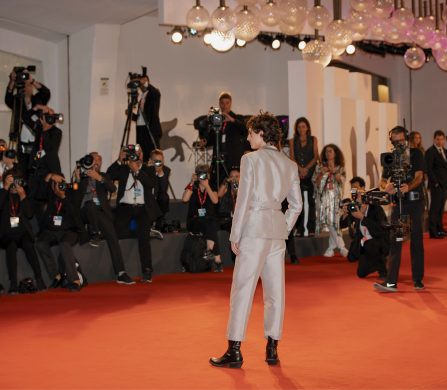
dress shirt. Fendi
trousers. TAAK
shoes. Grenson
Nearly ten years into his career, Hart Denton is still learning. And that’s exactly how he likes it. The actor, who first found global recognition through ‘Riverdale’, has spent the last decade steadily evolving from a theatre kid in Arkansas into a performer deeply invested in the craft of character-building. Looking back, Denton is the first to admit there was a steep learning curve when he arrived in Los Angeles. “There was just so much I didn’t know,” he reflects. “I was very ignorant in a lot of ways, and it’s wild now to think about how I handle myself professionally compared to back then. It’s night and day.”
That willingness to remain a student of the work has led Denton to his most immersive role yet. In ‘Dutton Ranch’, he plays Chet, a ranch hand whose unwavering loyalty places him at the centre of a moral storm after witnessing a violent crime. Neither hero nor villain, Chet exists in the murky space between devotion, survival, and conscience — a complexity Denton embraced through months of meticulous preparation. From building character scrapbooks out of vintage cowboy magazines to curating a soundtrack inspired by real ranchers and spending long days at Cowboy Camp under the Texas sun, the actor immersed himself in a world far removed from Hollywood. What emerged was a transformative experience, one that reshaped his understanding of performance altogether. “Every day was full of things that surprised me — things I couldn’t believe I didn’t already know,” Denton says. “Being part of that show felt like a masterclass.”
In conversation with Schön!, Denton speaks about the lessons he’s carried from a decade in the industry, the real-life cowboys who helped shape Chet’s emotional landscape, and why a pair of elusive cowboy boots became the key to stepping fully into character.

shirt. Calvin Klein
trousers. R.Swiader
hat. Vintage
opposite
suit. TAAK
dress shirt. Fendi
shoes. Grenson
Your first credit was back in 2016, so this year marks a decade of being an actor. Can you reflect and share how you’d describe your growth and development as an actor when you look back?
I grew up in Arkansas and did local theatre there. I was used to being on stage, but the film and television format was brand new to me when I moved to LA, and there was a steep learning curve. Acting on stage in Arkansas didn’t necessarily translate to acting on film and TV. There was a lot that I felt very green about and had to learn.
When I got on ‘Riverdale’, that was the first time I was on something consistently. Before that, I’d done two little jobs — a small part in a movie and a small part in a TV show — but they were both very quick, just day shoots. There was still a lot I didn’t know. I remember when I got on set on ‘Riverdale’, and on most TV shows, there’s a new director every episode or every two episodes because they need people prepping the next ones while someone else is shooting. After the second or third episode, I remember thinking, “Oh man, these directors keep getting fired.” I thought ‘Riverdale’ was really good, and I was worried the whole thing was falling apart. One of the cast members finally told me, “You idiot, that’s how TV works.”
There was just so much I didn’t know. I was very fortunate to get on that show, and I’m incredibly grateful for the opportunity because it opened a lot of doors and gave me some of my best friends to this day. But I was very ignorant in a lot of ways, and it’s wild now to think about how I handle myself professionally compared to back then. It’s night and day.
That’s what’s been amazing about ‘Dutton Ranch’. Sorry to jump forward, but it’s full of leaders across the board. No matter where you look — actors, directors, producers, writers, the showrunner — everyone is a leader. I felt like I was constantly learning something every day on that show that I hadn’t learned before as an actor. I don’t think I’d ever been part of something with that kind of structure, where everyone shows up so professional, prepared, and focused on the work.
Honestly, I felt like I was walking around with a notepad the whole time. Every day was full of things that surprised me — things I couldn’t believe I didn’t already know. Being part of that show felt like a masterclass.
I think it must be really cool to actually sink your teeth into a character for a longer period of time. How has your preparation changed for this role? I know you’re a big music lover — are you someone who makes playlists for characters to get into the mindset?
Absolutely. I did that for this one. I made a whole playlist called “Chet and Texas Sweat”. Every day at Cowboy Camp was incredibly hot — we were drenched in sweat after about an hour, and we were there from around 7 a.m. until noon. I would listen to that playlist on the drive to camp every morning.
Some days, the cowboys would have a speaker set up and play their own music. There were times I didn’t have my phone on me, so I couldn’t Shazam songs, which drove me crazy because that’s basically the only app on the front page of my phone. If I hear something I like, I have to know what it is. I’d be trying to rope cattle or work with horses while desperately trying to remember lyrics so I could look the songs up later. Then I’d get back to my car after camp, Google the words I remembered, and add the songs to the playlist.
I wanted to emulate those cowboys as much as I could. Most of the music was stuff I hadn’t heard before, even though I grew up around country music. They had all these hidden gems, and every cowboy knew every word. So I built this playlist out of the music that was part of their world. I also made a notebook. I went to flea markets, antique stores, and vintage markets and bought old cowboy magazines. Then I’d sit in my hotel room cutting things out and making collages — images and articles that I felt Chet would connect with. It was the first time I’d done something like that, and it was incredibly effective.
I could flip through a couple of pages before shooting and immediately feel like I was in character. There were ranch job postings, rodeo advertisements, all kinds of things I imagined Chet would save. It was funny because when I got to set, Chet’s bunk had all these magazine clippings taped up on the walls. I’d started making the binder before I ever saw the set, and so many of the images were similar to the things I’d collected myself. It was really cool to see those worlds line up. I carried that binder with me every day, looked through it every night, and spent hours working on it while running lines. Between that and the music, I know for a fact I’ve never been as prepared to play a character as I was for this one.

full look. Tom Ford
opposite
coat, suit + shirt. Goodfight
With costume as well, especially for a Western, costume very much informs how you get into the mindset. How do you embody a character? Was there a specific item of clothing that helped transition you from Hart into Chet?
I wear cowboy boots, but mine are kind of big. The boots that Chet had were tighter and smaller, and I was obsessed with them. I really loved those boots. I’ve looked for them on eBay, but I can’t buy them. I don’t know where they got them. I’ve like tried to take pictures and ask around to help find this boot, but I can’t find it, which is kind of cool. Those are the boots that I wore every day, and as soon as I would throw those things on, I mean, they fit like a glove, and then I was like, “Oh yeah, I’m in it.”
There was also a lighter that I had. I smoked a lot of cigarettes in this show, but you don’t know that — you don’t see all the cigarettes I smoked. I’m not a smoker, but I would see these cowboys, and they’d be up at 8 a.m. out on the horse and having a cigarette, and I was like, “Chet has to do that.” Every scene, I was trying to smoke as much as I could, just because I wanted to, and Chet’s also dealing with a bunch of stressful stuff, so it makes sense to chain smoke. The lighter and the boots were definitely the two things that I would say made me feel more like Chet and dropped me into character pretty quickly.
Let’s touch on the stressful stuff that he’s going through this season. He’s a witness to a murder that he wasn’t asked to be part of — he just happened to be in the car at the time. He’s in a really conflicting space. He’s definitely not a villain, but he’s not exactly a hero either, because he doesn’t come forward with what he knows. What was it like working through all of that?
I spoke at length with Chad Feehan, the showrunner, to understand Chet and his place in this family, and we came to the conclusion that Chet hasn’t had much of a home life. He doesn’t have much of a family, and he left home very early and found this ranch to work for, and that’s become his family. He also looks up to Rob Will so much and wants the validation of Rob Will more than anyone else because he feels like a brother. It’s the closest thing to family he’s truly had. Although Rob Will has made this decision, even though it’s so grave, I think Chet sees past it for his own survival, because if he’s got any sort of issue with what’s going on, it can mean the end of Chet as well. He genuinely admires and adores Rob Will, so he’s in a really tough spot.
One of the actual cowboys I met at Cowboy Camp left home when he was 12. When we would go out on these trail rides, I would talk to him about it and what that was like for him. To me, it felt like, “Oh, that doesn’t happen anymore,” like that’s that people would do ages ago, not now. This guy did it 15 years ago — I couldn’t believe it. When he said that, I was like, “no kidding.” He was so happy, and he’s not troubled. He was like, “This is what I wanted to do, and now it’s all I know and I love it.”
Ranch life is all that he knows. That helped me humanize Chet so much, to go, “Oh yeah, this does happen to ranchers.” The cowboy told me it was that or the military for him, and he couldn’t go into the military yet at 12 or 13, and he was ready to go. He wanted to be out of his house and out in the world, and ranching offered that to him. Now all the other cowboys and ranchers are truly his family. So having that conversation with him over several days on those trail rides helped me form Chet’s backstory, loosely related to that guy’s experience.

jacket, sweater + trousers. Simkhai
shoes. Jimmy Choo
opposite
coat, suit + shirt. Goodfight
shoes. The Row
Wow, that’s amazing. What an incredible experience for you, because not all actors get hands-on experience like that at all.
Moving forward, every role I have, I want to do that to some degree. Whatever that character is, whoever I think that guy is, find that person in real life and just absorb. Not emulate them and not become them, but really absorb the little pieces of things they can offer, because it connects you to a human immediately. Most of the things I’ve played have a lot of depth, and after doing it like this for this show, I’m like, “How did I survive doing what I did before without having done that type of prep?” That’s one of the biggest lessons I’ve taken from this experience. This thing’s been a masterclass. The prep is not just the lines — the prep is so much more than that. Those are things I’ve learned and things I’ll take with me on every job that I do in the future.
There’s a fight scene that happens, and Chet puts a fellow cowboy in the hospital. Knowing what you know now — that you were talking with somebody who left home at 12 and found family through this life — how did you approach that scene in particular?
This is new territory for Chet — having to lay the law — but it’s what the boss wants, and this is home. So, if you don’t make the boss happy, where does Chet go? I don’t know. It’s not a good thought to have for him if he’s banished from this place. For Chet to go and do this, I think he’s more afraid of being kicked out of the place than he is of anything else, so he’s going to do whatever it takes. These people are all brothers to him. He doesn’t want to do this, but it’s almost more of a show; it’s an act. It’s not really what he wants to do, but it has to be done.
There’s a scene with him and Beulah in her office where she essentially is like, “I know you know what’s going on,” which I really loved. I wanted to ask you a little bit about working with Annette, because obviously she is an icon, to say the least.
It was unreal. In that scene, she’s saying a lot to me, and I’m sitting there having to remind myself to act because I’m just watching her. I’m just absorbing what she’s doing, and I’m so enamoured with everything and all the choices. When we would do different takes, she was finding new things every take. It was such a lesson as an actor to see somebody find their space and not be stuck with one thing. To discover things within the scene, not just discover things in rehearsal, but actually discover moments and choices and switch things up.
She said something so profound to me. She said, “Sometimes it just takes a minute to get still.” Everything she would say felt like I needed to be writing it down. Anything she would say was a legendary quote that’s going to live on in history. In that whole scene, I was like, “Just steer the ship. Don’t do anything else. Don’t crash. This beast is running, don’t get in the way. Just let her do her thing.” Because there’s a reason she is who she is, and she’s been nominated for so many Oscars. She knows what she’s doing. I was just so fortunate, and I felt so blessed to even be in a scene with her. It was amazing.
Lastly, knowing what you know about his arc over the season, what advice would you give to Chet?
What advice would I give to Chet… I’d probably tell him to be careful. That’s kind of the overarching theme, I think, throughout this show. Be careful. These people are for real. I get what he’s having to do, but he needs to be really careful.

full look. Tom Ford
photography. Bianca Gerasia
fashion. Luca Kingston @ The Only Agency
talent. Hart Denton
grooming. Diana Berry @ The Wall Group using HORACE
interview. Kelsey Barnes
special thanks. 5M Ranch