


Steph Carter.
Director Culture Marketing of Marshall
Sound is an ever-present and powerful force in our lives, whether we are cognisant of it or not. The sounds that trickle in through speakers, headphones, or simply pass by have the power to shape our emotions and impact our mental health. It’s something the Marshall team understands – so much so that they’ve explored the mental and emotional impacts of sound in our daily lives.
Steph Carter, the Director of Culture Marketing at Marshall, has brought together a lifelong passion for music with a unique and distinct approach to cultural engagement. After joining the company in early 2022, he transitioned from Head of Education to Acting Head of Marketing, eventually stepping into the pivotal role of Director of Culture Marketing. Carter’s background in Creative Music Technology, in addition to the years spent as a touring musician, recording professional and educator, has helped shape the Culture Team and drive the legacy of Marshall into the future.
Schön! alive shares Carter’s thoughts on why sound is so impactful and how it can be used to boost our health and happiness.
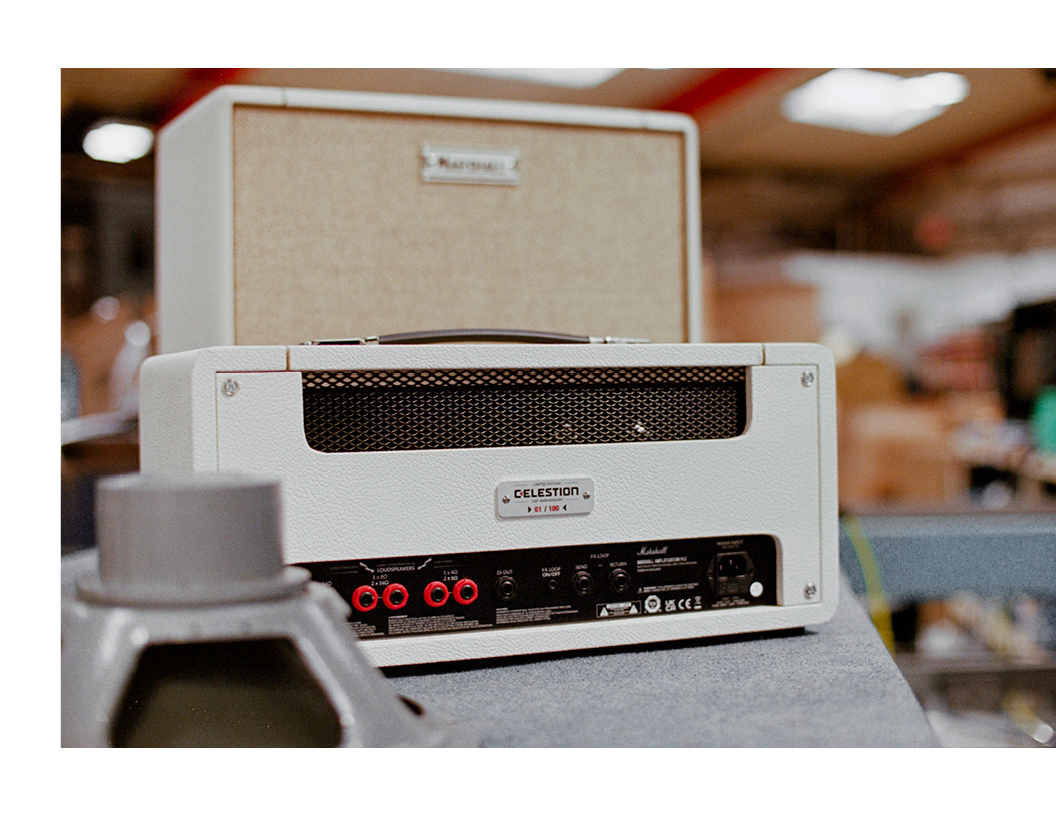
Marshall Celestion 100 Amp.
Marshall factory
in Milton Keynes, United Kingdom
marshall.com
image. Courtesy of Marshall
How does music or sound bring people together in social settings or communities? Why do shared sound experiences, like concerts or rituals, feel so unifying?
As a performer standing on stage, you are witnessing magic: whether you are seeing five people nodding in unison or 60,000 people singing back at full volume. At that moment in time, everyone is there for the same thing: a shared experience. It’s a place where all the worries of the world disappear, a collective escape and connection.
As humans, we all have rhythms and cycles we move through without thinking about it. From the Circadian rhythm, hormonal cycles, the phases of the moon and the seasons, we’re connected to and by something much bigger than us. While we’re listening to live music, there are beats and frequencies we sync up to, as well as the social aspect of being together for the same reason. We’re united by the music we love, as well as syncing up to the sounds we’re hearing.
Despite the unifying feeling of shared music experiences, why do people have such diverse preferences in music and sound environments?
Everything from cultural backgrounds to socioeconomic factors, to learned behaviours, to personalities, to generational trends will influence people’s personal preferences. What makes people fascinating is the shared universal truths and the vast differences we have as individuals. We love both new experiences and familiarity, while ultimately being driven by emotional connection. What lands for you might not land the same for someone else. Just because it’s different doesn’t mean it’s wrong!
There is a lot of research on emotion-driving musical preference and, while this isn’t my area of expertise, I know from experience that it really comes down to how the music makes you feel, regardless of the style or genre. For some, cinematic soundscapes make you feel relaxed and at ease, but for others, they feel relaxed when listening to thrash metal. It doesn’t matter whether it makes sense; what matters is that you’re feeling something.

Marshall Acton III.
SNS Stockholm
photography. Mike Palmer
Do cultural backgrounds shape our perception and response to sound?
Without a doubt, cultural backgrounds will shape how we respond to music. If you look at traditional music in Western Cultures, we associate a major key with happiness and a minor key with sadness. Why? Learned behaviour. But what if you’ve not grown up and been exposed to these norms? Will you have the same associations? Depending on your age, you might perceive Black Sabbath as heavy metal and difficult to stomach but, by today’s standards, this is easy listening as far as a ‘heavy’ genre goes. What feels ‘right’ to us is deeply ingrained by our generation, culture and personal sonic preferences.
How does sound influence our emotions and mental state?
While I can’t speak on a technical neuroscience level, from my own experience, I know that sound can have a huge influence on our emotional and mental state. After doing a little research, I’ve found some really interesting science behind how music affects our brain and body chemistry. Listening to music can increase the dopamine levels in your brain, and listening to upbeat music can boost your mood. Music can help reduce stress and pain, and boost your memory, creativity, and even help relieve some symptoms of Alzheimer’s.
Some athletes even show an increase in endurance performance simply because they’re listening to fast-paced music that helps keep them going during a gruelling workout session. There has been so much research done on how music can improve your mental, emotional, and physical well-being. It’s fascinating to read about it and see the importance of different kinds of music therapy as well as daily enjoyment of music.

Marshall Acton III.
Soho House New York
photography. Mike Palmer
What happens in the brain when we hear music or certain sounds? Are there sounds that can universally trigger relaxation or stress?
In a simple answer: yes, an emergency vehicle siren or a fire alarm instantly triggers stress and fear as you know this is a warning. This warning can trigger your fight, flight, freeze or fawn stress response, depending on how your brain releases stress hormones like adrenaline or cortisol. We all know what it feels like to wake up in a panic from a deep sleep when your alarm clock starts blaring! You can feel your heartbeat in your chest because we associate that sound with needing to get up and go.
Looking at film composition and syncing music/sound to moving images is another great way to understand how sound is linked to creating or augmenting emotions. If you were to take any horror film and watch it in silence, it brings the intensity down by at least 85%. Now, if you watch the exact same scene and put circus music underneath it, it becomes comedic. The tension in composition can get your heart pumping and make you feel on edge and nervous. The release comes when the music and sound resolve, and your body is given the chance to relax.

waving hands.
photography. Edwin Andrade
on Unsplash
Can sound be used therapeutically to alleviate mental health issues like anxiety or depression?
This is exactly what sound therapy is used for: focusing on rhythms, melodies and natural sound to improve physical and emotional health. In some people, it can help with their attention span and focus. Another example is people using white noise machines or apps that play nature sounds to sleep. They can help calm a busy mind and remove unwanted distractions. For my wife, brown noise is more effective than white noise to help her sleep. For me, cinematic soundscapes help me to relax my brain. Binaural beats are a fascinating area to look into as well. You can research more deeply into what frequencies are best for your desired outcome: some frequencies will relax you, while some might feel more stimulating. You can find entire playlists on streaming services that are dedicated to Binaural Beats for sleep, focus, stress relief and more.
How does sound influence physical responses, such as heart rate or breathing patterns, and does it have an impact on productivity levels?
The frequencies have a big impact on your physical response to sound, as well as the beat or rhythm. Another great example is Shepherd tones (a trick in composition to make you feel like the music is constantly ascending), which is great for adding tension in a film. It gets your heart rate going and can make you feel anxious. Usually, these Shepherd tones aren’t overbearing, and you may not even consciously notice they’re happening in the score. The opposite can be true for low frequency, long, drawn sounds. People go to sound baths and sound relaxation sessions to enter a state of deep relaxation. They can slow down the heart rate and bring peace and tranquillity to a person as well as help with muscle relaxation.

Unpeople Band playing Natal Drums, Marshall.
2000 Trees, United Kingdom
image. Courtesy of Marshall
As a sound-centric Culture Director, what role does sound play in non-verbal communication and understanding?
For me, I think of music when I think of sound. Music is the universal way to communicate, feel and connect. Even though we all have different preferences, every person you meet will have a favourite band, a favourite genre, a song that makes them cry or dance. We can remember the song we played at our wedding, or the one you played on repeat, thinking about your first crush, the first electric experience at a live concert, or the one that made you cry after your first heartbreak.
Music allows us to understand ourselves, understand each other, escape from hardships and celebrate the good times. All of this can happen within our minds and bodies without even realising it. Footnote Steph does not have formal scientific qualifications in sound; his insights are grounded in personal experience and years of professional expertise.

Marshall Middleton.
marshall.com
image. Courtesy of Marshall

Marshall Celestion 100 Amp.
Marshall factory
in Milton Keynes, United Kingdom
marshall.com
image. Courtesy of Marshall
Footnote: Steph does not have formal scientific qualifications in sound; his insights are grounded in personal experience and years of professional expertise.
Get your print copy of Schön! alive at Amazon.
Download your eBook.
interview. Sophie Axon
words. Kelsey Barnes
special thanks. the team @ Marshall marshall.com