If music is a language, then champagne is its echo. At Krug, music has been more than just an accompaniment since its inception; it has been the very essence of the creative process. Each cuvée is crafted like a score from a composer’s hand; each vineyard is seen as an instrument with its own voice. It is precisely at this point that Max Richter‘s melodies and cellar master Julie Cavil’s champagnes meet in the same universe.
For Richter, this process becomes a new source of inspiration, where taste, smell, light, and texture are treated like musical notes. For Cavil, the polyphonic world of winemaking finds its echo in Richter’s compositions. What emerges is not just three works describing three champagnes, but also a shared vision of two disciplines: transforming emotions, making time special, and creating an experience beyond everyday life.
Schön! chats with Max Richter and Julie Cavil to discuss champagne, their collaboration, and more.
When you first tasted the three cuvées, what emotions or sensations immediately translated into musical ideas for you? I imagine it must have been quite an unusual spark of inspiration compared to your usual process.
Max Richter: Beginning a new project is always exciting, but this one was a completely new landscape for me. The first step was getting familiar with Julie’s world and the world of Krug, and really trying to understand what mattered: how craft, taste, and culture all come together to create something unique.
Tasting was a great pleasure in itself, but I began to think about how the qualities of the champagne could serve as starting points for music. The way light reflects through the glass, the texture, the temperature, the scent, and even the sound. That is what I would call the emotional architecture. Champagne is tied to special moments, to marking time in meaningful ways, and above all to joy. That joy is something very precious.
Each piece, Clarity, Ensemble, and Sinfonia, mirrors a different expression of the 2008 harvest. How did you decide which musical form best embodied each champagne?
Max Richter: The three cuvées represent three different communities of wines, three communities of grapes. Clos d’Ambonnay, Clarity, is a single voice, so I built the first piece around solo instruments. It feels intimate, almost like a one-to-one conversation.
The other two become progressively larger, just as the champagnes themselves grow more complex, richer, and multi-dimensional. Ensemble, Krug 2008, took the form of large-scale chamber music. Sinfonia, Grande Cuvée 164ème Édition, expanded into a full orchestral palette with all the voices present. That natural progression became a principle for me to follow.
Precision and experimentation are at the heart of both music and winemaking. How do you balance structure with intuition when composing?
Max Richter: That balance is one of the enduring puzzles of composition, but also one of its greatest pleasures. Creative work is a process of discovery. You begin a voyage with a destination in mind, believing you know how you will arrive. At a certain point, the material takes on its own life and leads you to unexpected places.
As a writer, you will know this feeling. You think a piece will unfold in a particular way, and suddenly it wants to become something else. It is the same in Julie’s world. It is about exploration, curiosity, and discovery, and then shaping the final work out of the strongest things you encounter along the way.
Has that balance changed for you over the years, or has it always been like this?
Max Richter: It really depends on the project. Each one brings its own little universe. Sometimes you set out to write a piece, and it remains exactly what you intended. At other times, it wants to evolve into something different, and then you have to enter into a dialogue with the material, a kind of negotiation, until it reveals its true form.
Collaboration often requires trust. What surprised you most in your dialogue with Julie Cavil, and how did it shape your final compositions?
Max Richter: What struck me most was the extraordinary commonality in our philosophical approaches. Of course, the techniques are different since music and winemaking are separate disciplines and languages, but the mental constructs are remarkably similar.
We all begin with almost nothing and then strive to create something that feels real, special, and unique. That is the common thread across creative practices. Comparing notes with Julie revealed that we share the same struggles and joys. It was an inspiring dialogue, and one that confirmed how universal the creative process really is.
The 2008 harvest was described as exceptional. What made it so distinctive, and how did that guide the creation of the three expressions?
Julie Cavil: The 2008 harvest in Champagne was very classical. It was one of the last years that reflected the traditional northern climate, something we have not experienced again in many years. It was a cool year overall, with limited sun and contrasts we value, such as between day and night, or across the seasons, but without extremes.
The grapes matured under a steady rhythm, with no acceleration, no blockage, and then recovery. This consistent maturation gave birth to wines of immense elegance: vertical, refined, subtle, with a touch of austerity. Each time we create a new vintage, our aim is to tell its story, and in this case, the story was one of classicism. I believe Max was the perfect person to interpret this, to twist it and bring it into another universe.
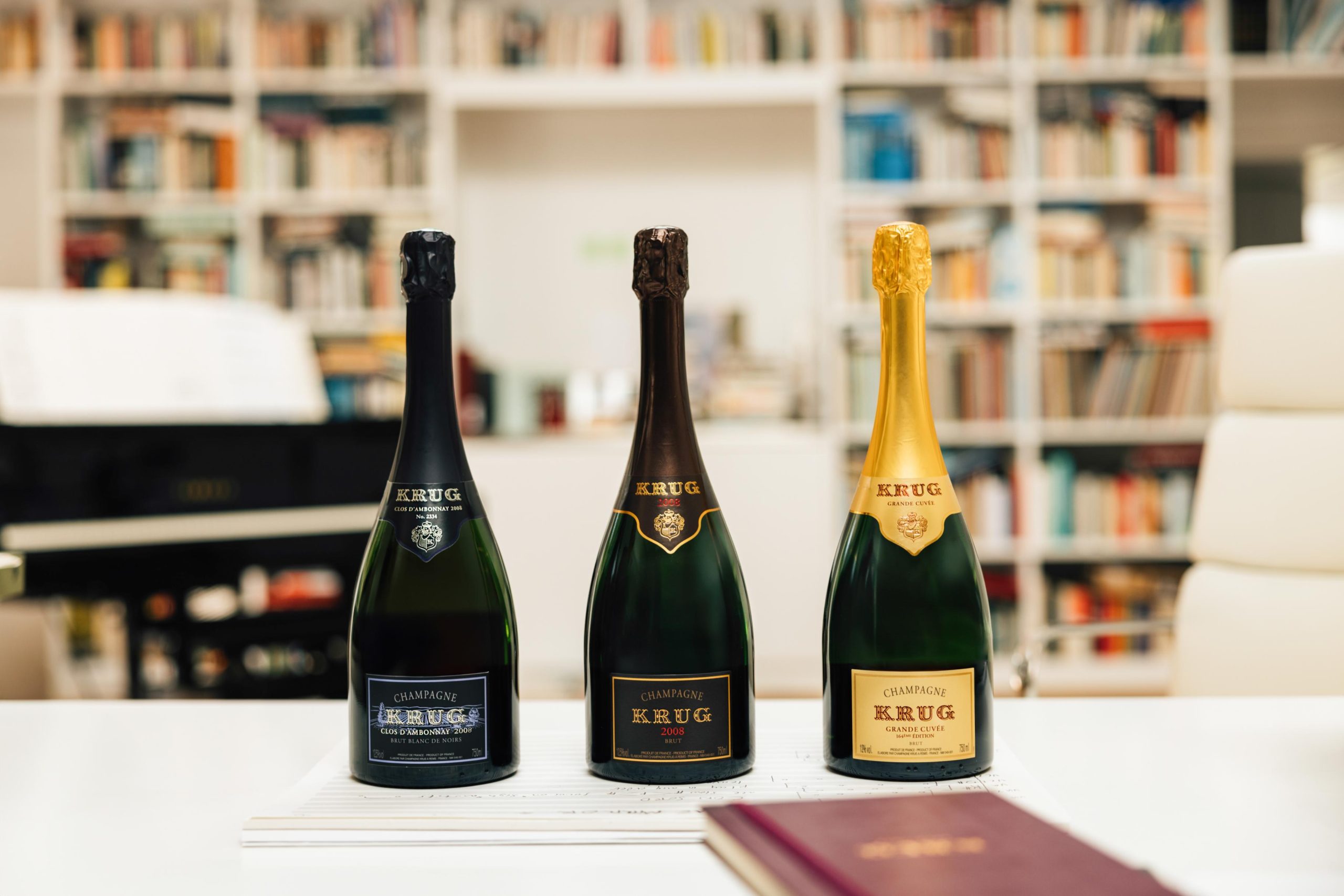
What made 2008 truly remarkable is that everything aligned. We were able to express three different champagnes that, when experienced together, reveal the full philosophy of the Maison. From the soloist, represented by Clos d’Ambonnay, to the music of a single year in Krug 2008, and finally to the full symphonic orchestra of the Grande Cuvée 164ème Édition.
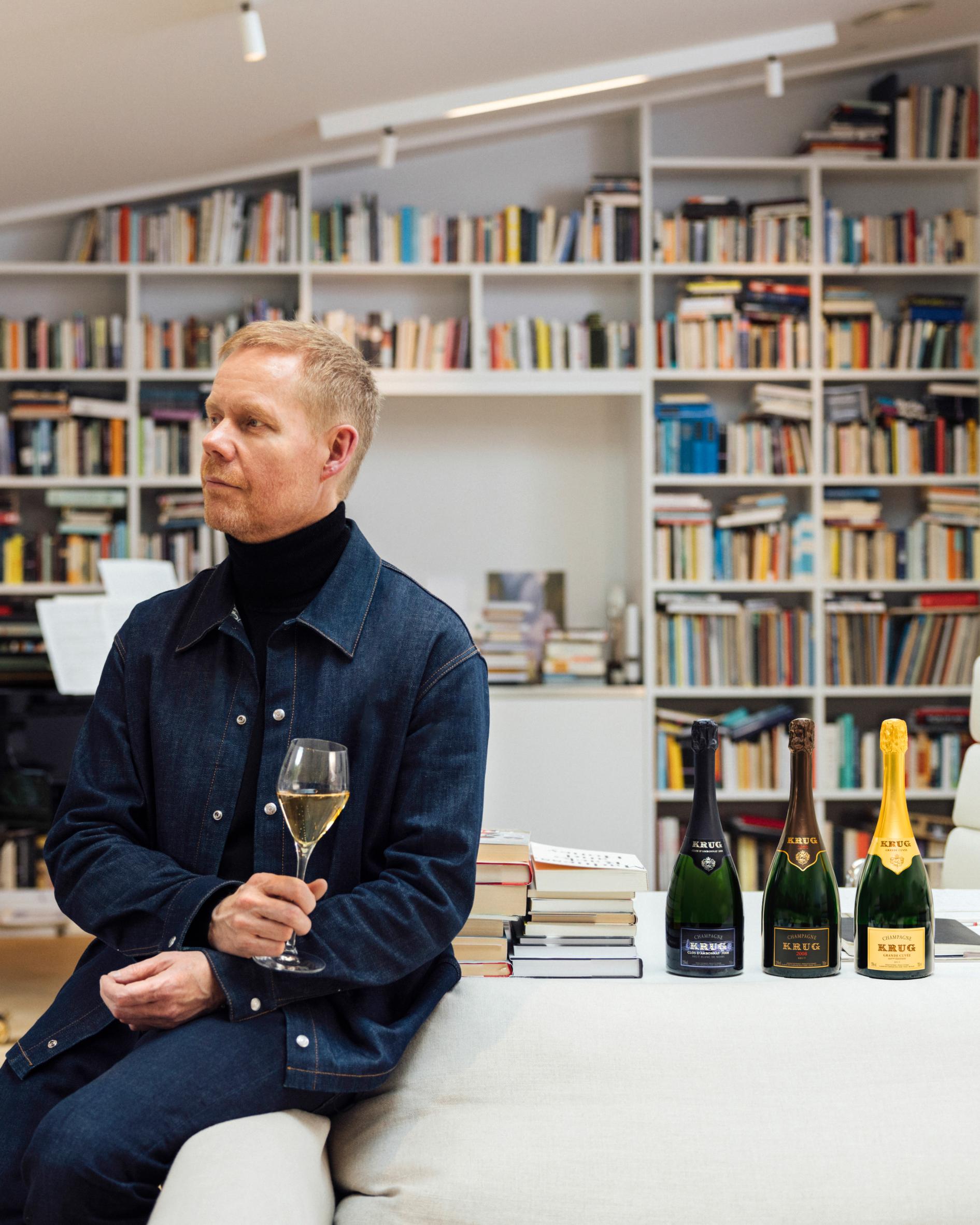
Crafting Clos d’Ambonnay, Krug 2008, and Grande Cuvée 164ème Édition as a trilogy is unusual. How did you envision them as parts of a larger story rather than as individual wines?
Julie Cavil: Music has always been part of Krug, thanks to the family’s history and relationships. From my first day at the Maison, I was struck by the parallel between music and winemaking. I often see myself as a conductor because we treat each vineyard plot as if it were an instrument with its own voice.
Our role is to understand the sound and singularity of every plot across Champagne and then bring them together, orchestrating them into harmony. Some years a vineyard sings as a soloist, other times it plays in an ensemble or contributes to a grand orchestra. It may sound simple, but in fact the expression can vary from year to year. Like a conductor, we must know the amplitude of each instrument’s expression and how to balance it.
Max and I both wanted to create unforgettable journeys, whether for the listener of his music or the taster of our champagne. Behind what seems like a simple, effortless experience lies an immense amount of work, detail, and time. And as we often say, nothing takes more effort than making things feel effortless.
Over the years, I have even translated our tasting committee notes into sound. Each plot has a sound, and this multi-sensory approach helps me understand our wines more richly. For me, each cuvée now has not only a taste, aroma, and texture, but also a sound and a shape. When Max spoke of landscapes in tasting, I realised that I, too, see images such as spheres, or hear instruments like clarinets and bassoons.
Ultimately, we want people to understand that, just as you do not need to be a musician to enjoy music, you do not need to be an expert to enjoy Krug. Max became a translator for us, allowing people to enter that world.
Listening to Max Richter’s compositions, did you discover new dimensions of your champagnes through the music?
Julie Cavil: Absolutely. The music forced me to find new words for what I was experiencing. Because Max does not use the same vocabulary as we do in wine, and I do not have the vocabulary of music, we had to speak through images and analogies. It pushed me to describe sensations in new ways, and now I can describe our champagnes not only through taste and aroma but also through shape, music, and texture. This process has enriched my philosophy and the way I approach blending.
Krug often speaks of blending as a form of artistry. What parallels do you see between conducting an orchestra of wines and the way Max composes music?
Julie Cavil: Through our many exchanges, both in Champagne and in Max’s studio, I discovered his profound human values. He gives meaning to his work and shows real care for the musicians he collaborates with. I feel the same about the community of growers we work with. We spend time with them, taste their wines, give feedback, and help them refine their instruments for the future.
There is always an element of uncertainty. You think you know what the result will be, but you are never completely sure. Our role as conductors, whether of wines or of music, is to find the perfect balance, bringing together every element until nothing more can be added and nothing can be taken away.
Learn more at krug.com.
words. Alper Kurtul