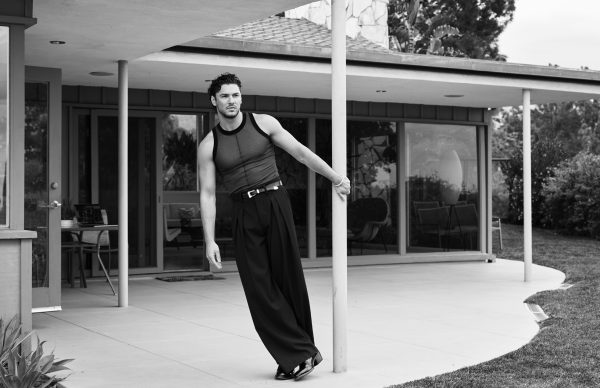
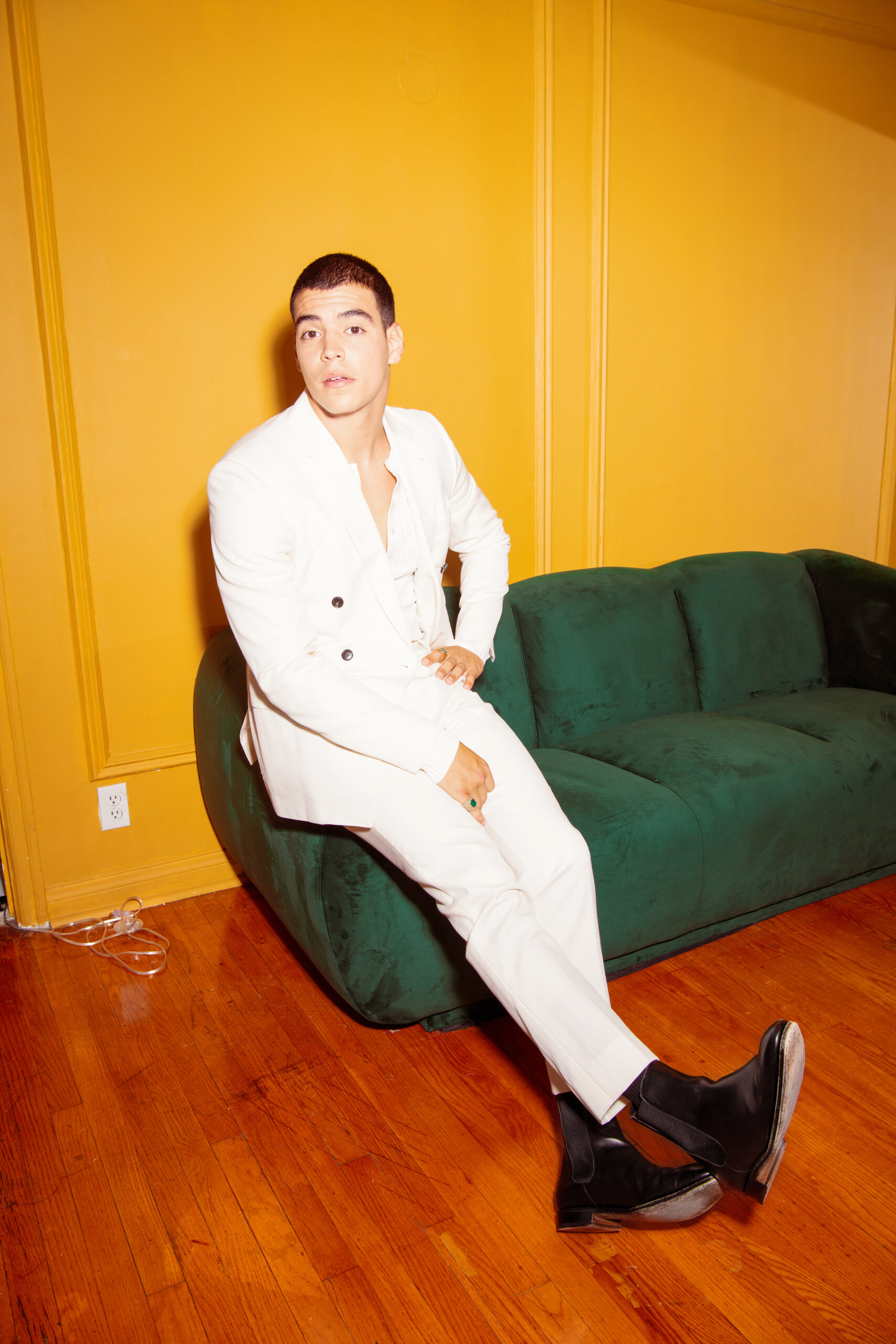
jacket. Louis Vuitton
tank top. Sunspel
At just 13, Tyler Conti discovered acting almost by accident. Watching a friend perform in ‘Little Shop of Horrors’, he was struck not by the spectacle, but by the reaction: the strange, immediate power of making an entire room feel something. What began as a hobby soon became a calling, taking him from amateur dramatics and Shakespearean theatre to increasingly ambitious roles across stage and screen.
Now, Conti is entering a particularly compelling chapter of his career. In ‘Fightland’, he plays Jay, a sensitive and instinctive young man navigating a world of violence, loyalty and competing influences. In ‘The Gentlemen’, he steps into the heightened, darkly comic universe of Guy Ritchie as Joe Green, a character whose history with Susie Glass brings romance and criminal intrigue into the same orbit. The roles could hardly be more different, yet both speak to Conti’s instinct for finding something emotionally truthful beneath heightened worlds.
With a growing reputation for versatility — and a desire to explore more intimate, naturalistic stories — Conti is beginning to define what kind of actor he wants to become. In conversation with Schön!, he reflects on the formative experiences that shaped his approach, the contrasts between Joe and Jay, working with Guy Ritchie, and more.

tank top. Sunspel
trousers + trainers. Louis Vuitton
hand wraps. Everlast
opposite
jumper. Margaret Howell
shorts. Ron Dorff
boots. Ami Paris
hand wraps. Everlast
socks. London Sock Co.
You’ve said your interest in acting began when you were about 13, after seeing ‘Little Shop of Horrors’ at school. What was it about watching someone perform in front of an audience that made you think, “I want to do that”?
I think it was probably the reaction more than anything. My mate was on stage, and everyone was laughing, and I remember thinking, “I want that.” Which sounds quite narcissistic when you say it out loud, but I think it was more that I’d never really thought about acting as something you could actually do. Then I got up there and realised there was this strange feeling of being able to make a room feel something. I was hooked pretty quickly. It was basically a hobby at first, but I think somewhere along the way the hobby started taking over my life.
You went from amateur dramatics to playing Shakespeare as a teenager. How did being thrown into something as demanding as ‘Romeo and Juliet’ shape your understanding of acting at such an early age?
It was probably the best possible way to start because I had absolutely no idea what I was doing. I was 13, had a very thick Essex accent, and suddenly I had all this Shakespearean language to learn. I think it taught me quite early that you can’t always wait until you feel ready, because sometimes you’re just thrown in and you’ve got to figure it out. I also had these lovely older actors around me who really took me under their wing. So I learned a lot about the work, but probably just as much about being part of a company and looking after each other.
Looking back at those first experiences on stage, what do you think they gave you as an actor that you still carry with you today?
Probably a willingness to have a go. I wasn’t thinking about whether I was doing it correctly when I started. I was just having fun and seeing what happened. I think you can lose a bit of that when you become more experienced because suddenly you’re aware of all the rules and all the things you think you should be doing. Those early experiences remind me that acting is supposed to be enjoyable. You have to take it seriously, obviously, but you don’t have to take yourself seriously all the time.
You’ve worked across theatre and television, and you’ve described them as requiring very different kinds of energy. What has moving between those worlds taught you about what a performance actually is?
I think it’s taught me that there isn’t really one definition of a performance. Theatre is very much about keeping the ball in the air for two hours and being completely present, whereas with television you can be much more microscopic. You can have a tiny thought or reaction, and the camera can pick it up. But I actually think theatre has made me more confident on screen because it taught me not to be frightened of doing something big. If it’s truthful, you can go further than you think. You just have to know why you’re doing it.

knitwear + boots. Ami Paris
You’ve played characters at very different ends of the spectrum, from Henry VIII to Jay in ‘Fightland’. Do you find yourself most interested in characters who are far removed from you, or is there usually something personal that you need to find in them?
I think there has to be something I recognise, even if the character is completely different from me. Henry VIII is probably about as far away from me as you can get, but there were still things in him that I could understand. With Jay, there was much more of myself in there, which can actually be more frightening. If you’re playing someone who’s completely different, you can hide behind the character a bit. When there’s something personal in there, you have to be a little more honest with yourself.
Let’s talk about ‘The Gentlemen’. You grew up watching Guy Ritchie’s films, and then found yourself acting inside that world. Was there a surreal moment when it stopped feeling like you were watching that world and started feeling like you were actually part of it?
Definitely. I grew up watching Snatch and Lock, Stock and Two Smoking Barrels, so there were moments where I’d be standing on set thinking, “This is a bit mad.” And then you have Guy Ritchie directing you, and you have to remember that you’re actually there to do a job. My first scene probably didn’t help with that because I was standing there in my underwear with Guy opposite me and Kaya next to me. That was a fairly quick way of getting rid of any sense of glamour or mystery!
You play Joe Green, who returns to Susie Glass’s life with an existing history and eventually becomes her love interest. How much work did you do around the history between those two characters that the audience never necessarily gets to see?
Quite a lot, because even if the audience doesn’t see all of it, you need to feel like it exists. Joe and Susie aren’t meeting for the first time, so there has to be an ease and familiarity there. I think it’s often the stuff you don’t explain that makes a relationship feel real. You don’t need to know every detail of what happened between two people; you just need to know what it feels like for them to be around each other again. That was something I was quite conscious of from the beginning.
The world of ‘The Gentlemen’ is deliberately heightened, but the relationships still have to feel believable. How did you find the balance between embracing that heightened style and keeping Joe emotionally grounded?
I think you have to commit to the world you’re in. If everyone else is operating at 100 miles an hour and you’re trying to make it feel like a normal Tuesday afternoon, you’re probably in the wrong show. But underneath all of that, Joe still has very human wants. He wants things, he gets jealous, he cares about people, he makes bad decisions. Those things don’t suddenly disappear because you’re in a heightened Guy Ritchie universe. In fact, I think the more real those things are, the more fun you can have with everything around them.

jacket. Louis Vuitton
tank top. Sunspel
opposite
coat. Karl Lagerfeld
under-shorts. Adidas
shorts. Studio Nicholson
boots. Grenson
socks. London Sock Co.
What did working with Guy Ritchie teach you about acting that you hadn’t encountered before, particularly given how unconventional his sets and shooting process can be?
To trust that you don’t always need to know exactly what’s happening. There’s a real spontaneity to the way his sets work, but there’s a real confidence behind it. You might be doing something and thinking, “How is this ever going to make sense?” and then you see it back, and it completely works. It taught me not to panic if something feels unconventional in the moment. Sometimes you just have to get involved, listen, react and trust the people around you.
You’ve talked about receiving a thumbs-up from Guy after your first scene. Beyond the obvious excitement of that moment, did his confidence in you change the way you approached the character afterward?
Absolutely. You can convince yourself of a lot of things in your own head, especially when you’re new to a big production. So having Guy give me that thumbs-up after the first scene was a massive relief. I think it allowed me to relax a bit and enjoy it rather than constantly questioning whether I was doing the right thing. And, honestly, I’ve kept that thumbs-up in my head ever since. If you get one from Guy Ritchie, you might as well carry it around with you!
Then there’s ‘Fightland’, which feels like a very different acting challenge. What was it about Jay that made you want to play him?
I liked that he wasn’t the loudest person in the room. There’s a lot of violence and big personalities around him, but Jay has a kind of quietness to him. He’s loyal, he’s sensitive, and he genuinely wants to do the right thing, even when he doesn’t always know what that is. I found that really interesting. I also liked that he isn’t some perfect moral compass. He makes mistakes and gets himself into trouble, but you understand why he does things.

tank top. Sunspel
trousers + trainers. Louis Vuitton
hand wraps. Everlast
You’ve described Jay as vulnerable, instinctive and relatively honest in a world where other people may be more guarded or aggressive. Did you see his vulnerability as something he was conscious of, or something that simply came through in the way he behaved?
I don’t think Jay is walking around thinking, “I’m a vulnerable man.” I think it’s just who he is. He’s not particularly interested in putting up a front, which in that world can actually make him quite exposed. He reacts emotionally and sometimes before he’s had time to think things through. I think that’s what makes him vulnerable without him necessarily knowing it. He’s not trying to show you that side of himself; you just see it.
Jay is also easily led and constantly being pulled in different directions. As an actor, how do you play someone who is reacting to the world around him rather than necessarily controlling his own story?
I think you have to stop trying to make him smarter than he is. Jay doesn’t always have the whole picture, so I couldn’t play him as if I knew where everything was heading. I tried to stay with whatever was happening in front of him. If someone says something that changes his mind, then it changes his mind. If something scares him, you see it. He’s quite instinctive, so I think the trick was not to overthink him when he wouldn’t be overthinking himself.
There’s a striking contrast between Joe and Jay: Joe exists in this highly stylised, heightened criminal world, while Jay feels much more emotionally exposed. What did moving between those two characters teach you about the different ways you can create truth in a performance?
That you can get to something truthful in completely different ways. With Joe, there’s a lot of style and confidence around him, so you can use that. With Jay, it’s almost the opposite. He’s much more open, and the emotion is closer to the surface. I actually went from one job straight into the other, so it was useful having them be so different. You put on Joe’s clothes, and you immediately feel like one person; then you put on Jay’s, and suddenly you’re somewhere else. Sometimes the physical stuff gets you into a character before you’ve even had time to think about it.
You’ve said you’re interested in exploring more naturalistic, relationship-led work next. After ‘The Gentlemen’ and ‘Fightland’, what are you now looking for in a character that you haven’t had the opportunity to explore yet?
I’d love to do something where nothing is exploding, and nobody is trying to kill anyone for a little while! I’m really interested in work where the drama comes from people and their relationships rather than the circumstances around them. Something like The Bear, where a scene can be incredibly tense without anyone necessarily pulling a gun out. I think there’s something really challenging about finding the drama in everyday life. I’d like to disappear into something like that for a bit and see what I can find.

coat. Karl Lagerfeld
under-shorts. Adidas
shorts. Studio Nicholson
boots. Grenson
socks. London Sock Co.
opposite
knitwear + boots. Ami Paris
tank top. Sunspel
photography. Dean Ryan McDaid
fashion. Andrew Burling
talent. Tyler Conti
grooming. Tarik Bennafla @ Stella Creative Artists using Horace
production. Martin Buckley
editor + interview. Kelsey Barnes


 Editor João Paulo Nunes speaks to the twin brothers behind the sexy DSquared2. How does every collection of menswear from this pair exude sex so effortlessly? Why are their catwalks more exciting than a Hollywood set? And, most importantly, what’s next? Find out in the latest issue of Schön! magazine 12.