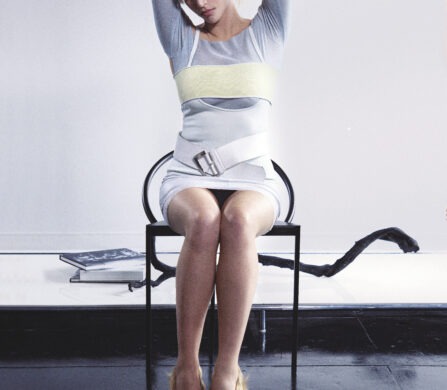
top. Meryll Rogge
trousers. 6397
Erotic thrillers are supposed to run on youth, glamour, and heat. ‘Night Nurse‘ runs on none of that. Director Georgia Bernstein‘s debut swaps the genre’s usual playground for a retirement community, where a young night-shift nurse named Eleni becomes entangled with an elderly resident named Douglas through a series of scam phone calls that curdle into something else entirely — desire is displaced, disguised, and repeated until it means everything.
Written for and starring Bernstein’s real-life best friend Cemre Paksoy, the film is less interested in shock value than in the strange intimacy of caretaking, and what happens when two people can’t say what they actually want from each other. Inspired in part by the scam calls Bernstein’s own grandmother received near the end of her life — and partly shot in her grandmother’s house outside Chicago — ‘Night Nurse’ pulls from a wide, unexpected lineage: Cronenberg’s ‘Crash’, Lucrecia Martel’s fragmented gaze, Catherine Breillat’s refusal to look away, even 1930s nursesploitation. The result is a film more concerned with longing than titillation, asking what an erotic thriller even looks like after the internet has already shown us everything.
In conversation with Schön!, Bernstein and Paksoy talk through the writing process, the visual language of desire, and the friendship that made the whole thing possible.

top. Meryll Rogge
trousers. 6397
opposite
top. Meryll Rogge
trousers. 6397
Erotic thrillers have been treated as disreputable for decades. What made this the right genre to tell this particular story in?
Georgia Bernstein: I didn’t really set out to make an erotic thriller so much as a film about falling into a toxic relationship. I was interested in what happens when people can’t, or won’t, express what they really feel. And what happens when those feelings get redirected somewhere else. I was thinking about how some of the great erotic thrillers had used this idea of displacing desire into something unexpected. The most famous example is Cronenberg’s ‘Crash’, in which people become sexually aroused by car accidents. In ‘Night Nurse’, desire is displaced into these nightly scam calls. They become a kind of love language between Eleni and Douglas, who repeat the same script over and over, but each time the words begin to mean something entirely new. That felt like my way into a genre that’s seeing a bit of a comeback right now.
The film sits in conversation with ‘Body Heat’, ‘Crash’, ‘In the Cut’, ‘Babygirl’. Which of those was actually on your mind during prep, and which did you consciously want to avoid echoing?
Bernstein: All of those films were somewhere in the conversation, but I was also drawing from outside the erotic thriller. I was interested in finding all the cinematic nurses, from Roger Corman’s nursesploitation trilogy from the ’70s to William Wellman’s ‘Night Nurse’ from 1931, as well as what I think of as the great doomed love stories, like ‘Bonnie and Clyde’, ‘The Honeymoon Killers’, and ‘In the Mood for Love’. I think I was looking beyond the traditional erotic thriller because I was interested in what the genre might look like after the internet. We don’t need to go to the movies to see sex anymore. Movies have to offer us something else. That question pushed me toward longing and fantasy.
Why a retirement community specifically? What did that setting let you do with power, need, and control that a more “obvious” erotic-thriller setting wouldn’t?
Bernstein: An erotic thriller set in a retirement community became our hook almost immediately, simply because they were such an unlikely pair. But this setting choice wasn’t arbitrary. The film was inspired in part by the scam calls my grandmother received toward the end of her life, and we actually shot portions of the film in her house outside Chicago. I also just love that the retirement community immediately changes your assumptions about the power dynamics at play. The question of who’s taking care of whom becomes much less straightforward.
How did you want the audience to feel about the age dynamics at play?
Bernstein: The age gap between our protagonists is definitely meant to be provocative, but I never wanted it to be treated as a joke or a gimmick. I wanted to take it completely seriously. I was interested in making a film about a young woman in a relationship with an older man and the complicated power dynamic between them. However, I was determined to approach that dynamic in a way that hadn’t been done before. What would happen if we pushed it to the extreme? What if the older man is so old that he lives in a retirement community? Suddenly all of our assumptions about who is in control begin to unravel.
To me, the age gap was never simply there to shock the audience. By taking the relationship to this extreme, I hoped the dynamics would become, in a way, more recognizable. I hoped that the audience might see something of their own relationships reflected back.
Georgia, what did you need from Cemre in the audition or early conversations to know she could carry this?
Bernstein: To be honest, I wrote the role for Cemre, so there wasn’t a formal audition. She’s my closest friend, and we’d worked together for years, so I already knew she was the only person I wanted to play Eleni. At the time, she was living in Istanbul, so we spent months figuring out how to get her a visa to make the film. Throughout that process, she kept telling me I should start casting a wider net, just in case. But I just couldn’t imagine doing this film with anyone else.
Cemre, what did you need to know about Georgia’s intentions before saying yes to a role this exposed?
Cemre Paksoy: I guess while ‘Night Nurse’ isn’t “exposed” in more traditional ways — there are no sex scenes or nudity — it’s emotionally exposed, and it’s uncomfortable. I think it makes the audience feel exposed as well, having to sit in that discomfort. My dream as an actor is to play roles like this, so this was flattery of the highest degree.
I honestly didn’t need to know anything, and didn’t ask many questions. I trusted Georgia completely on set and throughout the whole process. I think she’s brilliant. Her vision is clear and unique. You could see it in the script; it was all there. I don’t trust anyone else’s taste more, so for her to trust me back as an actor with this role was the greatest compliment of my life.
Pulling off a movie and role like this requires something intangible, something hard to describe, and that’s where the friendship and partnership come in. I don’t think this movie would have been possible without that mutual trust. There’s a quality to our relationship that allows us to move past a traditional “process” into something that feels more instinctual.

top. Meryll Rogge
Was there a scene where you disagreed on tone or interpretation, and how did you resolve it?
Bernstein: We honestly didn’t disagree very often because the collaboration started long before we got to set. Because I wrote it for Cemre, and because she was very involved on the script level, by the time we started shooting, we had already spent quite some time talking about Eleni. Cemre was the only person besides me who had every scene number memorized. She doesn’t like watching herself, but she was deeply invested in every stage of making this film. During the edit, I’d tell her something like, “we’re struggling with Scene 43,” and she’d immediately know exactly which scene I meant. She was more than an actor; she is a true creative partner in this film.
Paksoy: Georgia and I developed this almost unspoken language on set. Sometimes, she would walk over to give me a note, and half the time I’d already know what she was about to say. We just had such a shared understanding of the character and the tone.
Cemre, how did you build your character’s interiority? What’s she getting out of this dynamic that she couldn’t say out loud?
Paksoy: I never feel I’m building a character from scratch. My entry point to the story was finding a version of myself in this world. Like ‘Night Nurse’, most of my favourite films are about the things we can’t say out loud — the things that are under the surface. I think there is an ironic sense of fulfillment you can get from caring for another person, from being selfless. It gives Eleni purpose; it’s a sick satisfaction, but a real one. Some people see the movie as her losing herself, but you can also see it as her finding herself. Even if what she finds isn’t necessarily “good,” it’s true to life.
How much backstory did you two invent together that never makes it onscreen but shaped how a scene got played?
Paksoy: We imagined Eleni as someone who didn’t really have a life outside of work, as someone who has very little life experience. But more than anything, it was important to us that she felt like someone searching for purpose and belonging. Someone who could plausibly be drawn into a strange community or a destructive relationship because it offered her a sense of meaning.
Bernstein: Very little of that is ever stated outright. There are hints, like the revelation that she was fired from her last job, or the suggestion that she has some kind of troubled past, but those details are meant to function more as invitations than explanations. I wanted the audience to project onto Eleni in the same way that she projects onto Douglas. Ideally, watching the film feels a little like joining this strange nurse cult — you gradually find yourself adopting her logic before you realize you’ve become complicit in it.
How did you and your DP talk about desire visually? Whose gaze is the camera taking on, and did that shift scene to scene?
Bernstein: My DP Lidia Nikonova and I wanted the film itself to feel like the experience of desire. We watched a lot of Lucrecia Martel, especially The Holy Girl, and were inspired by the way she photographs the act of looking through these fragmented shots. Martel often catches the back of someone’s neck, the top of an ear, or someone through a doorframe. We similarly wanted the audience to always be reaching for something just out of view. That approach felt especially important because the film is almost entirely from Eleni’s perspective.
The nurse as an object of desire is an enduring erotic trope that we wanted to subvert. What if the nurse were the desiring one? And the camera is always aligned with her desire? Mirrors and reflections became another recurring idea. The film is full of people looking at each other indirectly, projecting onto one another. That felt much truer to the experience of desire. We also talked a lot about Catherine Breillat’s imperceptible dolly moves. We shot almost the entire film on a dolly to give the world a real weight and slowness that matched the rhythms of the retirement community. I wanted the world to feel suspended in time. I think when the movement is almost imperceptible, there’s a strange feeling that the world is pulling you in before you even realize it’s moving.
Music and sound in erotic thrillers often do a lot of the emotional heavy lifting. What was the temp track or reference that shaped a key scene?
Bernstein: I listened to ‘3 Women’ and ‘Picnic at Hanging Rock’ constantly while I was writing the script because they have this dreamlike, feminine quality that’s incredibly unsettling. Both films are also about young women gradually losing themselves. These scores were also used heavily as temp tracks until I brought on my composers Sam Clapp and Steven Jackson. We quickly shifted to Coppola’s ‘The Conversation’ and agreed on the power of a recurring melody. I wanted ‘Night Nurse’ to feel circular, like you’re going around and around in that swimming pool and you’re not entirely sure you’ll ever get out.
Sam and Steven then brought in their brothers, Will and Nate, and a handful of other incredibly talented musicians, and recorded much of the music live to picture. I had the chance to be there for those sessions. I’m not a musician, so my direction was never technical. I would talk in terms of feeling, and somehow they always knew how to translate that into music. By the time we reached sound, my sound designer Eli Cohn and I had the same instinct to keep taking things away. We wanted the film to be as quiet as possible, trusting silence as much as music to create tension.
Editing for tension vs. titillation: was there a cut that changed the meaning of a scene entirely?
Bernstein: My editor, Alex Jacobs, and I were always watching movies throughout the editing process. He was a big believer that if we got stuck, the solution wasn’t to stare at the timeline; it was to go watch a movie. We revisited ‘Crash’, ‘Exotica’, ‘Belle de Jour’, and Catherine Breillat’s films over and over again, and sometimes a single cut or transition would unlock something. One of our favourite discoveries came from Belle de Jour. There’s a simple editorial move where Buñuel cuts in a way that breaks our sense of what is real. We started calling it “the Belle de Jour cut” whenever we wanted to blur this same line.
We were also really interested in duration, in sitting in discomfort. That’s something I admire so much in Catherine Breillat’s work. She isn’t afraid to make the audience uncomfortable. She never cuts away. Eleni works the night shift; we also wanted the audience to experience her exhaustion. Dream logic became an editorial tool. It helped us move from one location to the next, and guided our decisions about what information to withhold and what to reveal.
What’s something Cemre brought to the role that wasn’t on the page?
Bernstein: Cemre has these remarkably expressive eyes. My favourite scenes with her are when there is very little dialogue, and we watch thoughts and contradictions move across her face without her speaking a word. We used to joke on set that “the camera loves her.” It goes without saying that she’s endlessly watchable, but I think we’re drawn into her performance because she has these wide eyes bubbling over with emotion. I love that it feels like they invite our projections.
Georgia, was there a moment on set where you realized the actor understood the character better than you’d written her?
Bernstein: It was the first phone call scene in the kitchen, which we shot on our second day. It’s a deceptively difficult scene because it more or less establishes the emotional rules of the entire film. Cemre understood immediately that Eleni isn’t simply resisting Douglas or giving in to him. She’s drawn to him, but she can’t quite admit that to herself. It’s a very contradictory emotional state, a kind of desire that’s difficult to write because it exists in performance rather than dialogue. We’d looked at a lot of references beforehand to get on the same page about tone, and once we got to set, this strange dialogue I had written came out of her so freely and simply. She found all these tiny emotional shifts that communicated everything that was going on internally. She was perfect.
If you made a second film together, what genre would you want to blow up next?
Bernstein: We want to make another erotic thriller. We’re working on a script right now inspired by “Vacation Noir” movies like ‘The Talented Mr. Ripley’ and ‘L’Avventura’, seeing if we can push our take on the erotic thriller even further.
Paksoy: There’s nothing like being miserable and yearning in a gorgeous summer town. Georgia and I are both interested in how you can make an erotic thriller today. Can there be even less kissing?
Bernstein: It’s that same idea that I keep going on about. What are we going to the movies for? What can we find there that we can’t find on our computers?

top. Meryll Rogge
trousers. 6397
shoes. Salomon
photography. Max Montgomery
fashion. Alexander Siliezar
talent. Cemre Paksoy + Georgia Bernstein
hair. Niki Rae
make up. Karly Ketelle
editor + interview. Kelsey Barnes