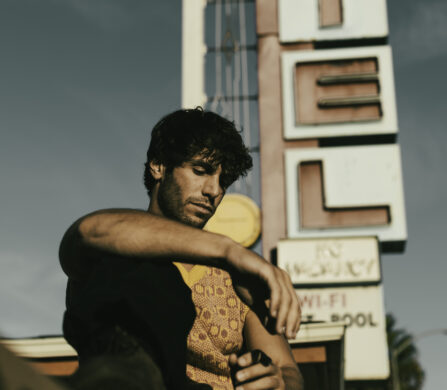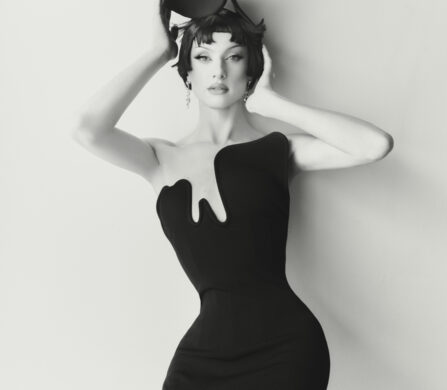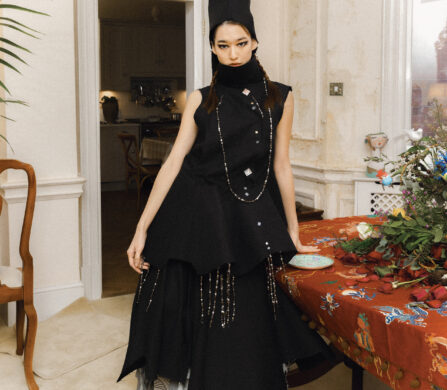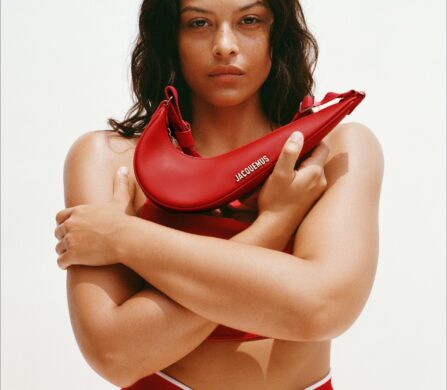
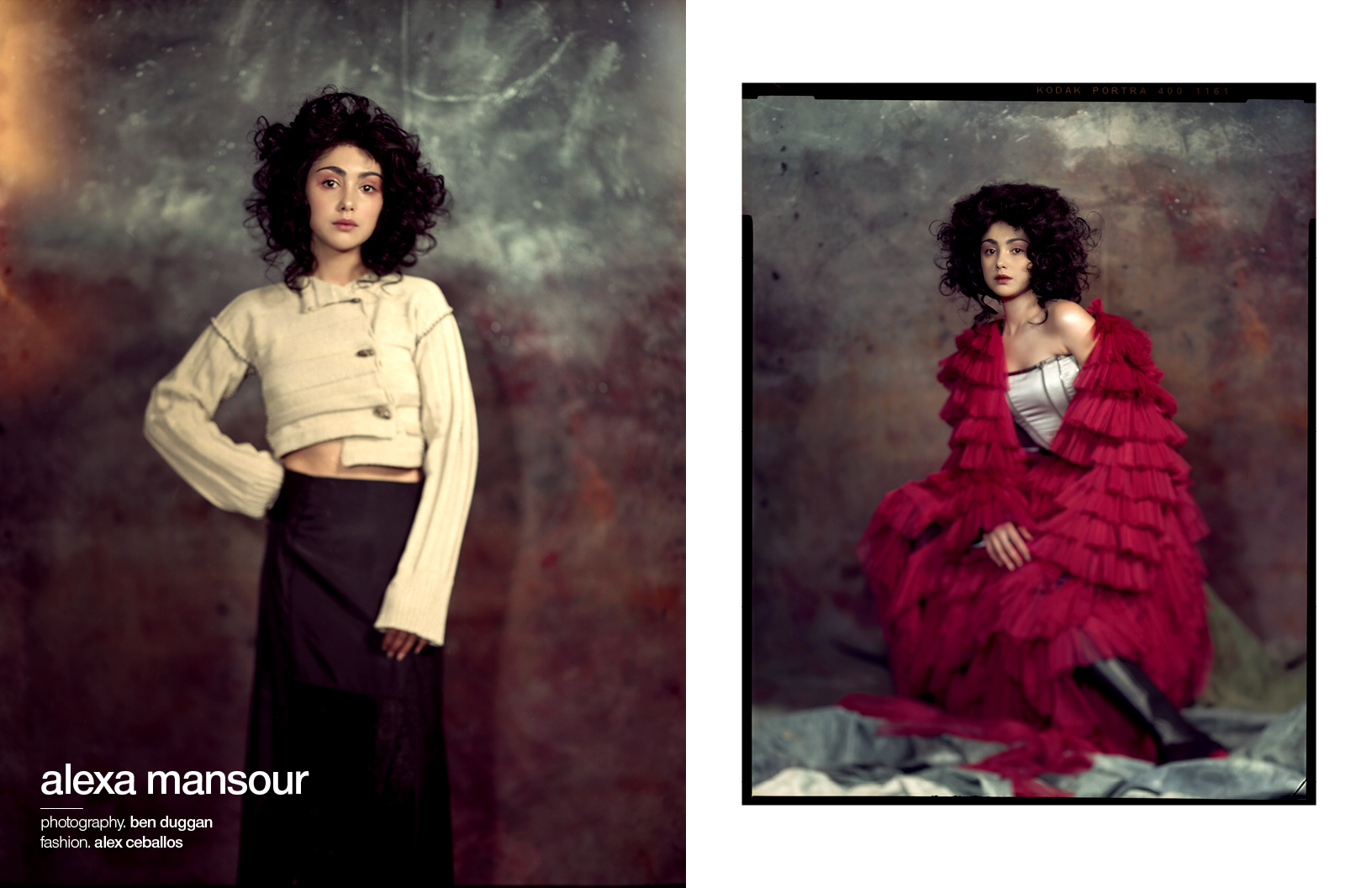
full look. Acne Studios
opposite
top. Dolce & Gabbana
dress. KAFTAN STUDIO
Before taking her breakout role in The Walking Dead: World Beyond, it was almost difficult to imagine such a kind and gentle actress like Alexa Mansour playing in the zombie apocalypse drama. Now, having gone deep into the mind of her on-screen character Hope, she’s managed to both show all the hidden traits of her character and showcase her undoubtable talent and professionalism. But acting is not the only creative commitment of 25-year-old Mansour; together with her full-time acting work, she’s currently launching her music career. Schön joins Mansour to discuss her career, childhood, experience working on The Walking Dead: World Beyond and so much more.
Your mum worked in show business, which gave you a taste of the industry from a young age. How did you envision your acting career in your childhood, and how does that vision compare to your present reality?
I knew I wanted to be an actress from a young age. I started lessons when I was around 12 years old. I would always tell my mom I wanted “the world to know me”. I definitely didn’t envision myself being a part of a reality show like my mom’s (or reality TV in general), but I’m very grateful for all the exposure I got through it. I think that 12 year old Alexa would think 25 year old Alexa is pretty darn cool. So many things are happening that I always dreamt of.
What is your favourite genre to work on and why? Are there any genres you wish you worked in more?
As of right now, my favourite genre to work on is drama. I love how uncomfortable it can make me feel; having to be vulnerable is something that’s hard to do alone, let alone in front of a massive cast and crew. It also feels therapeutic in a way. I would love to work more on comedy and thrillers (I know, polar opposites). Comedy makes me super nervous because I’ve never thought of myself as a “funny” person, and I would love to get more confident in that area.
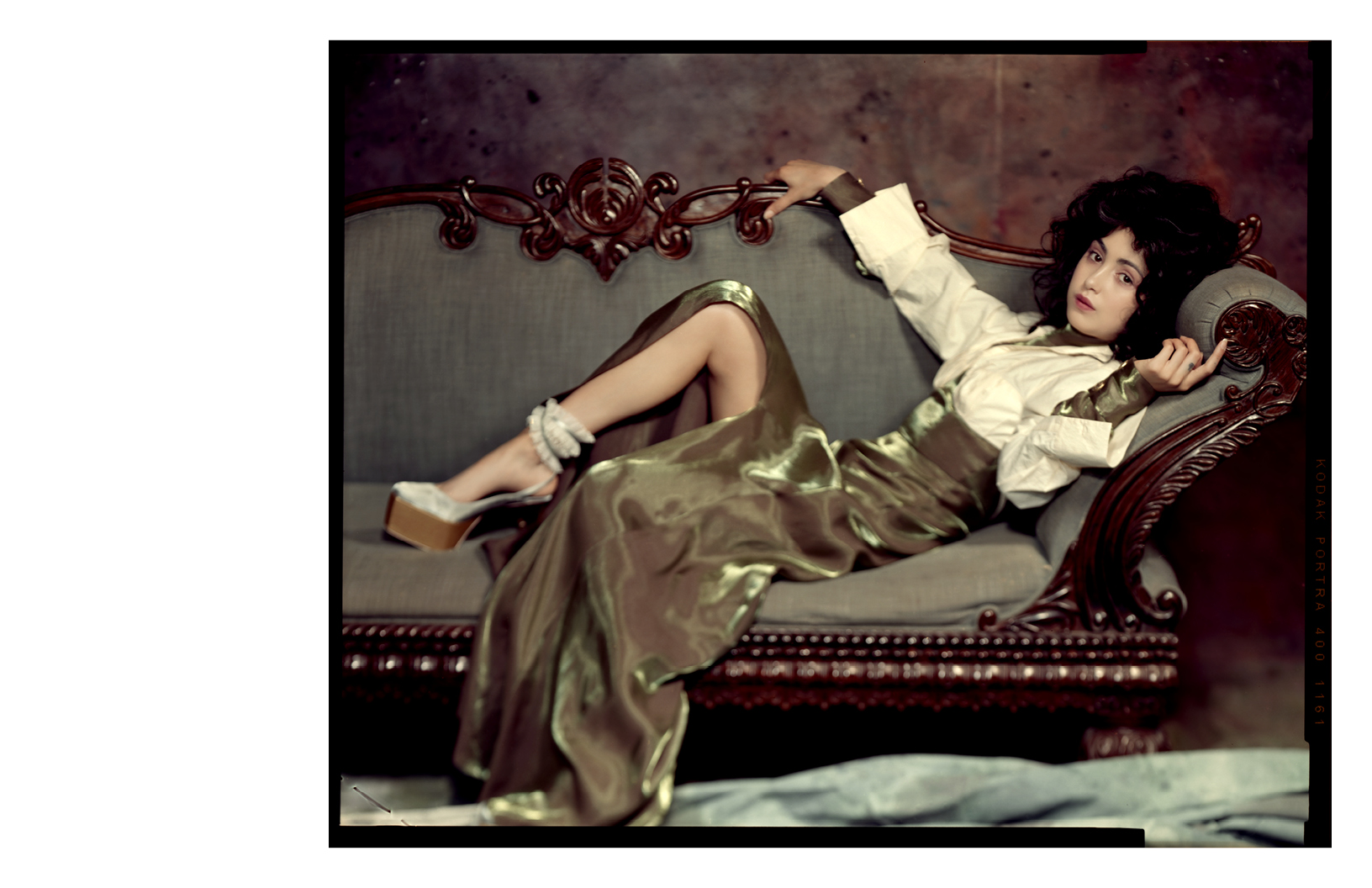
dress. Adiba
top. Jacquemus
shoes. Serpenti
What has been inspiring you recently?
A lot. I feel like I’ve been learning a lot about myself lately. So much has happened in the last year; lots of ups and downs and seeing people’s true colours. I spent a month in England surrounded by so many incredibly talented souls — that inspired me so much to get back into writing music. You can expect lots of sad songs coming up!
Let’s talk about The Walking Dead: World Beyond. How did you feel when you landed the role? What were you most excited or scared about?
I landed the role July 3rd 2019. I was half asleep when I got the call. I started crying; I was at such a low point in my life and was beyond ready to give up on acting. Getting that phone call reaffirmed that this is what I’m meant to be doing. I had never been a main character in anything so I was pretty scared about the pressures that came along with that, especially since The Walking Dead already had such a massive fanbase. That fear quickly turned into excitement when I saw how welcoming everyone was.
Did you have any specific preparation for this role, both as an actor and as a person? Anything unexpected?
I always feel kind of weird when people ask me about my “prep” as an actor because, if I’m being 100% honest, I don’t have anything special that I do to get into character. The only thing I did that was kind of out there was run 6 miles every morning before work. I would put my script on the treadmill and read my lines over and over. That’s how I would memorise my lines. I still do that, but now I tape my lines to the wall and jump rope while I read them over and over. It’s pretty crazy how fast I’m able to get off book by doing this.
Your character, Hope, is very versatile, and she learns more about herself in every scene. Was there anything you felt very touched or fascinated by when playing her?
I felt a deep connection to the way that she will keep her darkest secrets to herself if she thinks they’ll hurt anyone else. I’ve always been the kind of person that won’t say anything if I believe it’ll run the risk of negatively affecting anyone else. You can see what a toll this takes on Hope; she feels so guilty for so much but knows that if she opens up, it’ll just push those around her away from her. Hope is so strong, and the way she finally opened up to Elton and Iris in season one inspired me to be more vocal about what I go through.
Tell us a bit about the stunts and fights of the show. What was the preparation process, and what did the training teach you?
We had a lot of stunt training. Each session was tailored to whatever stunt we had coming up next, anywhere from 1-5 hours of training either alone or with cast members. At first it felt kinda silly — I felt like I looked really stupid waving the S-pole around, but the more practice I had, the more badass I felt. The training taught me to trust the process; anything new is going to feel weird at first, but if you put your all into something, there’s no reason you won’t be able to get good at whatever that is.
How did it feel working in an environment filled with such horror? Did it have any impact on your psyche, or on you as an actor?
I love horror. I’m fascinated by it. I had been going to Halloween Horror Nights at Universal Studios since I was 13 years old and loved the rush I got from it. I’m pretty good at separating reality from make believe, so no, the horror of it all hardly ever had a negative effect on me. The only thing that would leave me feeling a bit off was doing a really emotional scene. I tend to pull from actual life experiences, and it can get hard to just turn off those feelings when they call ‘cut’. I’ve gotten better at leaving my emotions on the set and moving on after the scene is finished.
What did you love about working on this series specifically as opposed to other projects you’ve worked on?
Before TWDWB I had only done one or two episodes max on any show, or been a small part in a movie. This series in particular felt like I had another family. I love everyone on this show with every inch of my being. Another thing I loved was how diverse this show was; there were so many layers. I think that everyone can find something in our series that they relate to on some level.
You have been working on this series for two seasons now, which means you definitely had a lot of interesting moments with the cast and crew. Do you have any favourite off-camera moments?
Nico Tortorella would randomly start making bird noises when the cameras weren’t rolling. People don’t realise how loud Nico can be; they made it known that they were always around. I miss those bird noises so much.
Tell us a little about your music — when did you start writing/singing, and what’s next for you in that space?
I started writing music when I was around 13, but I didn’t write anything “decent” until I turned about 17. I struggled with bullying, terrible self-esteem and giving too much of myself to people who don’t deserve it. Writing music has always been my biggest outlet; I initially started acting so I could gain some traction which would in turn lead people to listen to my music. However, acting happened a lot quicker. I’ve been writing a lot lately, probably more than ever. I’m hoping to release a full album sometime in 2022.
What’s next for Alexa Mansour?
So, so, so much. I’m so excited for the future. I have a few things coming up that I can’t name right now, but what I can say is that the world is going to be seeing a lot of me very soon. New shows, new music, you name it.
The final episode of The Walking Dead: World Beyond airs 5 December on AMC.
Kyler Gordon has always moved differently — on the field, in the locker room, and even in the tunnel before kickoff. Since entering the NFL, the Chicago Bears defensive back has grown into one of the league’s most versatile and instinctive playmakers, earning the nickname “Spiderman” for the way he bends, jumps, reacts, and seems to appear out of nowhere. But behind the acrobatic highlights is a player obsessed with the details: hours of film study, relentless fine-tuning, and a mindset that treats every Sunday like an exam he’s preparing for all week.
Now stepping into his third season, Gordon has evolved from a rookie learning nickel for the first time to a cerebral defender who dissects route stems, formations, and tendencies with precision. Off the field, he’s just as expressive, known for a bold, chameleon-like fashion sense that matches his personality and energy. From the first moment he realized he belonged in the league to the goals driving him toward All-Pro and Hall of Fame aspirations, Gordon speaks on growth, swagger, creativity, and what it really means to play like a superhero in Chicago.
vest + jeans. Frame
shoes. Axel Arigato
necklace. Miansai
opposite
coat. Brioni
denim jacket + tank top. Dsquared2
jeans. Frame
necklace. Miansai
You’ve developed into one of the most versatile defensive backs in the league — what’s been the biggest key to your growth since joining the NFL?
One of the biggest keys has been investing in learning. I mean the extra learning outside the facility — working with my film coach and coaches who aren’t in the league. That extra work gives me more knowledge and play-making ability when I’m on the field. It helped me grow faster, progress quicker, and become the player I am.
How has your approach to the game evolved from your rookie year to now?
My growth has been steady. As a rookie I was learning the basics, and especially for me, learning nickel for the first time ever was huge. Now I don’t focus on those basic things anymore — I’m studying deeper, more niche details that give me indicators about what’s coming. Who’s lined up where, how wide, how deep, what routes match that look. My game now is about constant fine-tuning.
full look. Prada
opposite
shearling coat. Dolce & Gabbana
full look. Prada hat. Stetson
Can you walk us through your preparation during the week — both mentally and physically — before a big matchup?
Mentally, it’s nonstop film: Sunday through Saturday. I break down first down, second down, third down, quick game, gun, play action, different run types, short yardage, red zone — everything. Teams run thousands of plays, all with different tendencies. It feels like studying for a test every week, and Sunday’s the exam.
Physically, I get everything from practice — technique, recognition, reps that make things feel natural on game day. You combine all of that in seven days, and on the seventh day you go out there and kill it. Pressure is a privilege.
What’s a moment in your career so far that made you think, “Yeah, I belong here”?
Two moments: My first training camp as a starter — going against the starters, sticking in coverage, making plays and interceptions on day one. I thought, “Dang, I’m doing this at the highest level.” My second NFL game — guarding a go ball from Aaron Rodgers to Lazard in the end zone. Everything happened fast, but I reacted, sprinted, and got the pass breakup. I celebrated like, “Yeah, I belong here.”
You’ve faced some elite receivers — who’s been your toughest matchup, and what did you learn?
Tyreek Hill and Justin Jefferson. Tyreek’s speed is one-of-a-kind — he ran a 25–30 yard comeback my rookie year faster than seemed possible. With Jefferson, he’s just an all-around great receiver. Competing against guys like that is fun and helps me grow.
jeans. Louis Vuitton
necklace. Miansai
opposite
sweater. Axel Arigato
t-shirt. CDLP
shorts. Dsquared2
necklace. Miansai
What are some personal goals you’ve set for yourself this season and beyond?
Six-plus turnovers, 100-plus tackles, win the conference, make the playoffs for the first time, become All-Pro — and long term, be a Hall of Famer. Every day I just stack the small goals toward that.
The Bears defense plays with a lot of energy and swagger — what’s the chemistry like in that locker room?
The chemistry is great. Everyone brings their own unique personality and humor. It all gels together. On game day we’re on the same mindset and timing. It makes coming to work fun — I’ve got a different joke or bond with everybody.
Fans call you “Spiderman” — how did that nickname start, and what does it represent to you?
It started during my rookie year when everyone saw me play for the first time. People connected my athletic ability, instincts, and play style to Spider-Man — being acrobatic, getting to the ball, moving a certain way. It stuck with fans, teammates, everybody.
full look. Dolce & Gabbana
opposite
full look. Hermès
Do you think the “Spiderman” nickname fits your playing style?
Definitely. My agility, twitchiness, body control — that’s my superpower. I really feel like I can leap, bend, react, and move in a way that fits the nickname perfectly.
You’ve become known for your unique fashion sense — how would you describe your style off the field?
I’d describe it as chameleon. Whatever mood I’m in, whatever vibe I want to give off, I can match it. Loud pieces, formal looks — anything I imagine, I can bring to life.
Where do you draw inspiration for your looks?
It comes from my creativity, my mood, and the vibe I want to bring that day. I like switching things up depending on what I feel.
vest. Frame
necklace. Miansai
opposite
sweater. Axel Arigato
t-shirt. CDLP
shorts. Dsquared2
shoes. Axel Arigato
necklace + rings. Miansai
socks. Scott Nichol
Do you see fashion as another form of self-expression, like how you express yourself through your game?
Definitely. Fashion lets me show a different side of myself the same way football does — just in a more visual, creative way.
How do you decide what to wear on game day — is it about mood, message, or just having fun with it?
It’s all based on mood and what I want to give off that day. I like to have fun with it and create something that feels right in the moment.
What’s one outfit or accessory that really captures your personality?
Anything bold that stands out — something loud or unique that shows confidence and creativity.
If you could design your own clothing line or brand, what would the vibe or message be?
It would match that chameleon idea — versatile, expressive, and adaptable. Something that lets people create whatever vibe they want and bring their personality to life.
Shortly after its release in July 2016, ‘Stranger Things’ became a global sensation. The sci-fi show, which is set in a fictional town in the 1980s, was immediately compared to Steven Spielberg and David Lynch’s work, thanks to its hodgepodge group of characters and larger-than-life storytelling. But, as with all good things, it’s coming to an end this year: Volume 1 will be released in late November, and Volumes 2 and 3 will come out in December. “The general feeling among the cast is the same: we’re all excited to watch this,” Charlie Heaton opens up for his Schön! 49digital cover story. “I’m really stoked about it. I’ve seen the first episode so far. It’s very, very good.”
Although filming for the final season ended months ago, Heaton’s head is still somewhat in the ‘Stranger Things’ world. Most of last year was spent shooting the show, wrapping up a decade of work. “I remember people asking, ‘Will you miss this?’” Heaton recalls. “I’ll miss the people. I’ll miss being on those sets. That whole year, every time we worked on set with the co-stars, it really felt in the moment. It couldn’t have happened more perfectly, the way the filming process ended and how they closed it out,” he smiles. “I don’t have any regrets or anything I’d want to change. It’s kind of like graduating and feeling really good about it.”
top. Edward Cuming
jeans. Our Legacy
tie. Tommy Hilfiger
Katy O’Brian is having a busy year, with 5 films releasing in 2025. From playing a secret agent in ‘Mission Impossible: The Final Reckoning’, to portraying real-life boxer Lisa Holewyne in ‘Christy’, and to Stephen King’s ‘The Running Man’, O’Brian has put in the work, and it shows. Solidifying herself as a certified badass (seriously, she’s got the martial arts certifications to prove it), on screen and off, O’Brian is looking forward to the slow path during the holiday season once the chaos of press is over. Back home in California, she chats with Schön! about some of the plans that were put on hold: writing (more for herself than for anything in the film world) and working on projects with her wife, namely, starting a family. Excited to pursue other creative endeavours while she has the chance, she shows no sign of stopping.
A far cry from being on the police force, O’Brian recalls to Schön! that she knew if she didn’t at least attempt to pursue her dreams, she would regret it. Her passion for film outshone everything else, and after getting a taste of what it was like to be on stage, she needed to give herself the benefit of the doubt. So, packing up her things, she moved to Los Angeles, taking one of the biggest risks of her life. In this case, the risk was certainly worth the reward. Stepping into shoes she didn’t think she’d ever be in. Now, she finds herself on the silver screen, sometimes able to mash together her love of bodybuilding or the martial arts (see: ‘Love Lies Bleeding’ and ‘Christy’), but still she wants more. She wants that leading role, to see herself represented, that chance to prove herself, and push beyond her limit.
In conversation with Schön!, O’Brian discusses ‘The Running Man’, meeting boxer, Lisa Holewyne, and more.
You’ve had an incredible run this year, according to IMDb, between ‘Mission Impossible: The Final Reckoning’ and ‘The Running Man,’ you’ve had five projects come out in 2025. How long before you’re back home in sweatpants and being able to decompress? What are you most looking forward to when this whole press tour is over?
How long before I’m back in sweatpants? Immediately. When everything is over, it falls right in line with the holidays. It’s finally getting to make up time with family, which I’m excited about. Then, it’s everything that we’ve been — not putting off — but not being able to focus a lot of our attention on. My wife and I are trying to produce some extra projects that we find exciting.
We’re trying to research things we might want to go after in the future. We’re also family planning and doing those steps, and all of that takes time, energy and effort. I’ve been doing a lot of writing too. I’m just trying to go back and be 100% to all those things.
You moved to LA in 2016 to pursue acting full-time. What went into making that decision? The moment you finally said, ‘I’ve got to do this?’
I wasn’t happy doing what I was doing. I made a short list of the two things that I really wanted to do. One was to act, and the other was to get strong and into really good shape. It was basically damn near the same day I found an acting class in Indiana that taught screen acting. Then I joined a gym, and rather than suggesting powerlifting, they suggested bodybuilding. It was like, “Screw it, let’s do it.” Both those things went hand in hand. I’d worked on a couple of local projects and done some auditions, and I wound up getting representation. I thought, “If I don’t do it now, I don’t know if I ever will.” I just packed up and moved to Los Angeles.
What were those first few months in L.A. like for you?
I was very broke. I was doing so many different jobs, but I had the energy at the time to do all of that. I was just so excited to be there. Everything was so new to me, just having access to so many different events and random events. One of my friends was a magician. We would go to the Magic Castle [in LA] and go to all of these underground magic parties. I dove headfirst into the martial arts community here, too.
One of the heads of UCLA’s martial arts program went to Indiana University, which was the same program that I went to. He hired me, and I wound up teaching at UCLA and Mount St. Mary’s. I found this young ninja program, which was an after-school program. You’re basically burning kids’ extra energy before you send them home. I found a lot of martial arts jobs, which were right up my alley. I love a job that also gives me an excuse to learn. I was constantly learning more about something that I loved. One was teaching, and one was martial arts.
Would teaching be something you’d go back into if you had the chance? Whether it’s for acting, martial arts or both?
I tend to enjoy a one-on-one kind of situation; a mentoring kind of thing. I feel like it’s easier for me to focus my energy on one person at a time. Sometimes it’s like teaching a class: you have some students that are there, and they’re excited, driven and motivated, and some that are just showing up to show up. It’s much more fun for me to interact with someone very passionate about what they’re doing.
jacket. Ernest W. Baker
trousers. Marni
heels. Jeffery Campbell
opposite
top. Edward Cuming
trousers. Steele & Edith
Some have said you manifested your role as Jackie in ‘Love Lives Bleeding’. How would you describe your experience from auditioning to seeing the response when the film was finally out?
I was surprised how many people liked it because I thought it was so niche. This is such a bizarre project that I thought was very specific to Kristen [Stewart] and me. I was so happy that people responded to it at all and found some love with it, and felt seen. I just love that it’s put in your face. Everyone’s like, “Oh, we want a strong woman in this.” Rose [Glass] did that. I love that Rose threw everything in people’s faces and made a meal out of it, unapologetically.
You’ve said in a previous interview that sometimes when you audition for a queer role, you were told that you look too gay. Whatever that means. Have you noticed a shift in the auditioning process from casting directors trying to go for more authenticity?
I do think that they tend to try to cast authentically. Sometimes that doesn’t always work out, especially when you’re casting lead roles. There are so many things that go into play. Part of that is whether it will make money back, and I think there’s a lot more flexibility with television and streaming.
With movies, they’re so dependent on the box office and attracting a broader audience. They’re still thinking, “What will attract men to this? What will attract the male gaze? What will attract the homophobic audiences?” Sometimes it’s not someone that looks like me, but I’m really stubborn at this point, and I don’t care [laughs].
There has to be an evolution in the industry beyond the male gaze. It has to shift. So many other stories deserve to be told.
It’s just so interesting to me how many people hate women. I mean, I’ve experienced that. Especially with ‘Star Wars’, where you’re just like, “Wow, they just don’t want a woman to have a lightsaber.” Not unless she’s Leia in a bikini, they’re angry that a woman exists on screen.
I agree. God forbid a woman holds a lightsaber and has autonomy. Like Kelly Marie Tran’s character, Rose Tico, got so much hate to the point of being bullied off the internet. Daisy Ridley, too, for playing Rey.
That’s so wild. First of all, I think everyone should get off the Internet [laughter]. For your mental health, it’s a really great idea. It happened to John Boyega, too, as a person of colour. It’s just unfortunate that people don’t seem ready.
tank top. Hanes
trousers. Marni
I’d love to touch on ‘Christy’ since the film was just released. This is your first time playing a real person. Where did your research start for that? Did you reach out to Lisa [Holewyne]? How did you combat the pressure of portraying a real person?
I was very fortunate that the documentary was already out. I watched that first because when you’re reading the script, you’re like, “There’s no way this happened.” So, I watched the documentary first, and there was something so special to me about Lisa. Her support, but also her dryness. She has a really dry, no-nonsense line delivery. She’s so cool.
I asked if it would be OK to give her a call, and she’s like, “Yeah, I don’t care.” [laughs] I chatted with her, and I could tell they were all rightfully a little guarded about this project. The whole Hollywood machine can be exploitative. This is such a personal story and such an intense story. In the wrong hands, it could be traumatic and reliving this is not easy. It’s a huge ask, so I could tell she was a little guarded.
But with a little bit of conversation, we found out that we’re very similar. Lisa is very intuitive, very smart and got me right away. At the end of the day, she said that she would feel good with me representing her and that she felt represented by me. That was the most important thing for me, because I didn’t need to take this project. I was busy. I had torn shoulders. I almost didn’t want to do it because I was so injured and tired. But that was the selling point for me. When you’re doing a film about somebody who is still alive, especially a story like this, I think it’s your responsibility to make sure that they feel safe and comfortable with it. The fact that Lisa wanted me to play her was the most important thing for me.
It shows there was a real trust and bond built out of that conversation. How did playing Lisa feed you creatively?
I get in my head a lot about everything all the time. This was something where I had a very short period of time to even try to study this role, these people, any of it. I also had a very, very short period on set. I think for me, I just wanted to pay some kind of homage to Lisa. I told her that it wasn’t going to be mimicry. I wanted her to know that she probably wasn’t going to see herself on screen. I was hoping that we’d get the same aura because I didn’t have time to move like her.
There’s not a lot of footage of her fights compared to Christy’s. There aren’t a lot of interviews of her back then, either. I said, “I don’t know if I’m going to be able to even sound like you.” She’s like, “I don’t care. This is Christy’s story. I’m here to support it.” That’s what’s important. She goes, “I know where I am on the totem pole.” She’s not trying to make it about her. That’s exactly what this character is in the script. In a way, it was trying to reinvent myself and pay tribute to someone else. But it was also getting out of my head and saying, “You know, this isn’t going to be a perfect recreation.” This is a movie. It’s not a documentary.
That’s a lot of creative license and permission given from the woman herself. I feel like that probably took a little of the pressure off, too.
Right away, we were joking around or in the back, showing some moves and stuff. It put me at ease. I was glad that she wasn’t sitting there watching me. I think I would have been a lot more self-conscious in that instance.
I read in an interview that you are a chronic overthinker, and you don’t like watching yourself on screen. How do you combat that overthinking and that imposter syndrome?
At the end of the day, I know that it has to get done. I started writing, for instance. I used to do— I even think there’s a term for it, like maladaptive daydreaming. I would just sit there and think constantly to the point where I wouldn’t get anything done all day. There would be a running story in my head. I started to just write it down so that it’s at least on the page. Then I could make little notes later or annotate something, and then go back to it. That has helped me so much in terms of just getting a story down.
My sister-in-law got me a productivity journal, and it’s got everything you need to get done — goals and things like that. I’m always thinking that I’m forgetting something because I have so much stuff going on all the time. At least I have a visual representation of it. Then, if I have another thing pop up, I can just write it down really quickly. It takes the pressure off thinking I’ve forgotten something. It’s very helpful. So, it’s just a lot of overthinking and a lot of anxiety and being in my head, but it helps putting it down somewhere physically where I can track it. That’s when you hope your team can mentor you and coach you through it and give you advice and guidance. I run things by my wife. She’s really smart and knows the industry pretty well.
In the instance of Love Lies Bleeding, I had an acting coach. So all of these little things help me at least nullify any of those thoughts. They don’t really serve me in any way except to make me run through multiple scenarios.
Are you looking to eventually step behind the camera and write scripts?
I don’t want to step back from acting. I like writing narrative, or in novel form, or short story form and stuff. I’m really bad at screenwriting [laughs]. It takes a certain ability to distance yourself from the world that you’re creating and distance yourself from the characters. In a screenplay, you can’t write out everything your character is thinking. It’s more “show, not tell.”
As an actor, we’re constantly exercising: What is our character thinking? What’s going on in this situation? You’re constantly creating a world based on whatever is on the page. I’m just not good at simplifying that into a screenplay. I like writing stories.
So, we’ll potentially be seeing novels or short stories in the future?
Maybe, if anyone likes them. Otherwise, I will have notebooks full of gibberish. I’m fine with that, too.
Moving to ‘The Running Man’. You reunited with Glenn Powell, your co-star from ‘Twisters’. Can you touch on that reunion and making Laughlin your own?
I wanted to surprise Glenn when I found out I was going to be on ‘The Running Man’ and just show up on set and be like, “What’s up?” But apparently Edgar (Wright) told him already. I got a text from him like, “Oh my gosh, I hear we’re going to work together again. Welcome to the show.” It was cool. It was so much fun. He is very intentional about the projects he picks. I think he likes to have these exciting projects that will do well in a theatre — poppy, hip, fun projects. I was excited to work with him again. I know he has an amazing attitude on set.
He is a great leader on set as well, in terms of making people feel welcome and excited to be there. I was also just super happy to work with Edgar; I love his work. I think he has such a unique vision, and he’s such a film nerd. You show up, and you will learn something. Also, I loved that I could text Edgar — who is in the heat of all this press or when he was in editing or whatever — about a random thing, and he’d get back to me right away. He’s just so sweet and makes you feel like you’re valued. I just felt very, very happy. That kind of helps with your imposter syndrome a little bit, too, when the director is really excited to work with you.
For Laughlin, when I read the script, I got her style, her vibe immediately. I was like, “This is going to be so fun.” I wanted to go full-on ’80s camp. I don’t really get to do that often. I really, really enjoyed getting to do the action. I knew I was going to have a blast. Laughlin was starting at the top right away—maximum insanity. We never toned it down. I don’t think.
You’ve delved into so many genres, is there one you’d like to explore that you haven’t already?
I’ve gotten to do a lot of these as a supporting character, but I’d love to do something as a lead or a supporting lead. I love a good crime thriller. I just pulled out ‘The Bone Collector’ the other day; I just remember it being so fun. ‘Se7en’ was amazing, ‘Silence of the Lambs’, ‘Chinatown’… I love those noir-esque films that we just don’t see anymore. Or an action-comedy — you know, 31 years of martial arts, I would love to do something explosive and fun and silly. There are so many things I haven’t done. Honestly, I don’t even care as long as the script is amazing. That’s something that’s few and far between.
As we head into 2026, what do you hope the future holds for yourself — personally, professionally, and for the world at large?
Personally, I hope that we get on this family planning. I would love to have a pregnancy in the household by the end of 2026, if not before. Professionally, I’d love to have another job — perhaps more than one. For the world, we need to get our shit together. I’d love to see a return to community and humanity and a return to civil conversation. I really think people are being manipulated online more than they even know. Just turn it off. Go outside. Interact with others and keep an open mind.
sweater. Edward Cuming
jeans. Our Legacy
heels. Jeffery Campbell
opposite
jacket. Ernest W. Baker
trousers. Marni