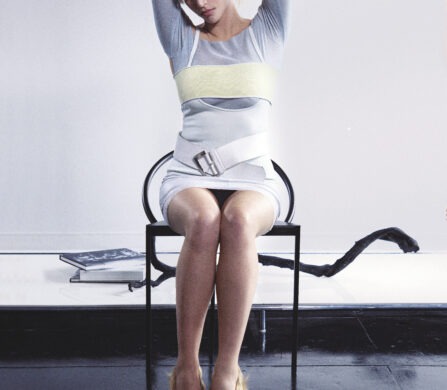
suit. Stella McCartney
shoes. Toga Pulla
opposite
jacket + dress. Valentino
What if we could touch the stars and push the boundaries of space exploration for the sake of humanity? It’s a concept that human beings have been toying with for decades, and Apple TV’s ‘Star City’, a spin-off of ‘For All Mankind’, explores the inner workings and politics that go into sending someone to the moon. A bold historical fiction that doesn’t pull its punches, the series takes place in soviet Russia at the height of its power, being the first to have a cosmonaut walk on the moon. Enter Alice Englert’s Anastasia Belikova, the first woman to make history and walk on the lunar surface. Now back on Earth, she has to contend with being a victim of her own success, living in the shadow of the state, and finding that space may have been less complicated.
There is a melancholy to Anastasia when audiences meet her. And it’s Englert’s acting expertise that shines through here. We’re given a window straight into Anastasia’s mind; she longs for adventure, to explore, to play, the actor explains through the course of our conversation. But she is made to marry, be shuttled around like a prize, and is, for all intents and purposes, grounded. What comes to fruition is a reckoning of someone coming to terms with their reality. The rose-tinted glasses are off, and now she has to face whatever comes next.
Chatting with Schön!, Englert discusses why she thinks humanity is obsessed with space exploration, working on an open set, what she loves about the genres of fantasy and horror, what her thoughts on Anastasia’s inner monologue are, and more.
I love the idea of alternate histories, ‘V for Vendetta’ and ‘Inglorious Bastards’ delve deep and ask the question, ‘what if?’ What was it about the story of ‘Star City’ that fascinated you? What were your thoughts on Anastasia being the first woman to walk on the moon?
Oh my gosh, I actually found a diary entry the other day from just after I had my first callback for the role, and in it, I’m writing about Anastasia, “I like her,” and then at the end, I don’t want to say I love her in case I don’t get it. I’m writing about it like it’s some high school crush. For me, I’ve always had a crush on space. I don’t love it in a fabulously detailed factual sense; it just makes my tummy flip with excitement. This idea that you’re floating.
When I spoke to Garrett Reisman, who is this astronaut who has been an advisor to Matt (Wolpert) and Ben (Nedivi) for many years, we were talking once I had the role about how, at the end of the day, it’s so compelling to be up there. There’s something really just magical and joyful and genuinely out of this world about the whole thing because I was really interested in the way that an experience like that can almost be an enlightenment experience. An awakening. And how much it can be a jolt to come back down to Earth.
When you see the world differently, and you think, “I thought I had some power, I thought I had control over my life,” and I think for me this comes down to that kind of magic I’m really interested in, in all genres. I’m drawn to the epic as well as the existential.
You do such a wonderful job of making us feel Anastasia’s melancholy at being back on Earth. She’s a victim of her own success. You can feel her struggle. Can you walk us through what it takes to get into that mindset as an actor and what you would say Anastasia’s inner monologue is?
First of all, thank you; that means a lot. It’s kind of funny and meta, but I’ve always found doing press a little bit terrifying. I just had so much compassion for her feeling eclipsed by her own expectation of who she has to be — even in my own dime-sized version of that. I think everyone who has to exist in an industry where, for whatever reason, you have to appear aspirational, something is gnawing inside of you.
The real person has to break, and the other one has to somehow keep it together, and I just thought that was really fascinating and beautiful. I feel like whether you’re in an industry where you have to be somewhat public-facing, or you’re in normal life, having to step outside, trying to put something on the hell zone that is the internet. I remember when you’re a kid, you go to school and all that, and it’s like, “Oh don’t worry no one’s saying anything as bad as you’re saying to yourself,” and then the internet came along.
I do think it’s so interesting the way it’s such a reflection of our consciousness. If we keep thinking, eventually we’ll arrive at some kind of trap door or solution or resolution, but we’re very well matched to just exacerbate our anxiety further and further and further. I don’t even know if I articulated that properly, but let that be an example of how silly the mind can be.
I read that if you weren’t a director or an actor, you’d be writing a fantasy novel. What would your fantasy world look like?
I can’t tell you because I actually am writing it. I just so appreciated the genre growing up, and I think that’s also what drew me to ‘Star City.’ What I like about fantasy is that it allows you to see the narrative of us in the world from a different perspective. It can show us places where we could have compassion or empathy, and explore curiosity and bias that we may have picked up along the way. I’ve always liked fantasy for that. Fantasy and the supernatural genre and sci-fi have always informed science.
Einstein had an imagination and was thinking about riding around on a rocket or whatever. Don’t quote me on that. [laughs] I remember the story, but it always takes imagination for the next leap forward. I was reading this great book by Carlos Rovelli, who’s a wonderful Italian writer who writes about quantum theory in a way that someone like me can comprehend. He talks about how every time we’ve moved forward it took letting go of one thing that we truly believed to be the backbone of science. You can’t take everything with you. That also takes this huge openness to imagination. I love that those things inform and hold hands with each other.
What is the kind of fantasy story that helped inform you as you were growing up?
‘Narnia’. I just used to listen to it on the tapes, and it also kind of terrified me. I like ‘The Hobbit’ and the whole ‘Lord of the Rings’ trilogy. I have a somewhat Hobbit haircut at the moment. [laughs] I do gravitate towards ‘The Hobbit’ a lot. I have to say ‘Kindred’ really blew my socks off. I only read that more recently. Octavia E. Butler is just such an incredible force in the fantasy world. She does exactly the thing that I love, which is transporting you to places that you otherwise thought you were familiar.
There’s also this Australian writer called Ian Irvine. He’s a marine biologist, and I remember finding one of his books and it was full of the most incredible landscape descriptions that I’ve ever read. I love ‘Frankenstein’ and ‘Dracula’. I love that women and femmes have contributed so much.
I also really like supernatural horror. I really like Mariana Enriquez as well. ‘A Sunny Place for Shady People,’ you might enjoy. A lot of inspiration came from me and my best friend. We would play the most elaborate fantasy games for years when we were kids. With huge respect to the genre, I was obsessed with other worlds. We would play in New Zealand, and that place is Middle-earth. It was hours of being wolves or some kind of creature. We were just so embarrassing because we played these games for way too long. We were busting into adolescence.
We’ve discussed ‘Star City’ being an alternate history, an alternate universe. Is there a part of history you would want to explore and play in and kind of your own twist to?
Another good question. I’m interested in when the continents hadn’t broken up yet.
Pangaea!
Exactly. I think that’s my truth. I’m interested in the ice age. I’m curious about when we started wearing shoes. When did that evolve? I’m curious about love in the very early days. What did that look like? I want to see hunter-gatherers. It’s just so fascinating. I did read this book once called ‘The Kingdom’, which was a fictionalized exploration of when Christianity was more extreme early days. It was a hippie alternative. I just thought it was interesting to imagine something that controls our calendar year as an alternative lifestyle. I always hesitate to be too casual about things that are super important to people. I’m a curious type, and I like figuring out how these things form. I thought that book did a great job of looking at that particular time and exploring how this writer, in his real life, found deep faith and then also lost deep faith.

top + skirt. Miu Miu
opposite
shirt. Souvenir Stand
There’s a moment where you can already tell that her faith in the States is shaken now that she’s back on Earth. There’s a moment when she’s in that club and in the bathroom, and she’s given an out by that agent. I don’t know if this was purposeful on your part, but for a split second, you can see she’s considering it before shaking it off and reaffirming her fealty. What’s going through her head? Do you think she knows she’s being set up?
I wanted her to be someone who was surprising herself. I really wanted to play her as an adult who was now experiencing her first real adolescence — someone who has realized they actually don’t know who they really are, but there is something inside of them that is beginning to wake up. She also loses all her autonomy at the very moment she has the most power. I think that she has to have secrets even from herself.
What I thought was really different about the way that she is intelligent is that it is a very intuitive emotional intelligence. It’s the kind of thing that you develop from growing up around a parent or a system that could and will blame you for anything at any time — where you have to be more than yourself, or you have to be what they need you to be. I think that requires abdicating your autonomy and a feeling of privacy, which is a theme in general. I felt that she had to move with the secrecy of a teenager through this situation. That’s the roguishness that can lead you into danger. You can’t trust that your adventurousness is not supported. It’s a strange situation to be in as someone who is ‘growing up’ in the series.
You’re not a stranger to film sets; you directed your own feature that premiered at Sundance (Film Festival), and you have family in the business. What’s something that you learned on ‘Star City’ that you haven’t learned on another film set?
I was impressed by how Matt and Ben were so approachable. It’s something I’ve experienced before, but they really wanted to know how we were doing and how we were feeling. They wanted to know if anyone was being a dickhead [laughter] because that actually matters. That wasn’t a one-time thing, you know? They were sensitive about it and made sure to check in. We were very lucky to have zero dickheads, but they really create an environment where they want you to feel flourishing and safe, where you don’t feel frightened to speak up, which is sort of the opposite of the material we were working with.
It was a really refreshing boundary between what you’re seeing on screen and the environment that you’re making that work in. There was just this genuine belief that you shouldn’t have to suffer to have empathy and compassion to do your work. It will be hard; there will be days when I have the flu, but I’ll also be skydiving, and it’s snowing, it has its charms, but there are times when it’s also intense. It just felt like it was hard in the right ways. You could know in your body why you felt sore or tired. That was just a beautiful thing to see. It was just nice to see some humanity. And to work with such nice people.
Of course! You want your film sets to be open and collaborative. You don’t want it to be a toxic work environment, because you don’t do your best work under that type of scrutiny or pressure.
It’s a total fiction perpetuated by assholes to justify that they don’t know how to express their pain another way. I have compassion for that, but it’s not enough to put up with it. I’ve found that whenever I’ve been able to direct, people are so smart and they have such good ideas. You just have to get out of your own way a lot of the time and be there together. I guess that’s another thing I like about the show: the relationships between people and the exhaustion and the compromise and the human cost of trying to always be first. It doesn’t take you nearly as far as it would to be creative, and to be curious instead of competitive.
One of my favourite things that I loved early on was the relationship between Anastasia and Sasha. The first time you really see Anastasia smile is when they’re at the club together. How would you say their relationship develops over the course of the season?
I feel so silly. I feel like I didn’t see how their relationship developed coming. I think that’s all I should say. [laughs] I loved working with Solly (McLeod), he’s so great. We’re both very silly, but also very serious as well. We want to have some space to enjoy the process, and we really trusted each other. We took our characters seriously. We just wanted to do what we thought they would really do, and that was so encouraging. It was surprising and obvious, in many ways. I loved it. They realize they have a real understanding of the other. They’re both outsiders, and they realize that they’re outside… together. It doesn’t feel so bad.
What I loved is that they’re something so special about going beyond the ick. The ick they have for each other, they ick they have for their lives. They have such deep ick. I feel like neither of them appeals to the other. Neither of them is a prize. For me, it’s interesting to see how people behave when they actually start understanding each other instead of feeling like, “Oh, this person will elevate me in some ways.” The business part of that is so very cut and dry for them. I like the way human nature grows like weeds on cement, and it bumps the pavement up. They’re supposed to be in this arrangement, but what are you going to do when you put two absolute weirdos together?
They’re going to do more weird things. Another moment that I’d love to touch on is her leaving him waiting at the altar. I know it’s not a funny moment, but I couldn’t help but laugh.
I love that. I’m so happy to hear that. I find it quite funny to think that he’s like, “She’s not my type anyway.” It feels like it’s got that gallows humour. It’s both tragic and funny. I think the show does have that in it, which I really like.
What is it about space exploration that you think keeps coming back for more?
I always think it’s about mortality, to me. It’s about identity. I find it quite striking that we know more about the stars than apparently we do about the bottom of the ocean. Which feels weird and compelling. I think that there’s something about the way we move and try to understand and comprehend what’s outside of our space. I think it appeals to me because it’s such a literal interpretation of our human beings’ endless search for ‘who am I?’ And ‘where are we going?’ And there’s something, I guess, about the final frontier. There’s something about adventure. But we’re pretty scared about dying, and there’s something about going into that night where being with it must be compelling.
And lastly, if you could sit down and have a conversation with Anastasia, what advice would you give her? If any?
Oh gosh, you know, I think I’m learning from her. Which I know is a funny thing to say as the actor. But I suppose I’m in a collaboration with the others and the story. I felt like I had slightly forgotten – and this is so cheesy to say, but still so true – that being brave also means being terrified. And that you don’t have to stop feeling terrified. It’s not something you vanquish. It’s something you live with. Nick Murphy had said in the audition, “Can you play this one as if you know you will fail?” And I was like, “That feels too familiar.” [laughs] But I think we forget the sensation of cowardice, that we feel like running, that you can’t do this, that you feel like you know you can’t do this, and having to do the hard thing anyway. I think that’s what I learned.

top + skirt. A.W.A.K.E. MODE
opposite
bodysuit. Valentino
photography. Samira Eugster
fashion. Jessica Skeete-Cross
talent. Alice Englert
casting. Emma Fleming
hair. Sandra Hahnel @ Caren Agency using Only Curls
make up. Terri Capon using Rare Beauty
lighting technician. Niko Mrtj
production. Clara La Rosa
interview. Dana Reboe