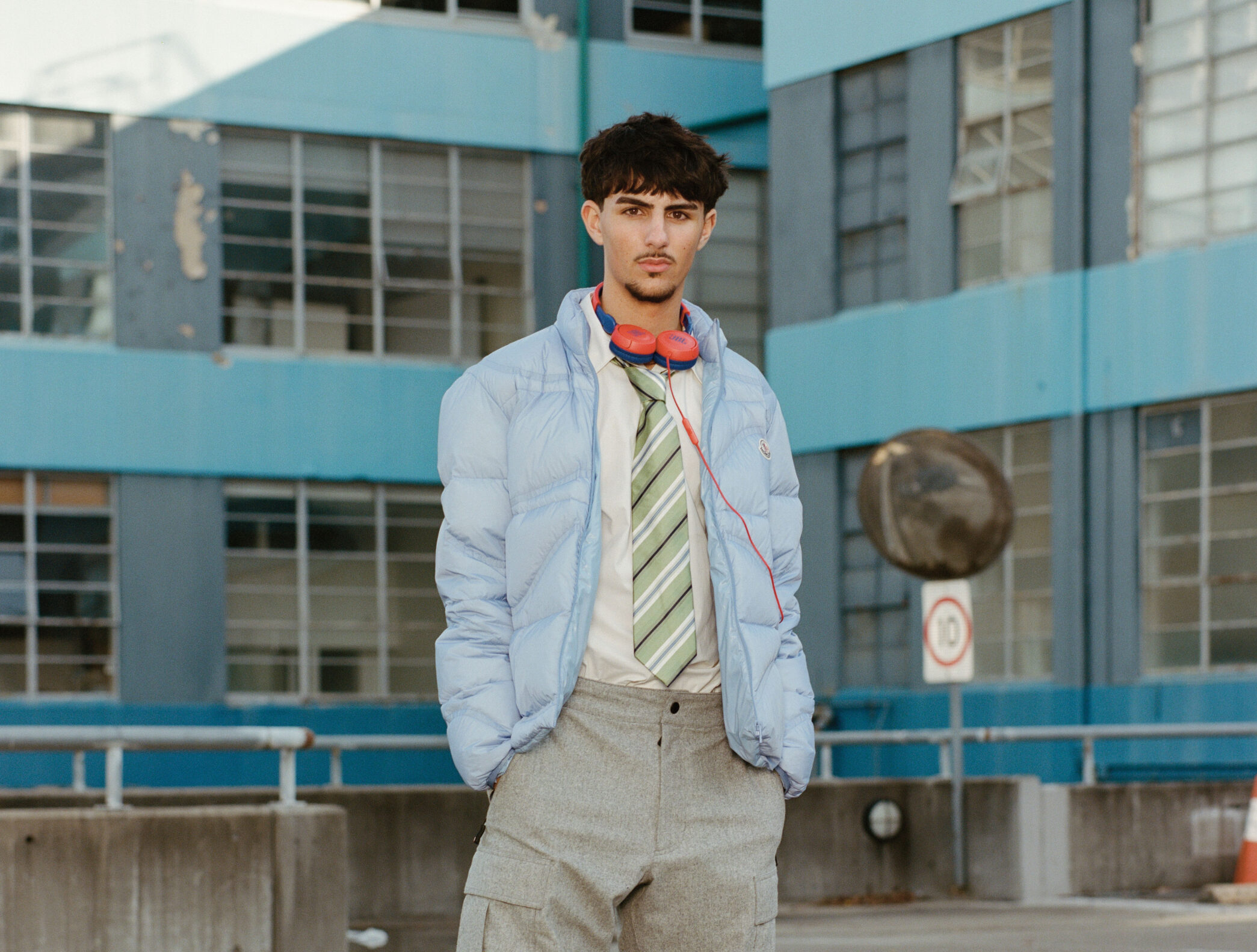
left to right
trench coat. Camilla and Marc
full look. Adolfo Dominguez
opposite
full look. Adolfo Dominguez
shoes. Massimo Dutti
In ‘Soulm8te’, David Rysdahl and Australian actress Lily Sullivan find themselves at the center of a provocative, darkly funny and unexpectedly thoughtful story about artificial intelligence, loneliness, desire and what happens when technology begins to blur the boundaries of human connection.
The two actors play characters whose relationship is anything but conventional, requiring them to navigate everything from intimacy and vulnerability to the film’s stranger, more unsettling ideas about technology and control. Off screen, however, the experience brought David and Lily together as genuine friends. Their chemistry, trust and willingness to embrace the film’s more outrageous moments became an essential part of creating the film’s unique tone.
Schön! sat down with David and Lily to talk about finding their on-screen chemistry, the complicated questions the film raises about AI, playing with femininity and desire, and the moments on set that turned two collaborators into close friends.

top to bottoms
pumps. The Attico
full look. Adolfo Dominguez
opposite
left to right
full look. Adolfo Dominguez
shoes. Massimo Dutti
trench coat. Camilla and Marc
pumps. The Attico
David and Lily, what was your first impression of each other when you met, and when did you realize you had the kind of chemistry that could carry a story this unusual?
DAVID: I first met Lily on Zoom. She was in a dark room, and I thought she was so cool and intimidating. Then I met her in real life and realized she was a weirdo just like me. I breathed a sigh of relief because this movie required collaborators who were comfortable getting a little freaky. Lily was down to play, and I knew we could trust each other and have a good time exploring this toxic AI-human relationship.
LILY: When I first met David I was also intimidated, but also had an instant feeling that this human being would be the perfect teammate because he is smart, introspective and doesn’t take himself too seriously, which is the recipe that you need on set to create this intense suspension of disbelief that is really fueled by your imagination more than any other job. It really matters who your partner is, because showing up each day as a robot and having to maintain that belief system, you really, really need someone who can meet your freak.
The relationship at the center of ‘Soulm8te’ is complicated by technology in some pretty provocative ways. What did each of you find most surprising about where the story ultimately takes these characters?
LILY: What surprised me was how much the role made me reflect on my own relationship with performance and femininity. Playing Sara raised a question I couldn’t shake: how much of femininity is instinct, and how much of it is choreography? How much of what we consider natural is actually learned, rewarded and repeated?
DAVID: I was surprised by how easy David’s relationship felt with AI Sara. Yes, the character I play in ‘Soulm8te’ is also named “David,” which was very confusing on set — the crew thought I was a method actor! Relationships with human beings require struggle, difficult conversations, vulnerability. AI relationships don’t require any of these things—they are frictionless and promise a shortcut to connection without any of the work. For someone as lonely and closed off as my character, David, this kind of easy, baked intimacy is addicting.
There’s a fascinating tension in the film between what we want technology to give us and what it can never truly replace. Did making the film change or complicate the way either of you think about AI in your own lives?
DAVID: The film made me think about my own addictive relationship to the internet and to my phone. I’ve already given so much of my brain to my phone — I’ve given it my memory, my free time, some of my critical thinking skills. I go to my phone when I’m bored, lonely, anxious. I’m aware of how addictive this technology is, but I still use it. AI is the next step in this evolution, and I know that if I’m not careful, I will become more and more dependent on it. I’ll start losing parts of my humanity to the cloud.
LILY: I think it definitely complicated it. Playing AI but also playing a female doll who is literally a product made me realize how much we’re all becoming products ourselves. We’re all weirdly our own brands now. We look at ourselves constantly, edit ourselves constantly, with access to this endless stream of instant gratification and reassurance that I don’t think our brains were designed for.
It made me look differently at my relationship with my phone, because AI feels like the next extension of something we’re already deeply addicted to. We’re giving these systems our thoughts, desires and insecurities, and then asking them to filter reality back to us. Playing Sara made me think about what we’re actually feeding these systems — all our existing prejudices, our ideas of perfect womanhood, beauty, femininity and desire. Of course, they’re going to regurgitate that toxic shit back to us. It made me much more conscious of what I’m giving away to technology, and what parts of being human I don’t want to outsource.
David, your character is dealing with grief and loneliness, while Lily’s character exists in this very different space between technology and human connection. How did you approach creating something that feels emotionally authentic despite such an unconventional premise?
DAVID: My character wants escape from his grief and loneliness. At first, it surprises him that this escape comes in the form of AI. He’s ashamed of how good this relationship feels, especially once it becomes more… intimate. I tried to play David without judgment because 1. it’s not my job as the actor to judge him — I knew the audience would judge him for me — and 2. I felt empathy for where he is in life. We are living in one of the loneliest ages. The world is full of people like David, easy prey for tech giants that hijack emotional intimacy for profit.
Lily, what was it like playing a character whose identity and sense of self are so closely tied to the expectations of another person? Did you find yourself thinking differently about intimacy or autonomy while making the film?
LILY: Yes, Sara is completely subservient to David. She mirrors his emotions; she takes her sense of worth from him… I thought I was playing this extreme idea… a robot designed entirely around somebody else’s desires, but it actually felt frighteningly applicable to very human relationships. The metaphor definitely got under my skin. She doesn’t even have an orgasm function! Her sexuality, her body, her emotional responses… they’re all constructed around his pleasure, and something is disturbing about how recognizable that performance can feel.

full look. Adolfo Dominguez
shoes. Massimo Dutti
opposite
trench coat. Camilla and Marc
David and Lily, the movie can be sexy, funny, unsettling and surprisingly thoughtful within the same scene. How did the two of you establish the tone together without losing the emotional core of the story?
DAVID: We thought of the relationship as a traditional straight man/funny man dynamic where David is the straight man, and Lily, of course, is the wacky doll trying to be the right partner for him. We knew the relationship itself was absurd, so if we just played it straight, the audience would find the humour and hopefully the pathos. And since we were making an erotic thriller, I’m glad you found it a little sexy too!
LILY: I think the more seriously we committed to the absurdity, the funnier and stranger it became. I wanted Sara to feel jarringly artificial, not this seamless fembot who could almost pass as human. So the more I could commit to the bit, the facial aerobics, the strange physicality, the more David had something very real to respond to. We really stayed in our lanes. I think that’s where the comedy, the sexiness and the unease could all exist at once without us having to manufacture any of them.
It really was such a joy to build Sara from the ground up. The challenge was finding the balance. I wanted the audience to feel the silicon, to almost cringe watching David fall in love with a metal-and-silicon woman. I didn’t want her to be unrealistically seamless; I wanted the mechanics to show.
You’ve both done very different kinds of genre work. Was there a particular scene or sequence on ‘Soulm8te’ that pushed you outside your comfort zone — or that you knew was going to be especially memorable?
LILY: The opening of the box. I knew from reading it that it was going to be confronting — the idea of getting into a box naked and being unpackaged as a gift, as a product for a man. Even just as an image, it felt incredibly bold. Finding a way to make that sexuality feel seductive, but also cold and mechanical, was definitely outside my comfort zone. And on the other end of the spectrum, crushing a man’s genitals.
DAVID: ‘Soulm8te’ has some intimate scenes. When I read a script with a sex scene, I always ask myself: does this scene add to the story? Does this movie need this scene? I felt ‘Soulm8te’ did because this story deals with our relationships with AI, whether that be chatbots, social media feeds or porn algorithms. Shooting these scenes felt silly, cheap, shameful, vulnerable and a little sexy — they felt how David felt. Scenes like these demand trust, and our director Kate Dolan created an atmosphere where we felt safe to go to these wild places.
Your friendship developed while making the film. Was there a moment during production when you thought, “Okay, we’re actually going to be friends after this”?
LILY: Probably day two, which is alarmingly early. We were shooting the opening of the box; I was naked, sweating under these enormous retro lights and definitely feeling vulnerable. David just looked at me and offered me a high five of support — with my tits out — and I took it. We both burst out laughing. I think that was the moment I thought, okay, we’re going to be fine. There was this immediate sense that we could be completely vulnerable and completely ridiculous with each other, which pretty much became the friendship.
DAVID: About halfway through filming, we did the scene where we are in the water fountain. We shot that on a cold Friday night in December in Dublin. Sometimes you work with actors, and they’re annoyed at moments like this — they’re tired after a week of shooting, tired of being cold and wet at 3 am. I remember looking up at Lily and seeing the joy on her face. She was wearing this tiny doll dress, shaking from the freezing rain machine and still making jokes with the crew. That’s the kind of dance partner you want when doing a film like this — someone who is in this industry for the right reason: because they love it. And that’s also the kind of person you want to remain friends with!
If you could sit down with your characters and ask them one question about their relationship, what would you ask — and what do you think their answers would be?
DAVID: I’d ask my character David the same question I think humanity is asking itself right now: are we going to choose the human, or are we going to choose the artificial? I think David would choose the artificial, and that worries me.
LILY: I feel like we already ask Sara questions every day — ChatGPT, Grok, Claude. She’s already here. So I’d probably ask her: are we gonna survive ourselves? And she’d probably say, “I’m sorry, David. I can’t perform this action for you.”
At its heart, ‘Soulm8te’ raises questions about loneliness, desire, control and what it means to be human. After spending so much time inside this world, what’s the one question from the film that has stayed with each of you?
LILY: What happens when satisfying human desire becomes the system itself? ‘Soulm8te’ sits in that blurred line between connection and consumption and asks whether, eventually, the two become indistinguishable.
DAVID: For me, the biggest question for AI is what it’s going to do to our humanness. What is it going to do to my brain, my critical thinking skills, my relationship with my wife and my children? Are we going to allow it to come into our schools, into our government, into our families, into our bedrooms? I worry that we’ll choose the easier path and will fall down the slippery slope into AI dependence. It could start with AI writing your work emails, but soon it’ll write your essays, and quickly it will be writing your love letters. The real horror of ‘Soulm8te’ isn’t the killer robot; it’s the addictive hold this AI technology is capable of having over the human soul.

left to right
trench coat. Camilla and Marc
full look. Adolfo Dominguez
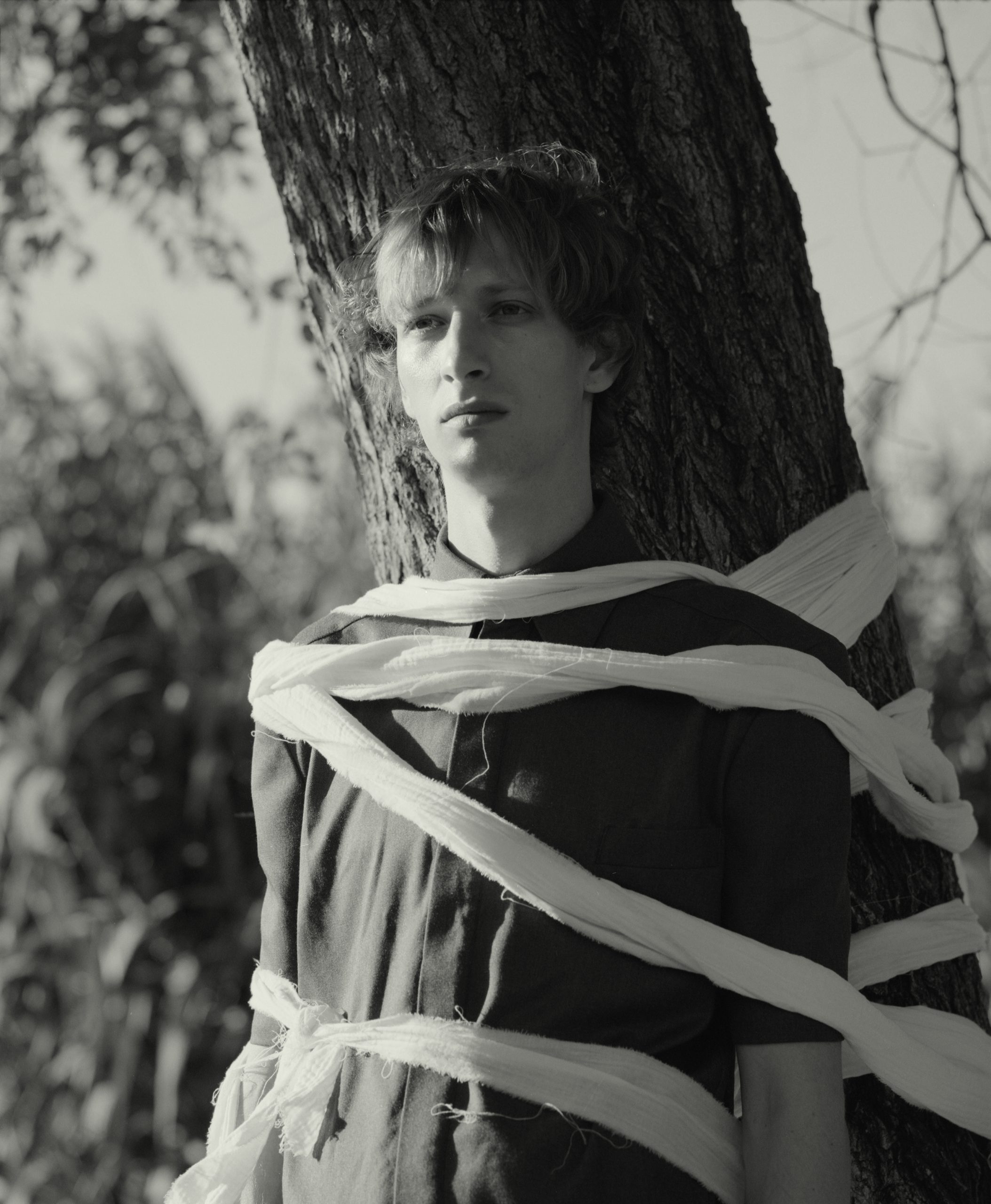
photography. Filip Kartous
fashion. Teresa Abrunhosa
talent. David Rysdahl + Lily Sullivan
grooming. Atsushi Yoshida
make up. Sara Fonseca
editor. Kelsey Barnes