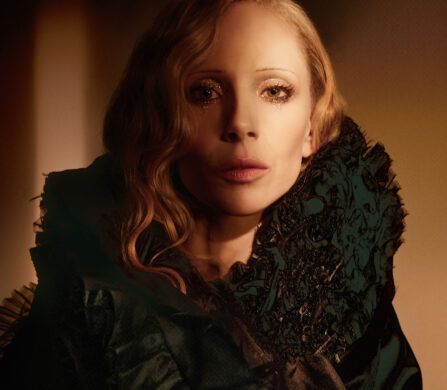
Freedom looks different depending on who’s chasing it. For Romy — the artist behind DeathbyRomy — it’s unguarded, unpolished, and entirely her own. She was writing songs at five years old. By fifteen, she’d picked a new name and started uploading to SoundCloud, an early act of self-reclamation before she had the language for it. She didn’t yet know how many times she’d have to reclaim it again. Autonomy, as she’s learned, isn’t handed to you — it’s something you build and build, over and over, if you’re stubborn enough.
That fight is everywhere in the work that’s followed: in “2468,” a snarling anthem for anyone who’s ever been told their differences were a liability; in “BODYHORROR,” whose comments section has become an unofficial support group for women who finally feel heard; in the tattoos, the armour, the alter ego itself. And now, ahead of a new chapter for her and fresh off opening arena-sized shows for Limp Bizkit after Fred Durst found her on TikTok — she is still building. Still reinvesting every dollar back into the project and choosing to do it her way.
In conversation with Schön!, she talks about the cost of independence, her creative partnerships, the references that shaped her as a storyteller, and what it actually feels like to turn your rawest material into a stage.
I’ve been listening to your full discography, and the music you’ve made and released independently over the last few years feels so authentically you compared to what you released in the past — you can hear how much freer you are. Can you tell me about the last few years, and what it’s been like taking control over everything?
I appreciate you actually delving into the music and listening to a bunch of it — it really means a lot to me. Being an independent artist was something I never knew was a novelty until I wasn’t one. I didn’t know it was something I’d ever have to fight for, or that I’d ever have to work to maintain. I just started making music as a kid — I started writing when I was 5, and I started producing my own songs and putting them out on SoundCloud and things like that when I was 15.
I never thought that control and autonomy were things that could be lost, and when they were, it was pretty earth-shattering — also something I didn’t know how to fight for while it was happening. Since gaining my autonomy and control over my project back, I’ve been reminded of the true joy it is to create — to create different little aesthetic and sonic worlds for each song, for each album, for each thing I’m going through in my life that I’m processing through music and the songs I’m writing. I just feel so lucky.
I watched your interview with MJ Gray, and you talked about how this artist project started over ten years ago and has grown alongside you as you’ve grown up. You’ve also described it as an alter ego — did you feel like you needed that kind of armour, having some distance from just going by your first and last name?
I didn’t think about it in such a deep, calculated way when I first picked the name DeathbyRomy — I picked it when I was 15 or 16. It was kind of a reclamation of beauty and strength for me. I experienced some really low times in my life where I took my life for granted, and DeathbyRomy was meant to mean death by something beautiful. It was me trying to own a confidence I didn’t yet believe in but really wanted to — it felt like a spell, in a sense, maybe not in the technical meaning of the word.
I wouldn’t say I created the alter ego knowingly, but clothes and my means of self-expression — the way I present myself to the world — have always been a form of armour in one way or another. Be it my tattoos, which I started getting more and more of because I liked how hard they made me feel, being such a soft, emotionally vulnerable person. I wanted to create that kind of armour just to face the world — even the artist project aside.
I know you work with stylist Elena Lark, whose work I love — fashion is very much a tool of self-expression, and your style is incredible. Can you tell me about your creative partnership with her, including for the “2468” music video, where she sourced the military costumes and made all the jersey sweatshirts for the cheerleaders?
In my whole career, I’ve never worked this closely with a stylist before. I self-styled pretty much everything until the “BDSM” video, which was my first project with Elena. There were a couple of one-off experiences before that — I worked with a lovely duo of husbands named Jack and Judson on the music videos for my last album, Hollywood Forever, and I enjoyed working with them, but ultimately felt like styling was still something I wanted to control myself. I know it best, and it’s easier to avoid hurting people’s feelings when you’re doing it yourself. I’ve always been kind of a do-it-all-yourself person, for better or worse.
I met Elena because she’s dating my guitarist and best friend, Jayden Hammer. I got to know Elena and her personality very well before we even talked about working together. She’s such a sweet, humble, gracious, honest, lovely individual — she has such a soft and kind energy, and I knew I’d feel very safe creating with her. I knew no one’s toes would feel stepped on, and it wouldn’t be hard to object to ideas that didn’t feel like me — something I’ve found can be difficult when working with stylists in general: wanting to give them room to do their thing while not wanting to compromise your vision. Elena and I have so much in common.
After “BDSM” went so well, it was clear we pull from a lot of the same references and share the same passion for clothes and creating a world. She’s quickly become one of my closest friends, through working with her and through her dating my best friend. She’s as hard a worker as I am, and I saw that immediately and knew we’d work well together. We spent countless hours going through one collector’s collection of military uniforms, making sure we were above board and not wearing anything frisky or problematic. She really wanted the uniforms to be real, and she took the time to hand-stitch the little patches with the R’s onto all of them.
We sourced and pieced the cheerleader look together — we’d been generously offered blanks for free from LA Apparel. Some of my favourite references were ’70s and ’50s cheerleaders — the earliest uniforms, the ones we see less interpreted today. That classic feeling invokes more dreaminess to me because it’s from a different time. She and I created that logo together, based on the Team Death logo with the upside-down star and the DVR in the center, and she hand-stitched all of them herself.
When you think back to your childhood, was there a specific book, film, or album that inspired you to pursue becoming a storyteller?
So many — from the world of Studio Ghibli, created by Hayao Miyazaki, and the very fantastical worlds he’s created in all his films, to Mark Ryden, the painter, to Björk, and seeing her collection of music videos early as a kid, to Lady Gaga, seeing the “Bad Romance” music video and knowing she was wearing Alexander McQueen because my parents had gotten me an Alexander McQueen book when I was young. The list goes on.
I was reading comments on the “BODYHORROR” video, and one that really resonated with me said this is the sentiment every woman has been screaming for centuries. What does it mean to you that people — particularly women — are resonating with your music that way?
It’s exactly why I’m doing what I’m doing. It’s scary to put yourself out there, to be loud about problems that maybe, when we were kids and teenagers, we weren’t ready to voice yet. It’s why victims and survivors don’t always come forward with their stories, and it’s not always safe to. That’s something I think is constantly overlooked, probably by the other gender only.
I did this for reasons that were cathartic and therapeutic for myself, and I knew that in doing that, it would be felt and resonated with by other people too. I’ve had some scary run-ins with people who don’t appreciate the things I have to speak up about, but I will never stop, and I care to be a voice that helps someone who maybe didn’t have the words for an emotion or experience they’ve gone through.
“2468” is a call to arms and an anthem for misfits — I think everyone has had moments where their differences felt like a liability rather than a strength. What was the writing and recording process like, and did it feel like you were reclaiming those differences?
Definitely — it felt like a complete reclamation of myself and the little girl who dropped out of school because she was tired of being bullied, and tired of being made to believe she was wrong for being herself, or that the things that made her feel comfortable and good were strange or undeserving of admiration, understanding, or love. It took a lot of years and further self-discovery, and finding my tribe, to realize our differences are what make us beautiful — that our individuality is something to be celebrated and cherished.
Writing this was very cathartic. I wrote pretty much the entire song on my own in my first session with a producer named Chris Lyon, who I’d never worked with before, and the song was pretty much done. I felt like it was lacking some elements to make it catchier, though, so I called in my friend Brasco to help push it further and help the story land — and he did right away. I write the majority of my songs alone, but I’m also very welcoming to collaborators, and I believe there’s power in numbers in all regards in life. He helped bring a digestibility to the song I think I was struggling to obtain myself, and made it all the stronger.
A unique thing with this song — one I haven’t run into too many times — is that the original production didn’t resonate with me for a long time. I felt like I had an incredible song that just wasn’t done justice yet, so I put it through many rounds of production and reproduction, and eventually brought it to another producer to work on. It finally got brought to life the way I wanted. We added the bridge super last minute — just a couple of months before it came out. It was a unique process, but it was worth it. The song deserved the moment we gave it.
At what point do you feel like a song is done?
You’ve got to just let it be. I have a lot of friends who are crazy perfectionists, and I’d consider myself a perfectionist to some extent, but when it comes to communicating something, it’s never going to be perfect. We’re never going to do it in a perfect way — even if we think it’s perfect and it gets misinterpreted by someone else, there’s always room for that. It’s going to happen, and I think I’ve learned to be more malleable, to allow my songs to shape and move me — I hope that doesn’t sound too out there. It took a while to develop my sound, and it took a lot of trial and error. I feel like I’ve established a sound that is Death by Romy, one that’s more malleable than I or anyone ever told me it could be. I feel like I’m in a really free place with my creation and sound exploration, and I think that’s coming through in the music. I’m happy to hear that.
You creative-directed the “2468” video as well — can you tell me about the storyboarding process and where the vision came from?
I make all my storyboards — I conceptualize and direct all of my videos, though I’m happy to share that title with the DOP. At their inception, all of the concepts are me — I make the storyboards in Keynote, on my phone, because I’m not a computer girl. This was the very first rough draft of the video that I presented to my whole team and directors. There’s some influence from the movie ‘Across the Universe’ — the Beatles movie, where Prudence’s character is seemingly singing “I Want to Hold Your Hand” to a football player, and then the camera pans and it’s revealed she’s actually singing it to a fellow cheerleader. I loved the way that was revealed in that movie, how nostalgic those shots felt — that’s part of why we used the old cheerleader uniforms.
It was also inspired by Glee and Santana. There’s a reference some fans have pointed out. That ended up being a later-down-the-line reference that my director and I decided would be cool to use for some of the shots. For the original story, my manager Allie helped me pace the storyline better than I had — she went really hard and mapped out, at this point in the song, during this lyric, we should start alluding to the girls, the feud between them, and their dynamic. That’s how all my videos start — a little mood board on my phone.
Your music is so cinematic — are visuals something you’re thinking about while you’re writing and recording?
You know what, I am and I’m not. I’m definitely a very imaginative person, a daydreamer through and through, and I do get visuals while I’m writing my songs — because I’m looking back on a memory I’m writing about, or recontextualizing that memory, and it gives me ideas. I don’t generally conceptualize the actual music video until I’ve lived with a song, run it into the ground in my own head, listened to it a million times over — and then I feel like the song tells me the story it wants to.
The lyrics in “Manic Dream” — “I wanna dance with the bliss of being seventeen / I wanna burn all my money and forget everything / I’d rather die at the top than ever make it there” — really resonated with me. What do they mean to you?
When I was 17, it felt like a very transitional age for me. I had just quit my job — the ice cream shop, which was actually the last real job I ever had, which I’m so fortunate to say. I was able to quit because I signed my first publishing deal, for $50,000 — more money than I’d ever seen in my life, and enough to live off of. There was no other option, no Plan B — there never has been. I wasn’t good in school. I knew I wanted to make music since I was five years old. I quit my job and felt like I had the whole world ahead of me — I felt so assured in that, but I also had no idea what was ahead: the ups and downs I’d face in my career, falling in and out of relationships in my work life and personal life, how hard it would be to maintain not needing to go back to a normal job.
This has not been easy. I’m still nowhere near where I want to be financially, but I’ve made it work — I’ve survived off music since that day. I’ve overdrafted my card a million times between then and now, but it’s fine — I’m making it work, and I have something to show for it. There was this sense of invincibility, even though I was already jaded — obviously, calling myself Death by Romy, having dropped out of high school — but there was still this unknowing bliss that the age of 17 encapsulated for me. I miss that at times — not having the weight of the world and the responsibility of survival, wanting to provide a big life for myself and for my sisters and my mother.
I really wouldn’t have it any other way, though. There are hard moments where I think, “This is really hard.” I have to keep fighting and pushing — there’s a million things I have to do this week, this month. I haven’t had a vacation since I was 18. I’ve told a lot of my friends that this year, and they’re like, “Oh God, girl, take a vacation.” That’s what “I’d rather die at the top than ever make it there” means, though — I’ve put everything I have into this. Every dollar I’ve made on this project has been directly reinvested into it. I’ve fought really hard for what I have, and I’m not going to stop. Even on the days I wish I could go back to fewer responsibilities, I’m ultimately just so grateful for my life and the ability to be doing what I’m doing — and to have a good fight to be fighting, and friends to fight it with me.
Limp Bizkit’s Fred Durst found you on TikTok, right? Can you tell me about how that came about and what touring with him was like? I also worked for Alt Press, so I saw the tour diary you did for us.
Fred saw a video of me playing live that was going kind of viral on TikTok — I think it was “Crash” — and messaged me saying, “You’re sick.” I was like, “Oh my god, Fred Durst is calling me a sick performer, that’s crazy.” There wasn’t much conversation then, but a few months later my agent told me they wanted me to come open for some shows in Europe, and I was thrilled. Each show was for between 18,000 and 21,000 people — the largest crowd I’ve ever opened for and played to.
It was really cool to share the stage with him, to feel the energy of this moment we’re living in right now around his song “Break Stuff” especially, and to sing that with him and see and feel that from his crowd. It was really cool and inspiring, and a good reminder that music is still really alive — as much as some of us want to believe it’s dying, or that people don’t want to go to live shows anymore, or that the internet has oversaturated the market. It’s very alive and well, still. That was a really good reminder of that, more than anything.
Lastly, if you could manifest something for yourself this year, what would it be?
Maybe an incredible vacation, and more success than I’ve ever seen around any body of work — around the album I’m going to be putting out later this year. It’s not done yet — I’m literally going to a session after this, and tomorrow too. It’s overdue, and I’ve decided it’s going to have to be a deluxe version, because there aren’t enough songs to put on the first version that will be done by the time I need to turn it in. But the date is set, and it’s coming out one way or another.
words. Kelsey Barnes