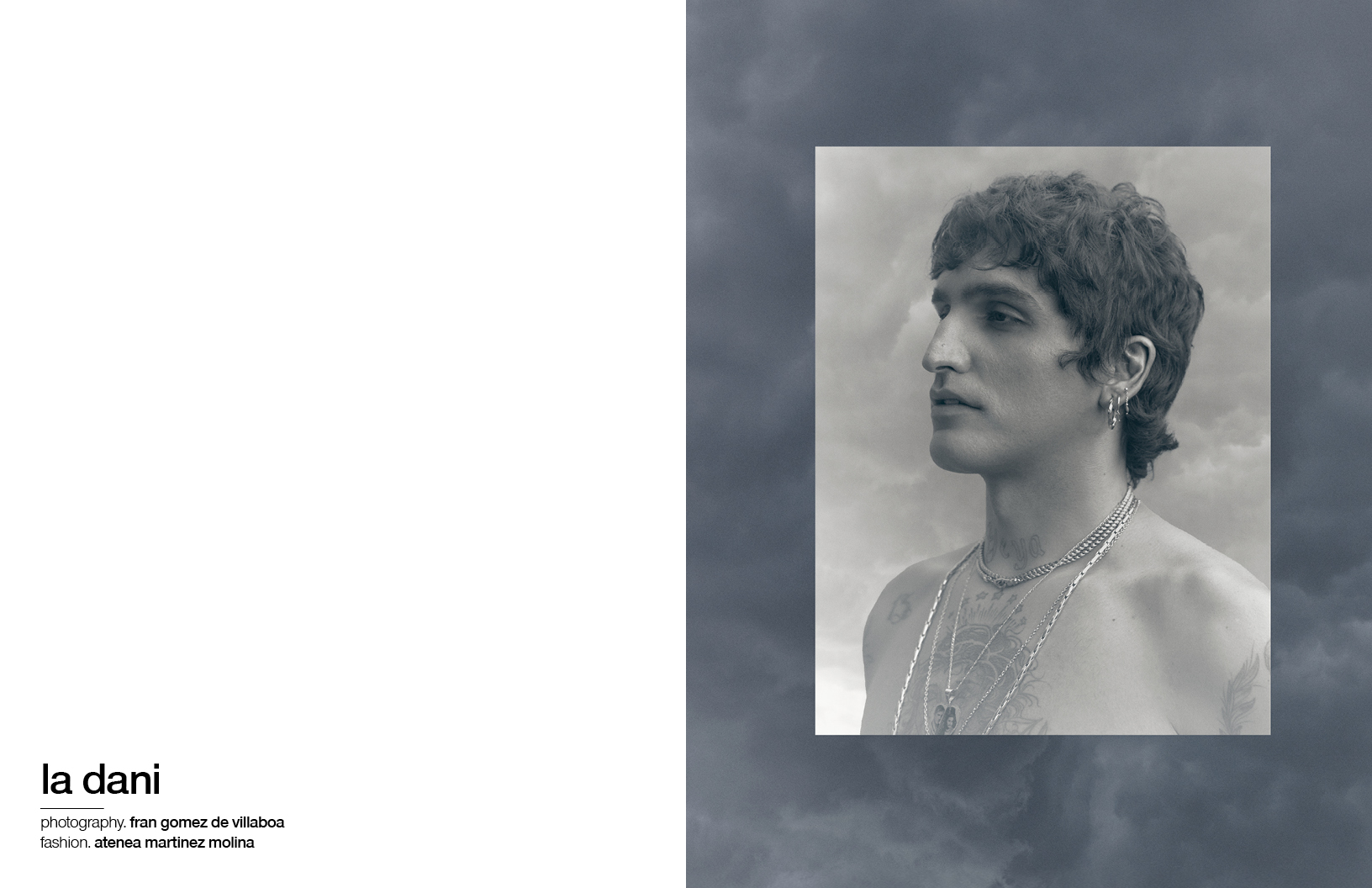
Strength, humility, and courage. Those are the adjectives with which one could define an artist like La Dani. Coming from beautiful Malaga, La Dani has become one of the coolest and most talented figures of the moment since she arrived in Madrid a few years ago. Achieving such distinction it in a city like the Spanish capital is complicated, where art is precarious and opportunities are scarce. But nothing — nor nobody — is stopping La Dani, and through hard work and effort she has built a musical career made up of a multitude of singles and three albums, the most recent being XAOMI, released in 2023.
But now, La Dani has decided to show us another of her facets and has been discovered as an actress co-starring in the film Love & Revolution, a tribute to the LGTBIQ+ collective that has received applause from critics and the public and even a nomination for Best New Actor at the Goya 2024. The reign of Dani has only just begun.
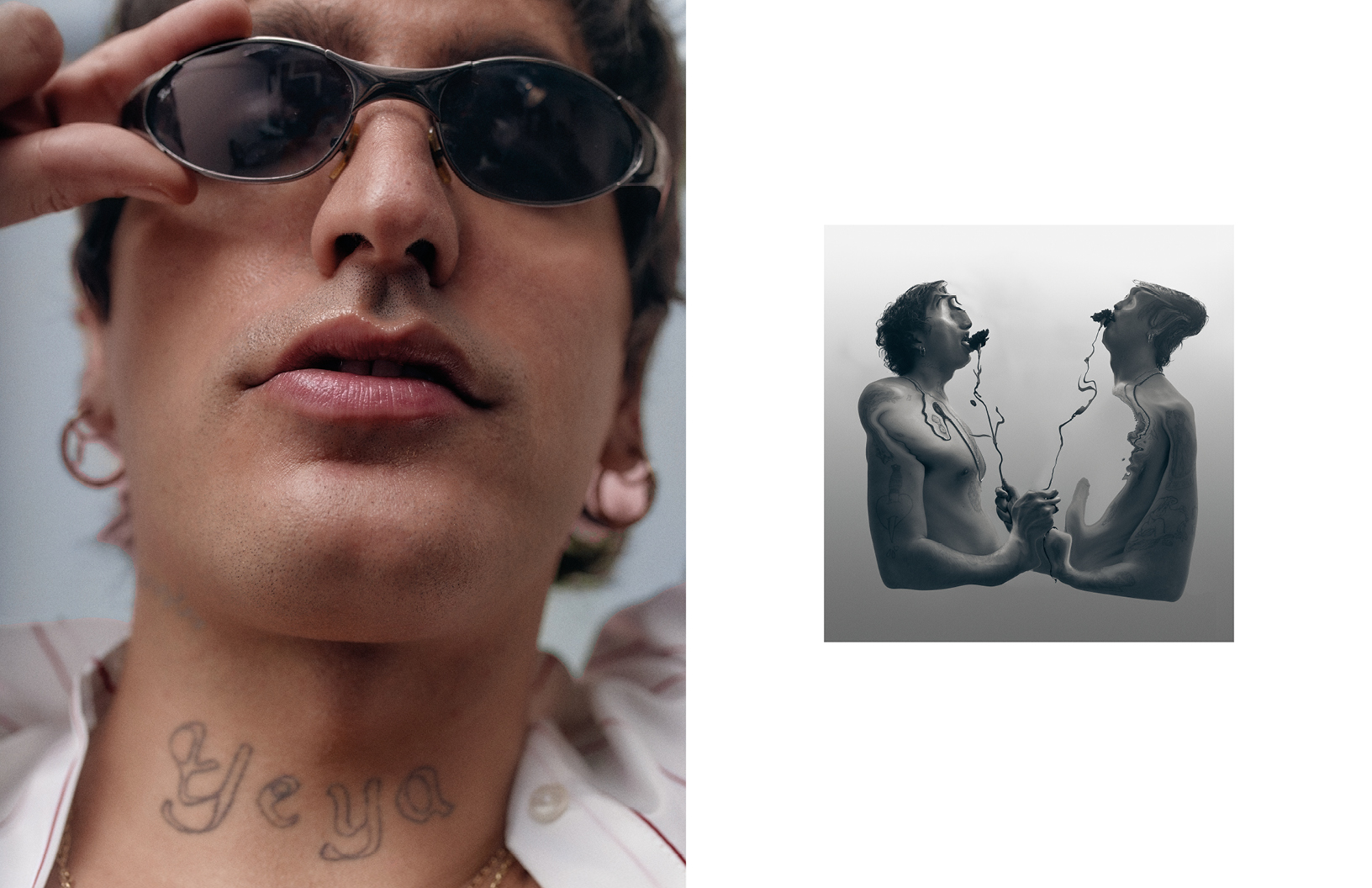
Congratulations on your nomination for Best New Actor at the Goya 2024! Tell me about the moment you found out about your candidacy.
Thanks a lot. It was a little crazy, I didn’t even count on it, I was in class, and suddenly Omar, the protagonist of the movie, called me, I couldn’t believe it. I left school, my friends and family called me and it took me a while to react and understand the magnitude. It is a gift and an honor
It has been a very important year for you professionally since Love & Revolution has been a success among the public and critics. How have you experienced the reception of this project?
It’s incredible, when the movie was in theaters we were lucky enough to tour cities in Spain to do some talks with the audience and there wasn’t a day that didn’t move me, I’ve never seen anything like it, people give another meaning to the movie.
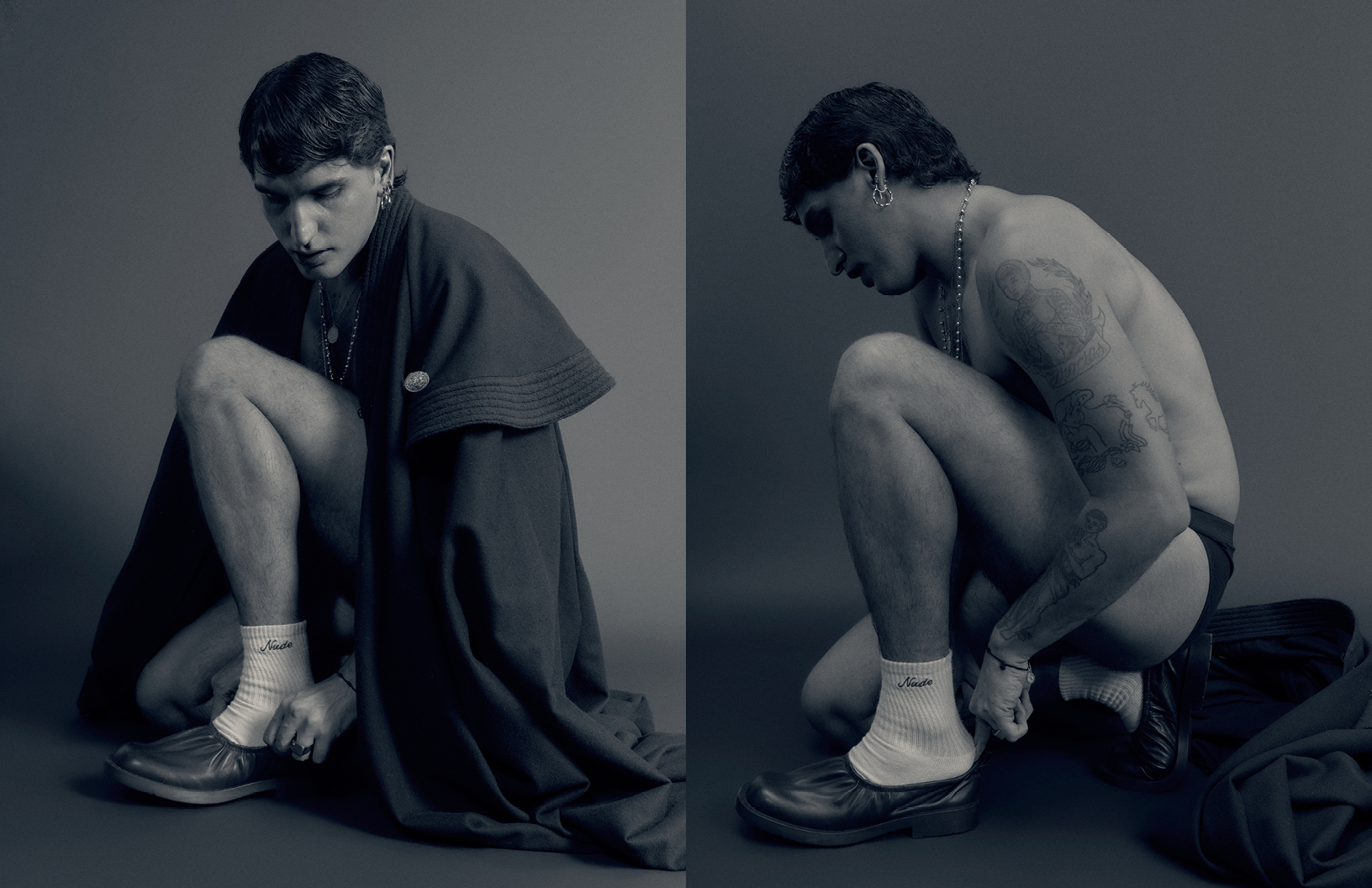
This character seems written for you. How did the role in this film come to you?
Well, a little bit, yes. When Alejandro Marin and Carmen Garrido wrote the movie, they were already thinking of me. I owe them everything. Although, I was the last person to know that I was involved in the project. I read the script on the way to Barcelona to start recording.
Love & Revolution also marks your debut on the big screen. Surely seeing you for the first time in a movie must have been a very special moment. Do you remember when it was?
Yes, before the movie came out we did a viewing just for the actors and it was impressive, not only seeing me but seeing everything.
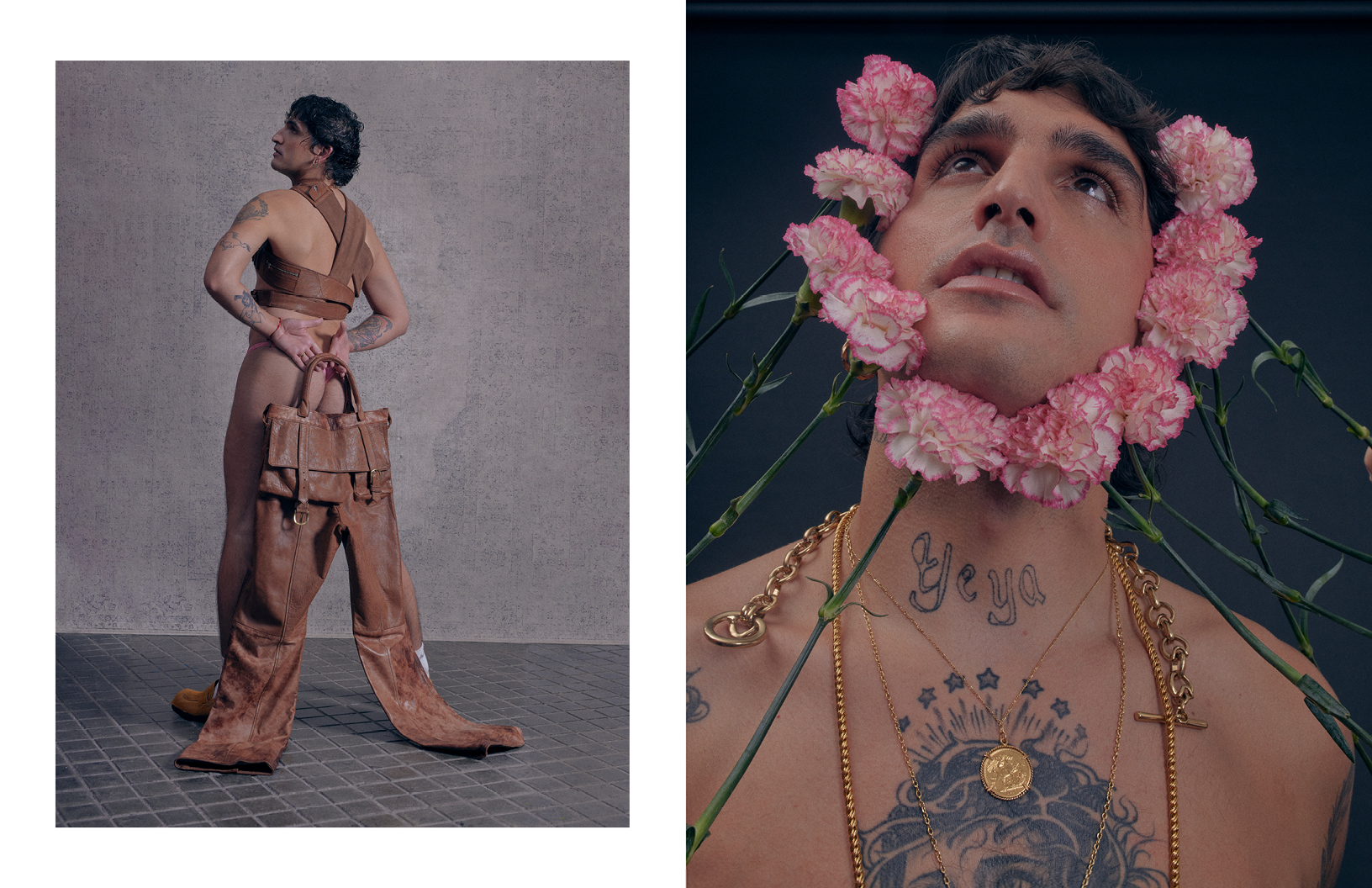
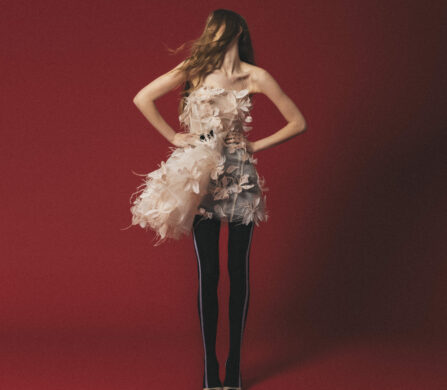
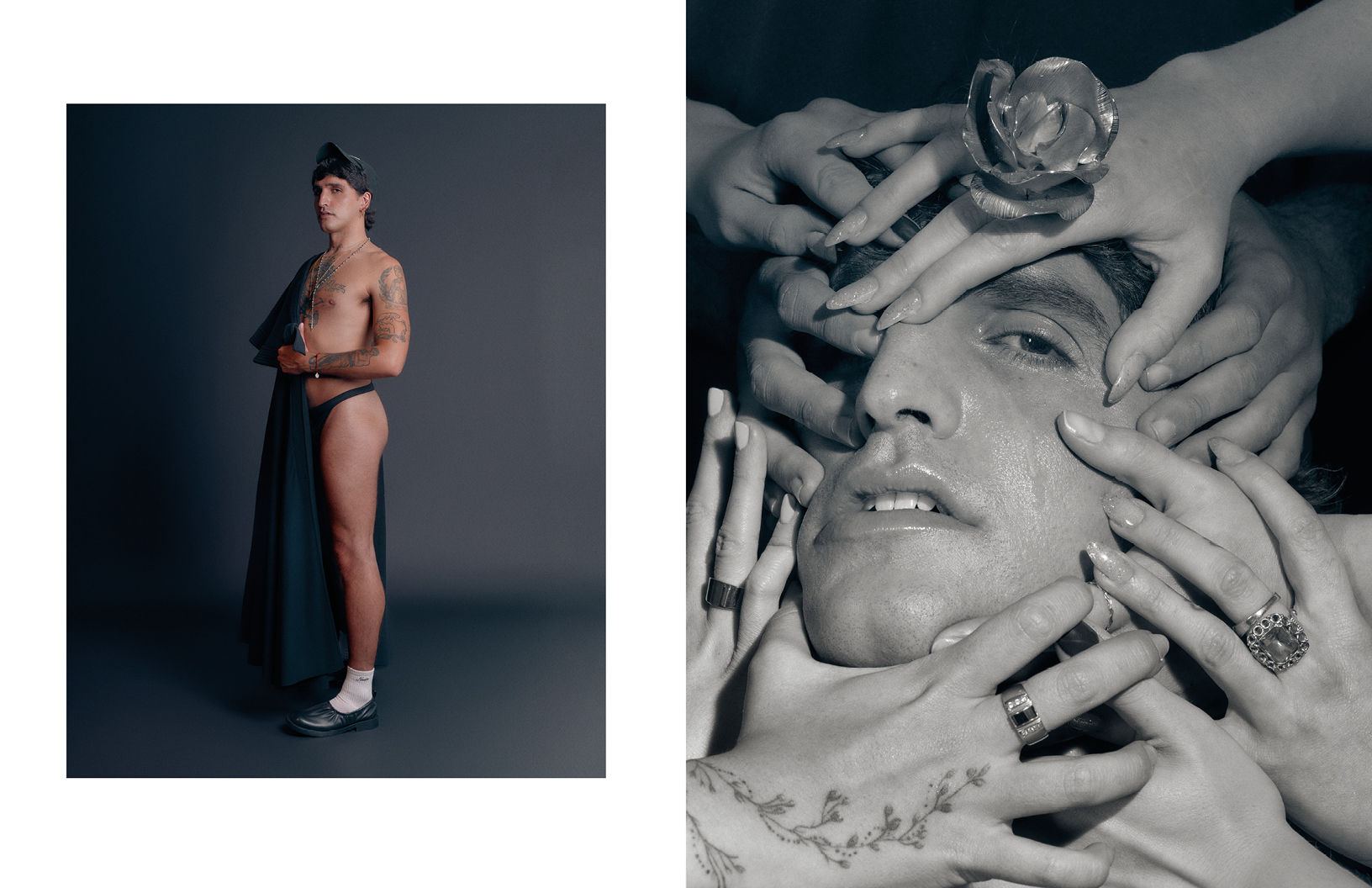
full look. Javier Guijarro
shoes. Camper
opposite
jewellery. UNOde50 + OSB Vintage
This paper talks about the moment in which the Homosexual Movement of Revolutionary Action began. How did you investigate that association and the time in which it was founded?
The truth is that I did not know the movement, I began to know it as we were rehearsing and recording. We were lucky that activists came to share their testimonies with us during rehearsals.
I’m sure that being able, even in fiction, to live in a time where so many people suffered brutal discrimination will have caused you a lot of feelings, right?
Yes, shooting the movie has been a beautiful experience of only good feelings, but sometimes it made me sad, of course. Some scenes haven’t come out but I was fighting with some Nazis, or the day the police captured Miguelito the screams [fictional] were horrible and I had a bad time.
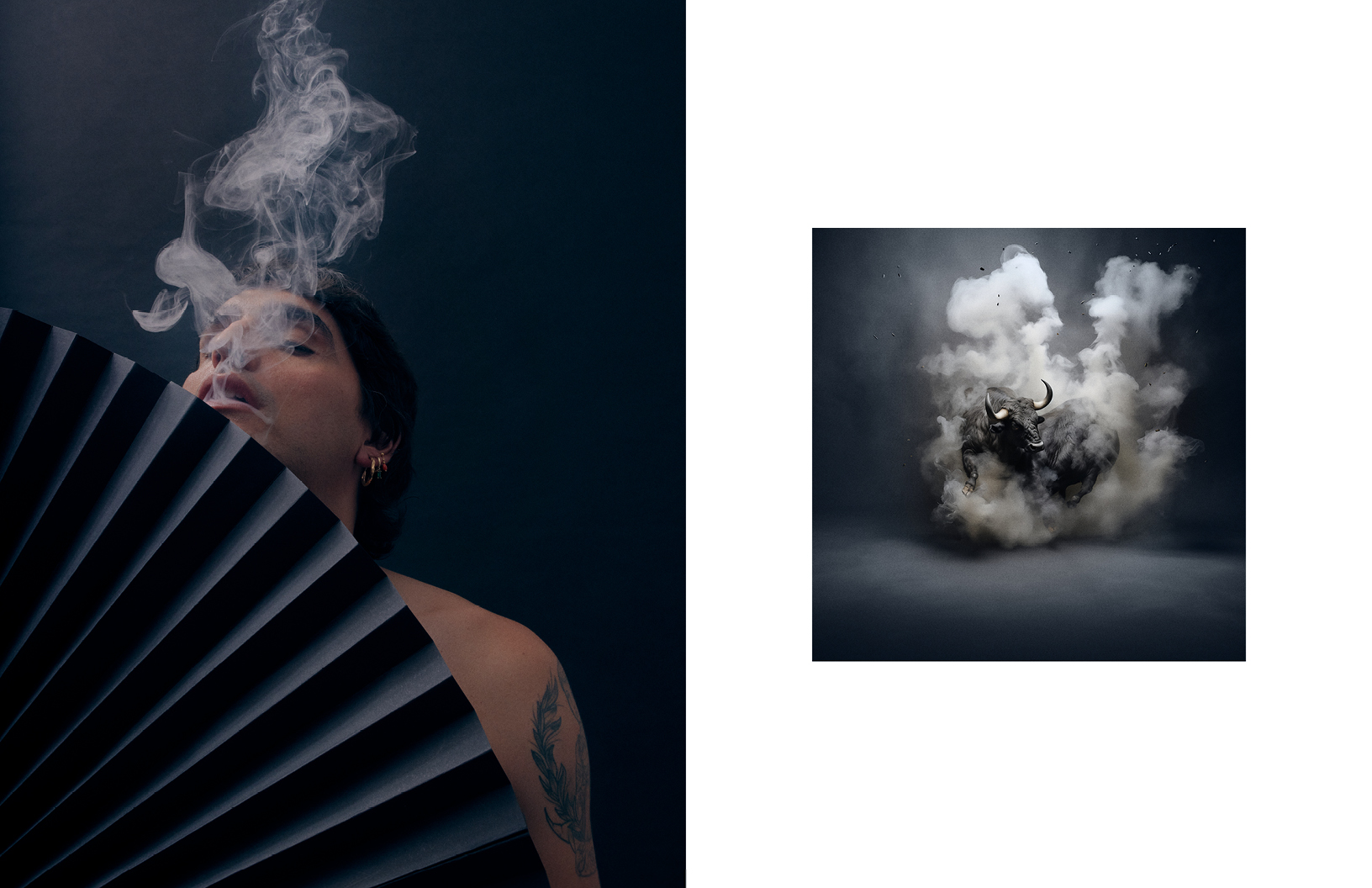
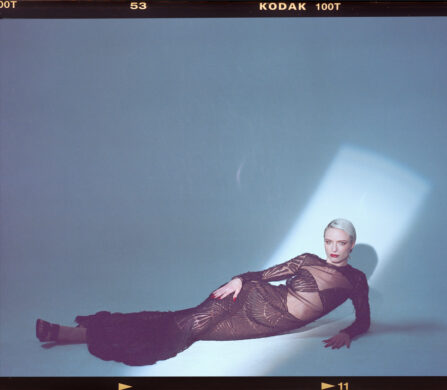
jewellery. OSB Vintage
The cast includes great actresses such as Ana Wagener and Alba Flores. The chemistry is palpable between everyone. Could you tell me an anecdote that you experienced during filming?
I couldn’t stay with just one anecdote, we have been a family — we have spent many days and nights together. One day that I remember very well is when we filmed the protest and the real activists were there.
Miguel is the protagonist of this story, a teenager who is discovering himself. What were you like when you were his age?
Very similar to a kid who wants to be himself, wanting to take on the world, dress how he wants and love who he wants.
Has this whole first experience in the world of cinema changed you in any way? What have you been able to learn from filming this first film?
Yes, but I think not in the way that is expected. All of this has put my feet more on the ground and has made me clear about who I am and what I want to do. Although I am open and want to do all possible acting projects, I am now studying hairdressing.
As an actor, who are your references?
My favourite actresses are Penelope Cruz, Candela Peña, Lola Dueñas and Carmina Barrios.
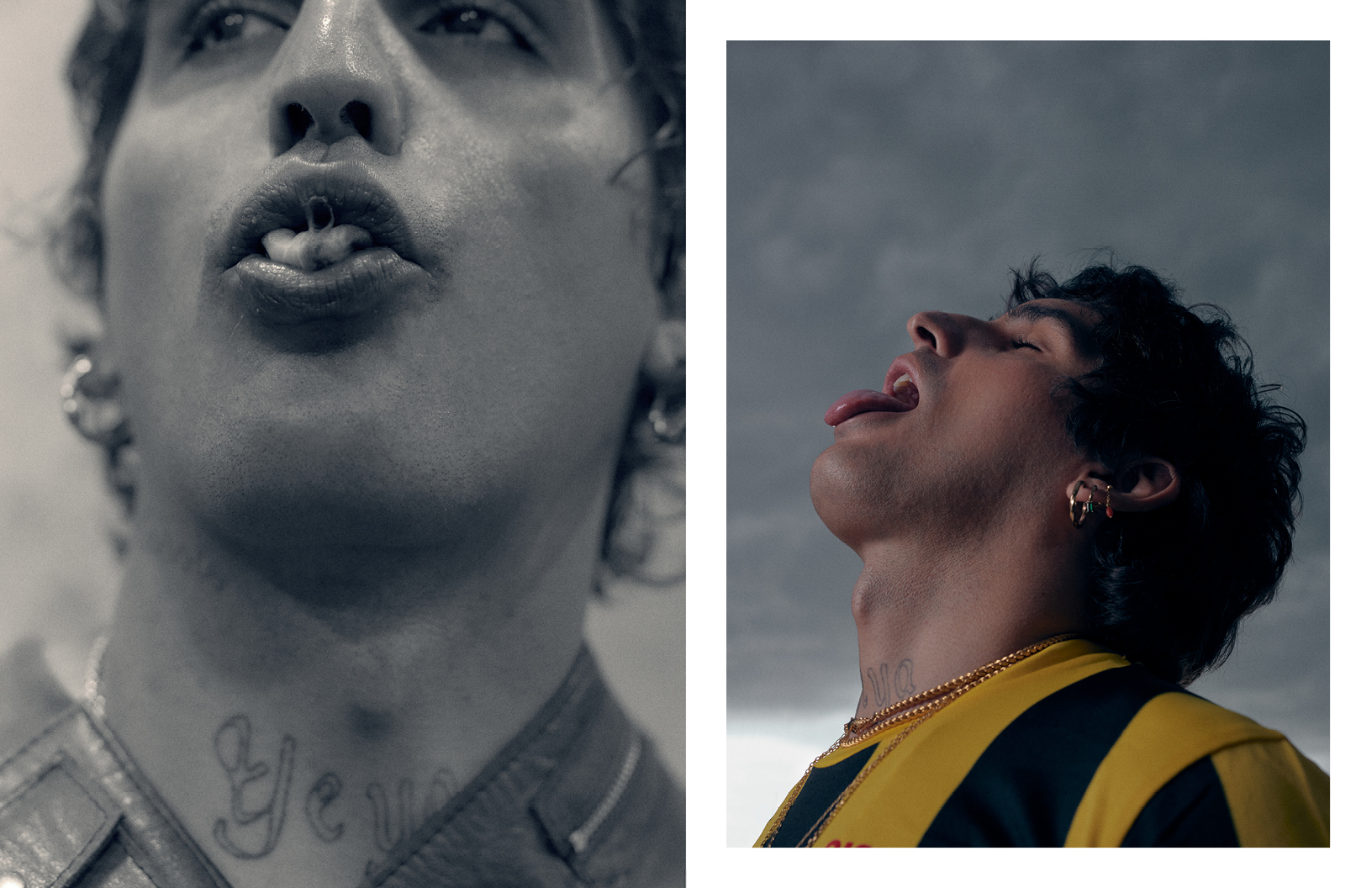
opposite
jewellery. OSB Vintage
This type of cinema is not very common in Spain, is our industry changing?
Clearly, although things are changing, they haven’t changed yet.
What does La Dani dream about?
Having a house, a healthy family, money and a job with which I can do what I like.
Sonja Weißer is captivating audiences with her charisma, both on screen and on stage. With the upcoming release of two series, a film festival screening and more, the odds for 2025 are decidedly in this rising star’s favour. “In drama, you can play pure love in one scene and the most broken version of a person in the next,” Weißer explains, wearing Miu Miu for her Schön! 49 digital cover story. “This intensity is what interests me most about people – their emotions and their extremes. I love extremes. I’m a little bit of an adrenaline junkie.”
Documenting life is an integral part of the human experience. For British singer Hope Tala, her weapon of self expression lies in lyrics and melodies. She spent over three years creating her debut album ‘Hope Handwritten.’ In the album’s opening track ‘Growing Pains,’ Tala reflects on “trying to write about what’s in my heart.” The result is a time capsule of her 20s spanning heartbreak and self-growth. It’s her very own coming-of-age piece. From 10 November she’ll be taking the magic of her album to stages across the UK and Europe on her ‘Hope Handwritten’ tour, following the US leg earlier this year. Before she heads on the road, she spoke to Schön! about the journey to her first album, her favourite tour memories and what fans can look forward to this November.
You released your debut album ‘Hope Handwritten’ this year. What do you think you learned from the process?
I was making the album for three and a half years so I always think of it like a degree because it was the same amount of time you’d be at uni. It was kind of like my songwriting degree. I collaborated with lots of different people which was amazing and learned so much from all of them. [I] really just learned to trust myself and trust my gut. A lot of times I felt like I was not getting it right over those years and then, you know, managed to come out of it with this body of work I was really proud of.
Our environment shapes the kind of art we create so how did your background influence this particular project?
I feel like the kind of album of my life is ‘The Miseducation of Lauryn Hill.’ I have always felt so inspired, not just by that music, but also just by that artist, her process, her lack of compromise, her commitment and dedication to authenticity and quality. The impulse and the desire to say something in her own words. I knew I wanted to make an album that felt soulful, but also, I really wanted to tell a story. I always have loved coming of age novels. I read a lot of them growing up and I still do. Literature has always been quite a big influence on me and I studied English at university. Sonically, I was branching out from where I’d been before which was really liberating and fun.
If this album was a city, what energy is it giving?
I wrote most of the music in Los Angeles where I’ve been living half of the time on and off since I basically graduated from university. So, LA is so influential on this album, but then I feel like there’s such a London influence because I’m from London and I spent a lot of time in London during the making of this project. So, [a] kind of hybrid of London and LA.
What will your upcoming tour feel and look like for the audience?
Hopefully, it feels really joyful. I did the American leg of this tour earlier this year and it really was so special and joyful every night. For me, performing isn’t something that comes naturally. I love doing it. I love playing shows. It’s such a privilege to be able to do that and connect with people in person. I’ve sometimes compared it to doing exercise or going for a run where, sometimes, you feel really scared or kind of feel reluctant to do it, but then you always feel better afterwards. I love just dancing with everyone, singing with everyone. Something I’ve really enjoyed doing this year is just chatting.
Is there anywhere on your EU tour you’ve never been to before that you’re looking forward to?
I don’t think I’ve actually played a live show in Berlin. I’m so excited for this to be my first show there. I’m also really excited to go to Bristol which is where I went to university. The venue that we’re playing in Bristol is on a boat and I used to go clubbing there sometimes as a student. It’ll be a huge full circle moment going there.
From your album, what song do you love to play live?
I have to say ‘Thank Goodness.’ Everyone sings along, it’s such an amazing feeling. When I play a show, the best case scenario is that there’s a group of friends who have come together and they’re just living for it. In Boston, there was a group of girls, that must have been like six girls, and the whole show they were kind of like ignoring me and just singing to each other which is my ideal scenario. I love it because I’m like, you know, this isn’t even about me. This is about you guys having an amazing [time] with your friends. As an artist, to be able to see people interact with each other in the presence of your art, there’s no feeling that’s more amazing than that. That makes me feel so lucky.
Step into ‘House of Guinness’, and you might half-expect the air to smell of stout and scandal. Set in 1860s Ireland, the series is a delicious tangle of ambition, clandestine affairs, and family feuds that make soap operas look like polite afternoon teas. Among its cast of characters is Lady Olivia Hedges-White, a woman whose elegance and authority belie the constraints of her era. A cash-poor noblewoman in a “lavender marriage,” navigating love, power, and identity in a society that tightly policed women’s bodies and desires. At a time when Irish women rarely had the freedom to express themselves sexually or physically, Olivia’s boldness feels extraordinary – and today, as debates over bodily autonomy and women’s rights resurface globally, her story feels even more relevant.
The show’s creator and ‘Peaky Blinders’ legend, Steven Knight, has long championed complex female characters, and in Lady Olivia, he entrusted Danielle Galligan with a role that, while anchored in the past, feels strikingly modern. The Dublin native, whom many may remember as Nina Zenik in ‘Shadow and Bone’, brings nuance to Olivia’s negotiation of marriage, ambition, and unexpected love, exploring how a woman might assert agency in a world designed to limit it.
In conversation with Schön!, Galligan reveals how inhabiting Lady Olivia allowed her to explore the complexities of love and loyalty in a society bound by rules, connect deeply with her Irish heritage and language, and channel unexpected insights – from ‘My Big Fat Greek Wedding’ to her own non-romantic instincts – into a character defined by her courage, wit, and surprising tenderness.
shirt. MCM
jewellery. Maison Lumiere
opposite
shirt. Lurline
skirt. 7 For All Mankind
shoes. Axel Arigato
earrings. Retro Chic
belt. Massimo Dutti
‘House of Guinness’ has been out in the world for a little while now, so firstly, how has it felt to hand it over to an audience?
The reception has been really lovely, honestly. A lot of people have questions because the narrative itself is so sprawling. It investigates a lot of different human experiences and a lot of different levels of Irish society, so a lot of people have different theories and engage with different characters in different ways and are reading into little things. I just love all of that, especially that people are also asking me a lot about Irish history.
I completely understand that, I don’t think I’ve been as fascinated by a historical figure in a drama as much as I have been by Lady Olivia since I became obsessed with Anne Boleyn back when ‘The Tudors’ came out. How familiar were you with Lady Olivia before signing onto the project, and with the story of Guinness as a whole?
I knew Guinness from drinking it, obviously, and then also there’s a thing in Ireland where if you say Guinness, someone has a story about a Guinness family member; there’s a lot of hearsay. I also know someone whose granddad worked for Guinness, got an injury, and then they continued to pay his salary for his whole life, so there were some historical facts that I did know quite a good bit about, but I had no idea about Lady Olivia. To be able to research and prep for a role like hers and colour it in with the real person was a real treat.
Was there something in your research that you found that hasn’t made it into the show yet but shaped how you came to understand Olivia as a character?
She passed away on her own in The Shelbourne Hotel, which is right in the centre of Dublin, and I thought that was incredibly fascinating. She was also part of the Watercolour Society of Ireland and would paint landscapes from their Dublin house, from St Anne’s. That image – of this solitary figure, looking out a window, painting the horizon or the sunset as if she’s searching for something that is missing – stuck with me.
That is such a stark contrast from how viewers first meet Olivia in ‘House of Guinness’. Right from her very first scene, she takes up space – quite literally. In your mind, where did that perceived confidence come from?
She is of noble birth, even though she’s cash poor, she’s asset rich and has an unshakeable sense of self-worth – one that I cannot relate to. But I think that it comes with old money and also the fact that, to her, the Guinnesses are upstarts; they’re new money, and so, even though she comes from this kind of ruined family with her father having essentially gambled their wealth away, I wanted her to be really dignified and have a lot of integrity.
She carries herself with such authority it is easy to forget that she, like Arthur, needs something from their “lavender marriage.” Was her ambition always central to how you played her?
I love your earlier comparison to Anne Boleyn because I was listening to something a while ago about how difficult it is to track women’s influence throughout history. For Olivia, that really resonated with me because she’s a really strategic, intelligent, pragmatic woman who has all this potential but exists in a society where there is no outlet for her to realise that potential or to have any sense of self-actualisation or purpose. She sees her marriage contract with Arthur as a contract, as a job. She’s almost like a Guinness employee.
There’s this quote from ‘My Big Fat Greek Wedding’, which is one of my favourite films, about how if the man is the head of the family, then the woman is the neck, and she can steer the head wherever she wants. That, to me, is Olivia.
I might be naïve, but I sensed a deep platonic love between Arthur and Olivia. Was, or is, there love and loyalty or was it never more than a business deal that happened to be a comfortable arrangement until it no longer was?
Oh no, I absolutely think they fall madly in love with each other in a very platonic and complex and nuanced way, which was one of my favourite things to explore throughout the series.
Did she underestimate him? Or her own capacity for love?
She completely underestimated her capacity for love and how deeply she could love. It really starts with her love for Arthur, who then underestimated her capacity and her need for love when she begins to fall for Rafferty.
Speaking of Rafferty, he did not exactly sneak up on the viewer, nor on Olivia; it almost felt like both the audience and Olivia herself were still blind sided by her feelings for him.
Absolutely, we had a lot to achieve here in a short space of time, but he really is one of those storms that she just couldn’t have prepared for. I’ve never been that much of a romantic, so, as much as I love the storyline, there was a bit of me that, for a while, hoped there was an option C. But you know, Steven Knight is so surprising, and he understands the complexity and nuance of human emotion and human action so well. I fully trust him that Olivia’s sense of spirit and her sense of self will not be sacrificed on the altar of a love story.
Another storyline that felt incredibly modern, even though it was dealt with arguably better than we often see in the real world today, was Olivia’s abortion. As an Irish woman, how did it feel to bring those themes to the screen, especially given the country’s long and complex history with reproductive rights?
Ireland has such a tenuous history with reproductive rights, and I remember the marches. I remember clutching my best friend Alex when they announced the result of the referendum in Dublin Castle and crying. I remember all those feelings and how much it meant to all of us as women who are just here in the modern world, but also to carry a woman’s story because so many women have made that journey. To be able to give life, words, and breath to such a universal Irish female experience, which, I think, is often swept under the rug, was really special. I wanted those women to feel taken care of.
The show isn’t all hardship, though, and I won’t lie, for a while I half expected a love triangle, or even a throuple, to emerge – especially after that wedding scene. Which begs the question, how does one focus, and what was more distracting to act opposite of – James Norton’s slutty little hoop or Anthony Boyle’s enormous moustache?
It’s all about exposure therapy. No, I’m joking, I’m ever, ever the professional, nothing’s a distraction from my job, ever (laughs). They’re both just brilliant actors to work with, and I honestly was just pinching myself. I learned so much from both of them; their ideas always felt really exciting and kind of dangerous.
What was lovely about working with Anthony was that during rehearsals, he’d go, “I had this idea that Arthur would end up with his head in her lap at the end of the scene.” And I was like, oh, okay, cool, so this is the level of improvisation that we can play with. It’s not going to be this stuffy, stiff-collar, etiquette-ridden kind of period piece. Obviously, that’s all there, and we have to have those rules, but then it became about how many times we could break them within the scenes. Sometimes we tried things, like throwing grapes, but other things had to be toned down a little.
Like you just said, ‘House of Guinness’ is a period piece and with that one some absolutely incredible costumes, especially for Olivia…
I could talk about the costumes for a whole hour. It’s one of those things where, when the costumes work, you don’t notice – does that make sense? But when it’s wrong, it’s all you can feel, all you can think about, all you can see. Edward and Nadine did such a brilliant job, and he works really emotionally, so when you’re going into a costume fitting, you’re not just a hanger or a mannequin. Every fabric, every colour, everything has a story and a reason.
dress. Lurline
earrings. Retro Chic
opposite
shirt. Lurline
skirt. 7 For All Mankind
shoes. Axel Arigato
earrings. Retro Chic
belt. Massimo Dutti
Do you have any specific memories of a moment when a costume told the story within a scene?
There’s that scene where Arthur is telling Olivia, “You can choose him and live in the streets, or you can get rid of him and stay with me.” The costume for that was so specific. She’s wearing this skirt – I don’t know the names of fabrics – but it’s this sheer, really pink, flesh-coloured, hard fabric. Edward was like, “This is because she’s like a shell of herself at the moment. She’s still recovering, she’s exposed, she’s very raw. This fleshy colour is her exposed insides, and this is her trying to protect herself.”
And then there was another one, the blue dress she wears at the dinner with Arthur when they’re talking about the abortion. There were little blue bows that Edward added in because the baby was a boy, in his mind. In the scene, when I noticed the bow and remembered what he had said, my heart just broke for her.
I can only imagine, and I am actually surprised I haven’t seen anyone pick up on that detail online yet. After all, there are some wild fan theories out there when it comes to the show. Have you heard of any, or do you have a personal favourite?
I do have a favourite theory, but it’s purely mine. It makes no sense within the story, but I just really want Jack Gleeson, who plays Byron Hedges, to be my cousin. There’s a line where she says, “I have this cousin who’s a devil, but I can trust him,” and I just think it would be great if it were Byron. Plus, then there’d be some kind of connection with Olivia and the Fenians. I just think it’d be really spicy because what if she is up to more than we think?
It could also explain why Olivia speaks Irish. How did it feel to speak and hear the language on the show? While we’re seeing more Irish in music and media again, it’s still relatively rare.
I don’t have a word for it, but it felt like kicking down a door. We Irish are very proud, patriotic people, and our language was definitely taken from us. So to have Irish being spoken on a commercial, global Netflix TV series is something I never thought would happen. To be able to say a line in Irish, the significance of it is not lost on me, even though I’m not a Gaelgóir.
Speaking of lines, Olivia has no shortage of brilliant one-liners. Do you have a personal favourite?
The line in Irish is definitely one of my favourite lines, but one of my other favourites was actually cut. You know, the bit where she makes Rafferty jump out the window, and he goes, “You’re fucking insane, do you know that?” In the script, she goes, “I’m a Guinness. We’re all fucking insane.” I can obviously see why it was cut, but yeah, I really enjoyed that one.
Finally, you’ve given us such a compelling Irish historical figure in Lady Olivia, and I truly hope we will get to see more of her in a second season, but is there another Irish historical figure you’d love to see brought to life on screen?
There are loads. I’ve always had a dream of playing Gráinne Mhaol, but I also think our pirate queen, Queen Maeve, is such an interesting character. All of our Irish mythology is so rich. Tír na nÓg could be a beautiful, tragic story as well if it’s done right, so I’d love to see more of that. And then definitely the women of the 1916 Rising. I think Steven Knight is getting at it with Ellen Cochran, which is great, but we need even more.