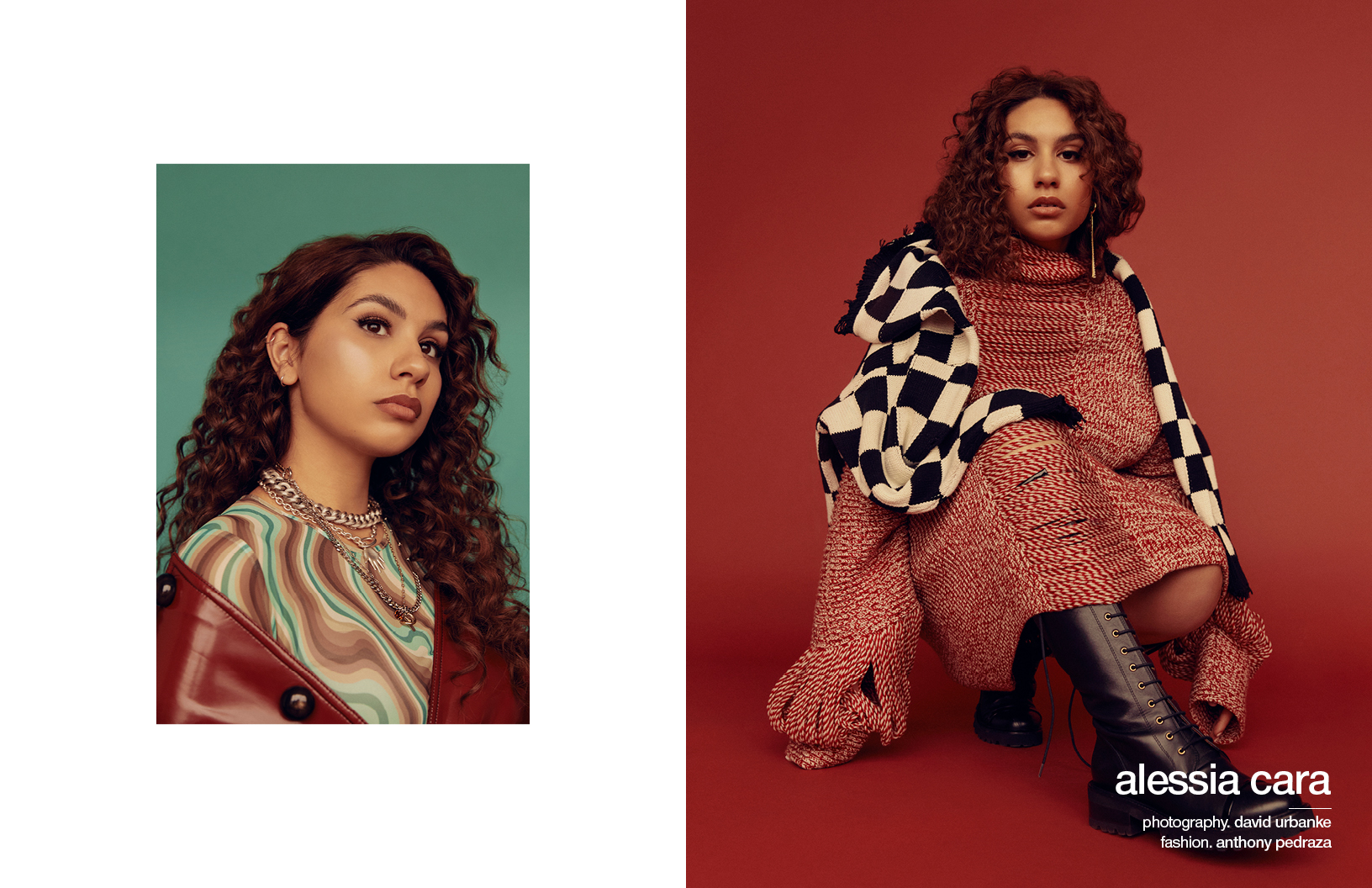
Alessia Cara is the resurgent voice of Pop. The Grammy-winning singer and songwriter was raised in an Italian household in the midst of Canada’s bustling cultural mosaic. “I grew up around a ton of different cultures and different people which really helped me form a greater understanding of the world,” she tells Schön! Her effervescent and tenaciously bold lyrics are a mirror of her personality. “For me, growing up in a rather sheltered home, I always felt like I wanted more out of my life. That was a huge driving force for me. Feeling like I didn’t have the room to say or do certain things really sparked that ambition in me to do as much as I could with my life,” she explains.
The 25-year-old singer and songwriter has distinct soul-baring ballads reminiscent of artists like Amy Winehouse and Remi Wolf and much of her artistry models the honest vulnerability of artists she grew up listening to like Lauryn Hill, and Joni Mitchell. Alessia’s journey into music started at the young age of 14 when she began posting videos of herself to YouTube. “It wasn’t until I was 16 that I had my first studio session. This really changed everything for me,” she says. Today, she boasts a Grammy award for Best New Artist and numerous chart-topping singles including: Stay and Scars to Your Beautiful.
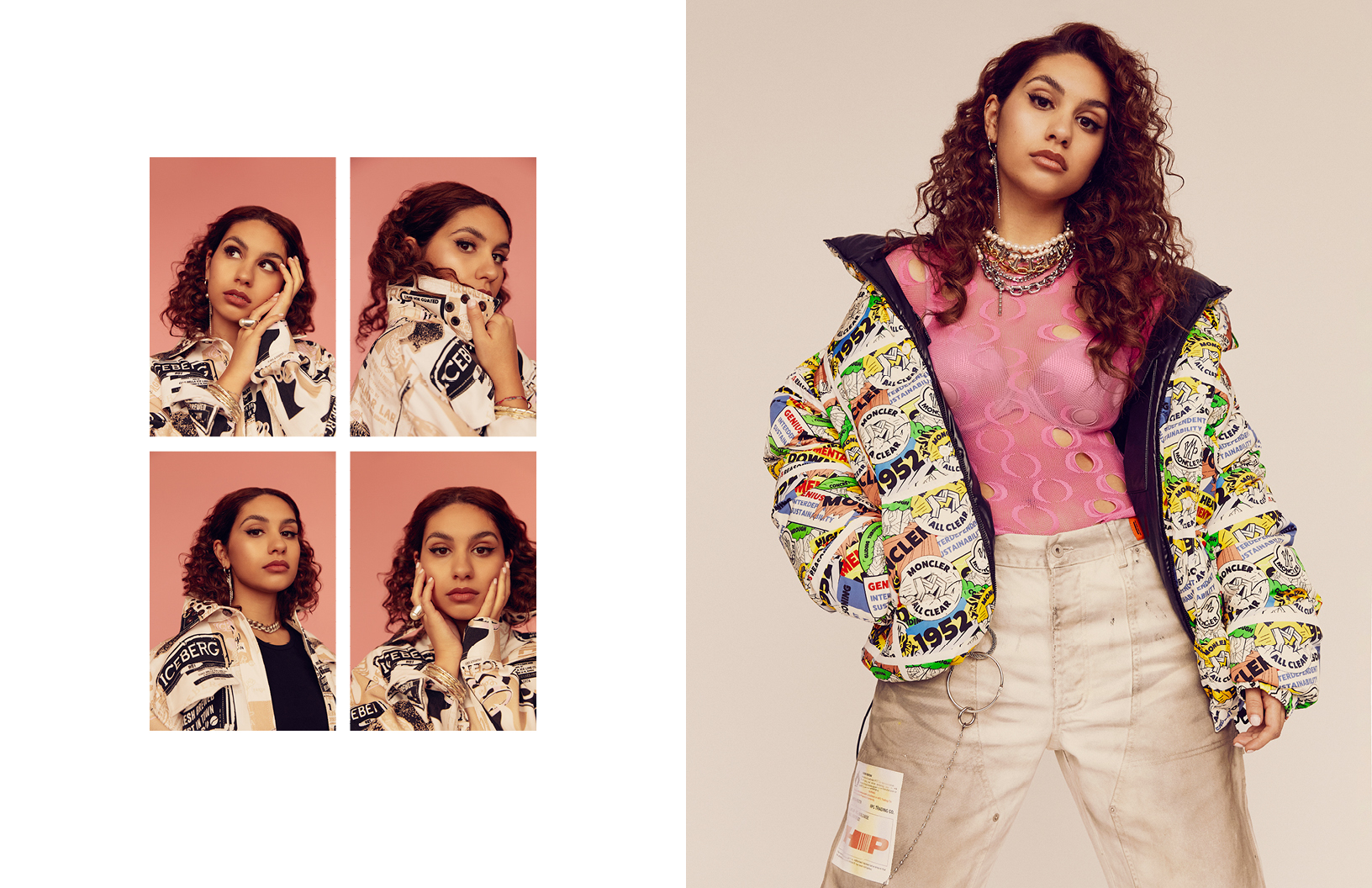
jacket. Iceberg
top. FM 669
earring + necklace. Justine Clenquet
ring + bracelets. Patricia Von Musulin
opposite.
coat. Moncler
top. Rui
trousers. Heron Preston
earring. Justine Clenquet
necklaces. Joomi Lim Wallet
chain. A Prix Eleve
Looking beyond her undeniable talents, the songstress is raising the bar on how we talk about mental health, healing, and our wildly confusing twenty-something years. Alessia’s latest album, In the Meantime, is a delectable ode to the tribulations of navigating your twenties. She confesses that this chapter of her life has been “very tumultuous and very confusing. There have been a lot of great moments and a lot of teaching moments too.” The songs on the album are what the artist herself considers to be some of her best work. Shapeshifter, she says, ranks among her favorites from the entire collection “because the making of it is super dear to my heart. I got to work in the studio where Amy Winehouse wrote pretty much all of her music. She is my biggest idol and it felt like the biggest victory for me.”
The studio album has pre-pandemic roots. “I wrote the first song for the album unknowingly when I was on tour in 2019. The creative process for this album, from the beginning to the middle and end was very different in terms of what the world looked like and what my life personally looked like.” For many artists, restrictions truly altered the creative process and Alessia is no exception. “I started on tour, being all over the place, travelling, and in the middle of it the whole world had changed. As a result, the entire album creation process had to completely change too. I had to rely a lot on myself and my own production skills. I did a lot more with local Canadian producers. In fact, a lot of the vocals on the album were done in my bedroom.”
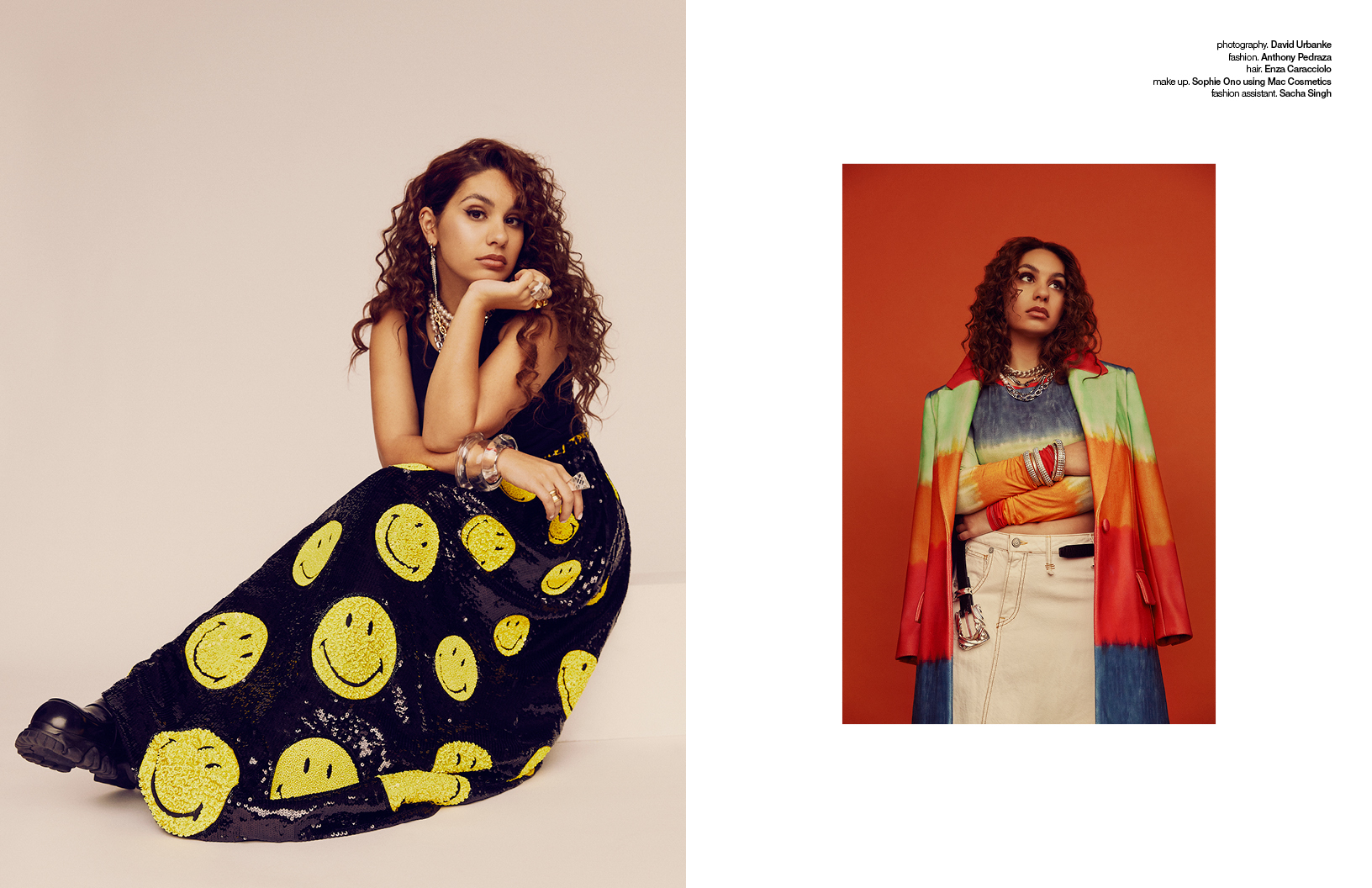
top. FM 669
skirt. Alice and Olivia
shoes. Angel Chen
earring. Justine Clenquet
necklaces. Joomi Lim
rings + bracelets. Patricia Von Musulin
opposite.
jacket + top. Alice and Olivia
trousers. r13 Denim
choker. Justine Clenquet
necklaces. Joomi Lim
bracelets + belt. Patricia Von Musulin
Whilst the pandemic forced her to strengthen her creative muscle, Alessia recalls why she ventured into music in the first place. “I am not very good at articulating emotions, whether it’s speaking or thinking, and the best way for me to understand myself is getting it out in the form of a song. It starts out selfishly but the reason I’ve released my music, and the reason why I continue to, is because I realise that’s the purpose it serves for other people my age.” Alessia adds that “the beauty of songwriting is being able to take a really specific emotion and give it a purpose or allow the listener to feel like it’s about them too. There is power in that and it connects people.”
Moving past the album release, Alessia reveals that she is not ready to let go of these songs just yet. “I can’t wait to play this album live and see what the songs sound like in a live setting.” Determined to be more fluid and consistent with her music, Alessia confesses that collaborations with artists like Anderson. Paak and Remy Wolf are on her wish list this year. “I’ll keep saying it until it happens.”
There’s an effortless magnetism to Cole Knight. Rooted in a noir-leaning, minimalist, and distinctly feminine aesthetic, her world feels both intimate and expansive. Knight’s artistry is shaped as much by introspection as it is by connection. Whether she’s behind the decks at her beloved Miami haunt Floyd — turning nights with friends into something euphoric and electric — or finding clarity in the ocean’s rhythm, her work moves fluidly between solitude and community. There’s a sense of intention in everything she does: a deep appreciation for texture, mood, and the emotional undercurrent that ties it all together.
For Schön!’s curated series, Cole Knight invites us into her orbit with a curated section of songs that drift between psychedelic classics, club-ready cuts, and soulful essentials.
Hey, what are you up to right now?
Sitting in the sunshine in my backyard, petting my giant tortoise dinosaur.
If someone asked you what your origin story was, how would you describe it?
Growing up in a small Midwest American town, life was simple and sweet. I was a shy girl who loved to live inside her daydreams and play guitar alone in her parents’ basement.
Describe your style in three words.
Noir, minimal, feminine.
What is the most precious thing in your wardrobe?
My engagement ring.
Which living person do you most admire?
Erykah Badu — she is the queen.
What was the last book you read?
The Sound and Mysticism of Music by Inayat Khan.
If you could play any venue, which one would it be?
There are so many places I’d love to play, but honestly, my parties at Floyd in Miami are special to me — all the homies pull up, and we get sooo rowdy. It’s like an opportunity to have fun with my friends while also throwing a rave — best of both worlds.
Where are you happiest?
Outside in nature, especially in the ocean.
What’s your ideal three-course meal?
Appetizer: Fresh-caught hiramasa crudo topped with caviar, horseradish oil, black Hawaiian salt, and lemon juice
Entrée: Grilled whole fish of the day on a bed of roasted leeks, broccolini, and onions
Dessert: Chocolate ganache with olive oil and sea salt, served with espresso
Who would play you in the story of your life?
Hopefully myself — my life is so much fun.
What’s one song you’d like to listen to for the first time again?
“Maggot Brain” — Funkadelic
An underrated song or artist you love?
“Paying the Rent” — Silvestre (but all of his music is a total vibe)
The track that describes your coming-of-age story?
“First Date” — Blink-182
An album you’d put in a time capsule?
Deadbeat — Tame Impala
A lyric you love, and the song it’s from?
“I’m sorry for being so sexy, and funny, I don’t know what’s wrong with me”
It’s been 15 years since Miguel performed in London. On 16 April, he reminded a sold-out O2 Brixton Academy exactly why he’s one of the greats. The Schön! 40 digital cover star is an irreplaceable voice in R&B, penning modern classics like “Adorn” and viral tracks like “Sure Thing.” At his core, Miguel is the rockstar of R&B, so it’s only right that his “CAOS” world tour leans heavily into the sounds of rock. The show’s gritty guitar riffs and punchy percussion were a harmonious contrast to Miguel’s sultry vocals. He was pitch perfect, effortlessly switching between hardcore belts and melodic vibrato. The set was minimal, featuring moody lighting and an overturned car as a platform, but with an angelic falsetto like Miguel’s, there’s no need for fanfare.
Miguel’s raw talent and hit-worthy discography is perhaps why his crowd was so forgiving when things didn’t go to plan. Although it wasn’t glaringly obvious from the audience, some unexplained technical issues meant the show had an impromptu intermission and Miguel inevitably had to skip some songs on his setlist to make curfew. It’s clear that the artist sets a high standard for himself and wanted to deliver a good show for a city that doesn’t get to see him often.
Although the show’s sound engineering was lacklustre, the night peaked most in its quieter moments. British crowds were raised on choral singing in school assemblies ,so when Miguel instructed the entire venue to sing the melody of “Girl with the Tattoo” in unison, it was a beautiful moment of connection. When it was just Miguel and his electric guitar, singing in Spanish and English while fans clutched their chests or their partners in adoration, is when the magic of his music shined brightest.
suit. Dolce & Gabbana
shoes. Alaïa
jewellery. Marie Lise Lachapelle Studio
Critically acclaimed film and television actor Sepideh Moafi is on the cusp of a new dawn on our screens and onstage. Featuring in several fan-favourite dramas, including Apple TV’s ‘Black Bird’, HBO’s ‘The Deuce’, Showtime’s ‘The L Word: Generation Q’ and the Emmy Award-winning HBO Max drama ‘The Pitt’, Moafi is one to watch for eclectic and versatile drama performances.
It’s no wonder that one of the most-watched TV shows of 2025 features a strong cast of talented actors such as Noah Wyle, Katherine LaNasa, Shawn Hatosy and Gloria Underwood. Joining the fortified cast for Season 2, Moafi delivers the role of the punctilious Dr. Baran Al-Hashimi, a highly educated and clinically precise attending doctor and the natural rival of Pittsburgh Trauma Medical Centre’s preceding attending, Wyle’s character, Dr. Michael “Robby” Robinavitch.
Discussing her comeuppance and career trajectory, Moafi invited Schön! ahead of the season 2 finale of ‘The Pitt’ to explore the thespian thinking that shapes her performances, including self-reflection, activism, cultural awareness and a thrilling insight into the works of tomorrow.
dress + belt. SEMSEM
shoes. Manolo Blahnik
jewellery. Marie Lise Lachapelle Studio
opposite
dress. Armani
jewellery. Marie Lise Lachapelle Studio
How did you set Dr. Al-Hashimi apart from the stereotypical “new-girl-in-town” trope?
When you get a role, you kind of throw yourself in, and it’s always kind of nice when parts of who you are connect to parts of who the character is. I tried not to think about it so much as “How I will be perceived?” Although that was intimidating, being the only new series regular entering ‘The Pitt’, the only other senior attending opposite Noah Wyle, Dr. Robby, who spent most of his career playing a professional doctor on screen. So, of course, it came with its complexities. But in general, I tried to home in on who she was and what was revealed through the scripts.
As an actor who wants to really serve her character and the world, it was important to remember that you can’t care what other people think. You can’t prove yourself. You have an entire life’s worth of experience, and you’ve devoted so much of your life, countless hours, decades to this career, to this path. For me, as an artist, for her in medicine. You know that you belong here, despite any other people’s second guessing in your ability. She’s not there to be liked. She wants to be of service; she wants to be effective. And I think that that also shifts the dynamic because it’s less about entering a space from a place of insecurity and just being very grounded in her sense of purpose.
You crafted Dr. Al-Hashimi to really home in on that half-Iranian, half-Iraqi descent, and we know that you also have an Iranian background. Being a person of colour, is the constant barrier of potential prejudice, always something you’re aware of — whether it’s for you as Sepideh or the character of Dr. Al?
It depends. As a woman of colour, and as any woman in any field, you have to work so much harder than your male counterparts. We need to establish and reestablish our worth and value in a system that doesn’t naturally accept us or create paths for our success. I think that’s a huge part of her. Also, something that I share with this character is that it’s almost like she had to compartmentalise that reality in order to see beyond it and go beyond any trace of victimhood or injustice. The injustice does fire her up, and it’s a foundational driver in her. She will advocate fiercely for herself; you see throughout the season Robbie being pretty hard on her and condescending, which is relatable for a lot of women in any field, whether it’s conscious or subconscious.
The way that we are viewed is that we are less capable, unless we sort of mask ourselves in the masculine, tough, impenetrable way. What I love about her is that she has that tough exterior, but she is vulnerable, and she has great communication skills, and she is such a devoted teacher/mentor and empath with her patients. Her years of experience and her vast medical background did not harden her. It made her better.
suit. SEMSEM
jewellery. Marie Lise Lachapelle Studio
opposite
suit. Dolce & Gabbana
shoes. Alaïa
jewellery. Marie Lise Lachapelle Studio
My first impression of Dr. Al was that she is pragmatic, stern, and self-assured. Calloused by a difficult life and refined by her prestigious education, a serious attending and more so, a tough opponent for Dr. Robbie. Could there be some intimidation that Dr. Robbie must confront within himself because this other brilliant attending is a woman?
It’s incomprehensible. It’s a very sort of capitalistic approach to success and medicine. It’s like there’s only room for one — they need to push you down to get ahead or be seen as powerful. But I do think that at its core, their tension is not personal. It’s part of what we’re talking about, the deeply ingrained patriarchy, but it’s also philosophical. He leads through heroic endurance and instinct. And she has a background in clinical informatics, which is data science, research and medicine. She also has a background in humanitarian aid work as a doctor, so bridging that global field work with this more science-based research world, she understands systems, and she’s trying to work within the system to shift things and improve through prevention and accountability.
Over time, I think these approaches actually strengthen one another. If they could put their differences aside, they could be a really powerful team. When different cultures, traditions and systems meet, there’s often friction. But that friction isn’t a problem — it’s where new forms can emerge.
Well, we hope that by season three, we see more of the synergy! Maybe a bit more professional chemistry, more of that collaboration.
To be honest, it’s so easy for me to tell the truth about this — I know nothing about season three. Okay? Absolutely nothing!
coat. COS
shoes. Fendi
jewellery. Marie Lise Lachapelle Studio
opposite
ensemble + shoes. Armani
jewellery. Marie Lise Lachapelle Studio
Arguably, today’s America hosts categorical tension between people who believe they’re different but are actually very much connected. ‘The Pitt’ has explored that in part, also, notably in the “ICE episode” (Season 2, Episode 1) where we see systemic oppression affect realistic situations. How important is community as a theme in ‘The Pitt’?
Extremely. When you scratch past the surface, it’s really about all the societal issues that we’re facing, not just in the States, but in the world, particularly in the Western world. What it does so beautifully is that it shows the human cost of the pressures, the emotional toll on people trying to hold the line. It explores the moral density of the emergency department and the relentless pace and urgency of life, and yet, in the hospital, there’s an inevitable confrontation with our existential nature. We have to confront the fact that we are mortal creatures — we will die. ‘The Pitt’ is medicine meeting the full spectrum of human life, and you can’t separate politics or society or culture from hospital culture.
I’m really grateful that ‘The Pitt’ hasn’t shied away from that. I shadowed the LA General Medical Centre in the emergency department, and the day that I went was after the mass protests in June in Los Angeles. The hospital was almost empty. The attending there asked why it seemed like a manageable triage, and said it was because of the protests and the crackdown. People, in particular undocumented citizens who have a legal right to healthcare, are terrified of going to the hospital. To have that reflected in our show this season, I thought it was poignant and very important for the moment we’re living through.
Touching on the technological aspects of Dr. Al-Hashimi’s interests… she’s very positive about AI, and she insists on using it for the betterment of patients. Do you share similar attitudes towards technology and medicine, or do you have a different perspective?
As a doctor, you’re always weighing the pros and cons. You’re always weighing those risks. So, I don’t think she’s naive to the potential dangers of AI. I think she’s well aware. She is living inside a system that is crumbling and impossible to keep up with. The need is impossibly high, and time is limited. So, she sees AI not as a saviour, not as a form of replacement, but as a tool to help relieve the burden for healthcare workers with things like diagnostics, charting and admin. But it can’t be left unchecked; with this technology, it’s so much about stewardship. It’s a bullet train that is speeding by, and if we don’t hop on and try to pave the path ahead, then we are, pardon my French, f***ed. But these are things that will be dealt with case by case.
But for me personally? I’m terrified. I’m terrified of the inevitability of what AI is doing. You see algorithmic bias, job displacement, how it’s affecting labour unions, and deep fakes that are so troubling. They’re so real. And if they’re this good now, what are they going to be like in two years, four years and 10 years? It’s a moving train, but it’s inevitable.
blazer. SEM SEM
earrings. Marie Lise Lachapelle Studio
opposite
top. Armani
jewellery. Marie Lise Lachapelle Studio
Surely you know a lot more about ‘Newborn’, the play listed for the Minetta Lane Theatre. You star in your own monologue of three one-woman shows. What has it taken to get here, and how do you feel about what is to come of Newborn?
I cannot put into words how excited I am to get back on stage, get into this process and do a play. More than anything else, I’m collaborating with these unbelievably talented, brilliant artists. The playwright Ella Hickson, the director Ian Rickson, Hugh Jackman, Mariana Gailus, and then being in the broader company of Corey Stoll and Cecily Strong. I’m so excited. It’s a very athletic and demanding endeavour, but theatre is my home and doing this play feels like a homecoming. I started as an opera singer, and I just come alive when I get to be on stage and in rehearsal. There’s nowhere to hide in this show; the piece is very intimate and psychologically demanding, which is exhilarating and terrifying.
You seem to have such a deep connection to New York — you’ve worked there and live there currently. What has New York revived or sparked within you that has ignited this passion for Newborn?
Before I got the offer for this role in ‘Newborn’, I did a workshop of the play. It was me, Hugh Jackman and another actor in the West Village at the Minetta Lane Theatre. The moment we stepped into the rehearsal room, we just sat there, and our director Ian Rickson set the space. My monologue has a lot to do with light. I’m reading it, and the sun from outside is hitting my face as I say the word “light.” It was one of those magical moments where you’re saying these words and thinking I can’t believe I get to live inside of this playwright’s brain and bring this character to life.
So that, for me, sums up why I love New York. You walk out, and you’re dealing with the subway and people. There’s something harsh and stark, but so beautiful about being alive. You’re in this magical moment, and then the next, you’re waiting for your train that’s 20 minutes behind. There’s urgency and creative intensity in New York that I love. It pushes you to be more of who you are. There’s a reason it’s a Mecca for artists—it’s so alive, vibrant, and full of possibility. And that makes you want to live more fully and confront all of yourself.
dress. SEMSEM
jewellery. Marie Lise Lachapelle Studio
opposite
coat. Miu Miu
shoes. Manolo Blahnik