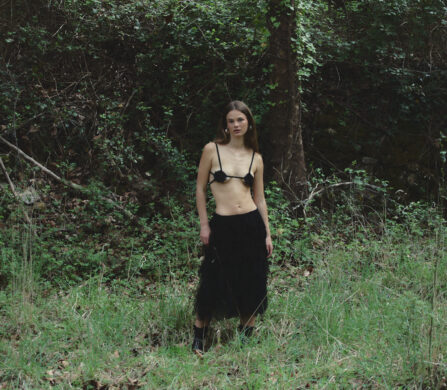
full look. Emilia Genova
opposite
full look. Emilia Genova
With the debut of her eponymous label, Emilia Genova steps into the spotlight not with spectacle, but with quiet conviction. Rooted in sculptural silhouettes and a reverence for craft, her first collection unfolds as a study in controlled volume, precise pleating, and the poetry of movement. Each piece is made to order in the brand’s atelier in Sofia, Bulgaria, where traditional techniques meet a contemporary instinct for drape. The result is a visual language that shifts between bold and ethereal — rich tones dissolving into soft sheers, garments that transform with light and motion.
For Genova, this launch is less a beginning than the visible culmination of a lifelong inner dialogue. Raised between cultures and shaped by years of drawing, experimentation, and self-funded persistence, she has built her label outside the conventional fashion-school-to-runway narrative. Instead, Emilia Genova emerges as a designer who treats fashion as a deeply personal syntax — a way of giving structure to emotion. Rejecting the urgency of seasonal cycles, she proposes a slower rhythm: limited production, intimate craftsmanship, and pieces designed to endure beyond trend. Positioned between artistic ready-to-wear and unconventional custom creation, the collection reflects a designer who has taken the long way around — and arrived exactly where she intended.
In conversation with Schön!, Genova reflects on childhood ambition, creative doubt, reinvention, and her collection.
You describe fashion as a way of giving structure to emotion. When did you first realise that designing could become a personal language rather than just a profession?
It was always a form of language for me. The idea of it being a profession came much later. I remember being four or five years old when I started drawing my first “collections”. There would always be a gown with little shoes and matching gloves, with some accessories to choose from on the side. I’d beg my mom to draw princesses for me so I could decorate their dresses with tiny bows and flowers. One of my earliest clear memories is flipping through a Barbie career book my dad had bought me, showcasing the different jobs she had – “Astronaut Barbie”, “Doctor Barbie” and so on, and then…Fashion Designer Barbie!
The moment I saw that atelier diorama, with a carefully curated mess of tiny scissors and fabric and hangers thrown around, I knew that was where I wanted to be someday. So I started plotting. I would set up impromptu markets in our living room so I could sell anyone visiting the house my latest drawings, fresh flower bouquets I had arranged, or my personal favourite – glittery rocks I had painted (minimal effort, maximum profit). My marketing techniques were ruthless, I was a 7 year old with a mission and a “business plan”. I’d pool together all the money I made to buy more clothes for my dolls, arrange little photoshoots for them, and staple together my own “magazines”.
As I grew, I ran around the neighbourhood asking all the local grannies for leftover fabric scraps so I could make new outfits for my dolls. My own grandmother helped me stitch them and taught me basic embroidery. I spent hours watching runway shows on our old television and flipping through piles of my mother’s 90s fashion magazines. All my dreams fit in an old tin cookie box filled with thread, the kind your grandma probably still has at home.
The dreams never faded, they were just transferred from box to box. From the tin one of my childhood, to the cardboard box my best friend and I kept under my bed in high school, full of sketches for our prom dresses, to my tool box in university, and finally to the mock-up box for my brand, with my name embossed on top in cursive. Somewhere along the way, armed with the naive conviction that “if Barbie can do it, so can I”, design became the language I was most comfortable speaking.
You were raised between cultures and outside a traditional fashion school trajectory. How has that shaped your confidence and your doubts and your sense of independence as a designer?
My early 20s were mostly filled with doubt. I was a terrible student in university, got told multiple times that my clothes were simply “unwearable”, that I wasn’t really a designer, and that I should pick another path. Being 20, my immediate reaction was to go party and forget all about it, of course. Little did I know that the very people I spent countless late nights with in Florence would be some of my closest friends and most cherished artistic collaborators 10 years later.
My confidence developed once I started working. I knew pretty early on that I wasn’t cut out to work for a big fashion house, so I did pretty much any survival job that came my way. I picked jobs that allowed me to be flexible with my time, worked in pubs and bars, waited tables, flipped burgers, welcomed customers, mopped dry beer off the floor, poured my first pint of Guinness – you name it. I went from the weird girl with the pink hair who couldn’t really do anything, to a respected employee. I’d pool my tips and savings to buy fabric and organise photoshoots, just like I did when I was a kid. I moved apartments, learned new languages, changed countries, met new people, but my goal remained the same. I was going to start my own label some day.
Eventually, I realised that if I could be good at the jobs that I did just to pay my rent, then I could be great at what I actually love. My lack of experience in the industry didn’t seem like such a big obstacle anymore, because I had learned to adapt to any work environment. I would just figure it out, like everybody else.
The final push I needed came from the fact that people actually liked the visual world I was creating, and they wanted to see more.

full look. Emilia Genova
opposite
full look. Emilia Genova
Drawing, draping and sculpture sit at the core of your practice. What do these disciplines reveal about you creatively that fashion alone cannot?
More than anything, they’re a mirror of my spontaneity. There’s no pattern or plan, there’s just a dance around the mannequin, fabric in hand. Whatever comes out as a result and feels right, that’s the silhouette I’m going for. I guess I’m a bit of a romantic, and I was never a big fan of rules. Controlled chaos is what I excel at.
This debut feels like a quiet arrival rather than a sudden launch. What inner shift had to happen before you felt ready to share the collection publicly?
As I approached my 30s, I was faced with the fact that my dream was still just a dream. Time had flown by, and I had gotten lost in a whirlwind of events that made it slip through my fingers.
I moved to Paris quite suddenly, and spent a very long time rebuilding my life from scratch. I was lonelier than I’ve ever been, but I had the opportunity for a fresh start. One day, I went to the cinema to watch the “Eras Tour” movie, and while everyone in the room was singing and dancing, I was sitting in the dark staring at the outfits. It dawned on me that I was watching someone who actually did something to bring her dreams to life, and here she was, sparkling on the screen in front of me, an unstoppable force of joy and light. I ran home, slammed my diary open and wrote “work hard every day until you make a dress for Taylor”.
Sometimes you just need someone to inspire you to take the first step. My mind started working overtime, trying to come up with a real business plan this time, but I was blinded by logistics and budgets (or lack thereof) and how big the whole thing seemed.
A few days later, I was at the salon and got struck by one of those epiphanies you only have in the most inconvenient places. I opened ChatGPT (thus far only used for middle-of-the-night tarot readings and to decipher men’s confusing texts) and asked it to help me. Within 30 seconds, it had given me a full step-by-step guide on how to start my brand with an imaginary budget. It wasn’t perfect, but it structured my chaotic thoughts into a few simple bullet points. Say what you want about AI, but that one single search solved years of self-doubt, and might have potentially changed my life.
Around the same time, my mom and I sold my childhood home in Bulgaria. I agreed to sign the papers under one condition: part of the money would go towards the brand. The allocated budget was tiny, but for the first time ever, there was a budget. It was time to pull off the biggest project of my life, and I would need some serious allies.
I called everyone I knew and put together a small team. The seamstress I had worked with since I was 16 years old as head of the atelier, my childhood friend as my graphic designer, my mom as the designated adult, and a lawyer. I spread the word that this was finally happening, and I got an amount of support from friends and other creatives that I have a hard time thinking about without tearing up.
A year later, we launched the brand and held our breaths. I listened to Taylor as I pressed “publish” on the website and cried happy tears in my Paris apartment.

full look. Emilia Genova
opposite
full look. Emilia Genova
Pleating and controlled volume are central to the collection. What do these techniques allow you to express about movement, restraint and emotion?
Pleats have a mind of their own, and they tell you where they want to go. They transform even the simplest fabric into something effortlessly beautiful, with an ever-changing silhouette. Draping pleated fabric is always an adventure; you can’t really plan it, you just have to follow along with where it brings you. I’m just the translator for whatever the fabric wants to say, and I’m there to control it so that the shape of the clothes feels just right. The fact that it feels right to other people as well is still mind-boggling to me.
The silhouettes move between transparency and structure. Do these contrasts reflect different sides of your own personality or way of thinking?
We all have light and dark within us. I’ve often limited myself by being too rigid, too stuck in the past and in my own head, too focused on the problems rather than the outcome. In the brief moments that I manage to escape my own insecurities and stand in front of the mannequin, everything feels simple. There can be just as much elegance in structure as there is in chaos. Hopefully, both translate in the collection.

full look. Emilia Genova
opposite
full look. Emilia Genova
Producing made-to-order in your Sofia atelier keeps the process intimate and precise. What does this closeness to craft give you as a designer?
Most importantly, it allows me to work very closely with my team. I get the privilege of being present in the atelier throughout the entire process, so I can make sure that everything is exactly as I want it to be. No order is made carelessly. Production is an endless dialogue between me and the seamstress, Valentina Stoimenova. I drape, she sews, we discuss, we improve. We’ve been working together for almost 15 years now, and I often joke that she’s the second half of my brain, the more practical one.
There’s something special about creating all of this in my hometown. It made me reconnect with Bulgaria, a country I had tried so hard to flee when I was younger. Ironically, it ended up having all of the resources that I needed.
Being present there means that every detail can be curated, from the fabric and pleating techniques to the specific type of paper we use for our business cards. The whole branding process was done with my friend Anna-Maria at Allude Studio, who spent countless hours perfecting every detail of every piece of paper, box, website page and logo that we created together. We wanted to give our customers the highest level of a luxury experience that we could, starting from the general visual language of the brand, and ending with the final product and its packaging.
Working in Sofia taught me that if you ask people for help, you will find it. Everyone that I worked with there, from design and production to the editorial team, went out of their way to bring me one step closer to the launch, for which I am forever grateful.
Light and motion play an important role in your work. What are you looking for when you watch your pieces move on the body?
Time slows down in a weird way when the clothes look right. Like when you see a jellyfish at the aquarium, or you stand in front of an abstract painting. It’s peaceful. If the movement doesn’t stress me out, then I did a good job. This might sound weird, but my favourite moment is when I look at the clothes and feel like someone else made them. For a moment, it feels like I’m a kid again, watching a show, something bigger than me. I still can’t believe that I actually get to do this.

full look. Emilia Genova
opposite
full look. Emilia Genova
You have chosen a slower rhythm outside the traditional seasonal cycle. How does this pace support your creative wellbeing and long-term vision?
It helps me not immediately lose my mind right after the launch. This is very much a self-funded project, so creating constant seasonal collections is completely out of the question for now. I want to focus on my customers and on creating a relationship of trust with them. I don’t want the “old” collections to be discarded; I would rather keep a permanent collection that I add to when I feel inspired, and retire when I feel like it’s time for a new chapter.
When someone wears Emilia Genova for the first time, what do you hope they feel, and what do you hope they understand about you as a designer?
I hope they feel seen for their true selves. I hope they look in the mirror and think, “this is what I’ve been looking for”. I hope the pieces become a staple in someone’s wardrobe. I hope they recognise the childhood dream behind the designs, and go on to achieve their own goals while wearing the clothes. I hope the colours and textures seep into their happy memories. I hope I’ll get to see a stranger wear the collection on the street someday. I hope a kid somewhere in the world will cut the pictures out of the magazines and save them in their diary. I hope I can be someone’s Fashion Designer Barbie. They don’t really need to understand me, but I hope I understood them.
This launch is a love letter to all the people who helped me get here.

full look. Emilia Genova
opposite
full look. Emilia Genova
To view the collection, visit emiliagenova.com.
fashion design. Emilia Genova
photography. Zlatimir Arakliev
styling. Ivan Tsutsumanov
models. Yana Kotzeva + Hristina Radoslavova @ Ivet Fashion
hair + make up. Valentin Stoianov
video editing. Beatriz Ruco
music. Naresh Ran
assistant. Nikolay Nedelchev