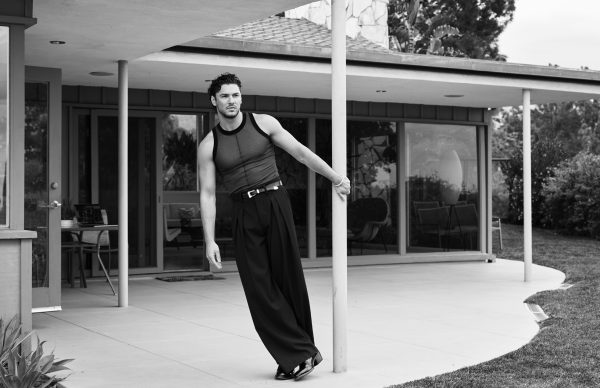
There is something inherently transportive about the worlds Rohan Campbell is drawn to. They are the kind of stories built on childhood wonder, small-town secrets and the promise of adventure lurking just beyond the familiar, like ‘The Goonies’ or ‘The NeverEnding Story’ — the films that first ignited his imagination offered an escape into somewhere entirely new. It’s a sensibility that finds a fitting home in ‘Below’.
Set against the rugged, atmospheric coastline of Newfoundland, the series brings together community, folklore and a sea-bound mystery, with Campbell stepping into the role of Jay, a charismatic golden boy whose confidence conceals a more complicated relationship with family, belonging and expectation. Yet, as our conversation reveals, the experience became something far more personal. Immersing himself in Newfoundland’s distinct culture and close-knit communities, Campbell found an unexpected connection to a place that reshaped his understanding of home, identity and what it means to be a Canadian actor.
Speaking with Schön!, he reflects on the transformative power of make-believe, the freedom of losing oneself in a character, and why, sometimes, the most rewarding journey is the one that brings you back to where you started.

When you think back to your childhood, was there a formative piece of media — a book, film or album — that shaped not only your worldview as an actor, but also made you want to pursue this career of make-believe?
I feel like it was probably music first. I think everyone has a similar journey where, if you’re a creative person, an artist or an actor, sometimes we’re people with big emotions who are failing to articulate them. I think listening to music was a big moment for me. I didn’t really grow up in a movie or TV household. Mostly, I just played pretend with my brother. My brother was always really good at sports, and I wasn’t as good as him, so naturally I sort of leaned into the creative side of things.
But one particular piece? Watching ‘The Wizard of Oz’ was definitely one of those moments where it catapulted me into thinking, “Oh my God, you can really go to a different world.” Or ‘The NeverEnding Story’, those kinds of films. Even early Spielberg stuff, where they used to make movies about kids in danger — when you’re a little kid, that’s the greatest thing ever because the stakes are so high. I think about ‘Stand by Me’ and ‘The Goonies’. When I was a little kid, I just wanted to live in a different space. Then the acting came from feeling like, “I don’t necessarily know how to articulate these feelings that I’m having, so it’s nice to have them written down and be told where to stand and how to act.”
Interestingly, you mention films like ‘The Goonies’ because ‘Below’ has that same sense of a group of people coming together to save a community. Did you feel that connection when you first read it?
Yeah, definitely. Even reading it, I was like, “Oh, this feels like early Spielberg.” I think we’re sort of travelling back to that now. I can see the trend coming in the industry where we want community, danger and adventure films. We want those mystery series, but even more than that, we want the most niche, specific places to explore those things. We were lucky enough that Newfoundland, Canada, got represented, and I think that’s the coolest way to do it. It’s a show about Newfoundland, but it’s also a sea-creature mystery piece set in Newfoundland. I’ve always said Newfoundland is the lead character of the show, but the genre just fits the community so well.
The scenery and the island itself really do feel like characters in their own right. I also loved the specific Newfoundland details, right down to the Pepsi references. You spent time there ahead of filming, talking to locals and getting a lay of the land. How did that help you flesh out Jay?
I sort of had Jay in my back pocket from growing up in Alberta. I was around a lot of guys who worked on the rigs, and a lot of Newfoundlanders who were away from home. They spoke about Newfoundland like they were returning to heaven, and I grew up hearing about it even though I’d never been. I knew a lot of Jays.
When the show happened, I basically contacted them and said, “I’d like to get out there as early as possible.” I think Josh was the first one out, and I wasn’t far behind him. I got there alone with my new three-month-old dog and just walked around, trying to meet people. I’ve told this story before, but the first café I went to, a couple asked me where I was from and wrote their address on my hand. They said, “If you’re ever lonely or missing home, just come through the back gate. I’m sure we’ll be there.”
You get a taste for it immediately. That sense of community was already in the script because Jay is so baked into Newfoundland culture. But it’s one thing to read it and fantasise about it, and another thing to bake yourself into the community. I really felt that happened. I genuinely feel like I left a big piece of myself over there. It’s become such a significant part of me. It’s weird to describe to people because I’m not from Newfoundland — that’s not who I am — but now it’s a big part of me, and that’s what that place does to you. Alot of pubs, a lot of walks and a lot of meeting dogs at dog parks.

Everyone I know who has been to Newfoundland seems to come back with a story about how welcoming people are. Is that really what it felt like living there?
That’s Newfoundland. That’s just what it is. They’re unbelievable at hospitality. They’re just the best people. They’re always having a good time. I don’t know how to describe it — it’s just incredible. The accent was also a big piece for me. I stayed in the Battery, which is this community on the side of a cliff coming into the Bay of St. John’s. You’ve got people there who have been there for generations.
The first conversation I stopped to have was with somebody who was asking about my dog, and I think I understood every fourth word. I’d never heard an accent that thick. My family is from the UK, so I was just smiling from ear to ear. Learning the accent was the biggest thing, and the only way to do that is to talk to people. So I spent the first two weeks trying to engage in conversations with people — which, in Newfoundland, isn’t difficult because they’re all happy.
There’s a line about taking a shot of vinegar and putting a pebble under your tongue before bed, which made me laugh. Were there any other quirky old wives’ tales or pieces of folklore you picked up while you were there?
My favourite one is the fairies — and it’s the severity and seriousness with which people say it. I remember the first time I heard about them. I was walking home or going through the woods, and somebody I thought was joking said, “Oh yeah, look out for the fairies.” I was like, “What? Okay, what?” But they were dead serious and just walked away. I was thinking, “Is this an animal? What are they talking about?” It’s basically an old tale that if kids go into the woods, the fairies take them and send a clone version of that kid back, which is the scariest thing.
That’s a Netflix movie in itself.
Exactly. Maybe if we do a Season 2, it’ll be all about the fairies. Who knows? Episode 5 is already this acid-trip, crazy episode, and I think, as stylised as it is, when you get into the folklore of Newfoundland, there’s something about it that just feels honest. It really works.
Jay arrives with a lot of charm and confidence, but there’s obviously a lot going on beneath the surface, particularly with the money he owes and the resettlement. When you approach a character like that, what’s the first thing you look for underneath the surface?
For me, a big theme of this was being the golden boy. I think, as children, a big part of who we become is shaped by who our parents expect us to be. For Jay, the first thing I learned was the charisma, the charm and how to play that role — how to be that guy in the bar, how to come into town and make everybody feel good, how to be there for all of his siblings, and how to see his dad and make him proud.
Then, after looking at that on the surface, it became: how much of that does Jay actually want to do, and how much of it is because he’s expected to be that person? For me, being the life of the party was about asking: what’s the truth of that? I thought about Jay as someone filling that spot for his dad. It really pays off in Episode 3 when he finds out that his dad is voting for the resettlement. That’s the crushing moment for Jay, where everything is sort of lost with the family, and he needs to keep himself useful in the community. I think that’s such a strong thing for him.
I tend to try to solidify three pillars and latch myself onto them, and then get Rohan the fuck out of the way so that I can actually do my job appropriately without judging myself. It’s hard not to self-monitor. You’ll hear actors say, “I don’t know if I would do that,” and I think the truth of it is that you need to figure out someone who would do that. Get yourself out of the way.

One scene I really loved was when Jay offers his dad money. At that point, the audience doesn’t even fully know how much debt he’s dealing with, so it’s such an interesting moment. He’s struggling himself and still trying to prove that he’s okay.
Yeah, I love that scene so much. I think that was one of the first days Josh and I worked together, and it was so much fun. Again, I wonder if that was the $100 Jay had stuffed in his shoe for six months, just to prove to his dad that he was doing okay. Or maybe he’d just been sitting on that money and hadn’t spent it yet. I don’t know.
Another scene I wanted to ask about is the car-in-the-water sequence. What was it like filming that and dealing with the physicality of the scene?
That sequence was a monster sequence — no pun intended. We shot it over three locations. One sequence was in the studio, on an exterior set in a pool, which was very warm and lovely. The third location was the actual water, and that was a night shoot. But it was amazing. They literally drove that Urus off a cliff, obviously with no one in it except the dummy versions of ourselves.
The most exhilarating part was when we put the car on top of a ramp at about 30 feet and drove it into a pool. It was weird being in a car that was submerging in water. It’s such a jarring experience. You’re thinking, “Oh, this car is filling up with water, and I know this is fake, but this is still an unnerving situation. We’re good, right?” But there’s nothing more bonding than doing stunts in water at three in the morning for nine hours. It’s pretty great. Newfoundland in the fall, though, the water is not warm.
You’ve described this project as a defining moment in your relationship with being Canadian. As someone with British parents who has spoken about never entirely feeling British or entirely feeling Canadian, how did filming this show change your relationship with that part of your identity?
I think sometimes you’re right. There’s also this subjective thing that happens to you as a Canadian actor, and that’s why I have so much respect for what Netflix and a lot of Canadian networks are doing right now with this resurgence of Canadian content. Growing up as an actor in Canada, it was always: get enough work so that you can move to Los Angeles. Get enough so you can go away. That was always a thing for me. I had this idea that I was always going somewhere, and I never knew where I was going.
So, on top of the identity thing of thinking, “Okay, I don’t know if I feel Canadian. I don’t know if I feel British. I definitely don’t feel American, but that’s where I’m supposed to be going,” a big part of this project was reconnecting with Canada. It was also reconnecting with myself and saying, “No, you can be Canadian and have an audience and have respect. It can be that. It can totally be that.” I think it’s such an important time for Canadian content to be delivered to the world. We’ve been at the top of the streaming charts for three weeks now, and it just shows that people are interested in it. It means a lot.
The identity thing is also, I think, an actor or artist thing. There’s a distance from defining yourself. Personally, I have a higher interest in not searching for that and finding a way to get as far away from my identity and my ego as possible, and to have an undefined life playing other people. I think that’s really exciting because I think knowing yourself can be quite a torturous experience if you really need to.

There’s such a culture now of constantly trying to understand and analyse yourself that sometimes it feels like people are intellectualising themselves to the point where they can’t simply exist.
Exactly. You’re intellectualising yourself, which is ego. For me, all these film experiences — if I’m doing it right, it has nothing to do with me. I think I said in the Hunger interview that all I really want to do is work. What I mean by that is that I want to be as lost as possible, so that when scripts, worlds, directors and characters come to me — or when I’m directing something — I have the ability to indulge in that in an unbelievably fulfilling way.
Playing a Newfoundlander, for example, gave me an entirely new lease on life as a kid from rural Newfoundland. That’s such a special thing. I think the less of myself I bring to that, the more special it is. The identity thing, for me, is that it exhausts me to try and figure out who I am and, quite frankly, I’m not that fucking interested.
That’s actually incredibly refreshing. It also feels freeing as an actor — not wanting to be defined by one thing or associated with one character for the rest of your career.
Yeah. I want to be able to go to different worlds that I didn’t think I could go to.
Knowing what you know about Jay’s arc over the season, and without knowing what the future holds beyond this limited series, what advice would you give him?
Oh my God. This is completely sidetracking everything we’ve just talked about in terms of detaching from the character. It’s actually a good question. God, what would Rohan’s advice to Jay be? Maybe the answer is: unscrew it. To me, this show is about family, so I would love to see Jay lean on his family more.
Do you see Jay staying in Newfoundland after everything that happens?
Yeah. The more I think about it, the more I do. I think Jay stays in Newfoundland. I think that’s where Jay lives. I think everything that happens gives him a newfound pride in the specific place he comes from. That’s already baked into him, but I just don’t know how he could leave after all that. It’s pretty scarring.
Trauma bonding, for sure. It sounds like he’s got a few icebergs to deal with.
Exactly! [Laughs]

‘Below’ is streaming now on Netflix.
photography. Mallory Turner
fashion. Courtney Mitchell
talent. Rohan Campbell
editor. Kelsey Barnes
grooming. Claudine Baltazar @ Plutino Group
clothing. Wanze