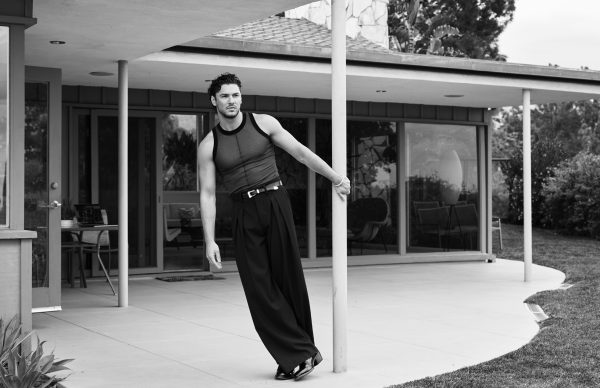
tank top. Diesel
trousers. Zara
necklace. Dolce & Gabbana
Vladimir Burlakov has spent much of his career slipping into other people’s lives. From troubled detectives and enigmatic outsiders to artists and historical figures, the German actor has built an impressive body of work by refusing to be defined by any one character, genre or expectation. Born in Moscow and raised in Germany, his own story is one of navigating different worlds, an experience that perhaps makes his ability to inhabit unfamiliar identities all the more instinctive. For Burlakov, acting is ultimately an invitation to explore the many facets of human nature, to step outside the boundaries of his own experience and discover something unexpected in the process.
His latest project, ‘Vienna Game‘, offers another opportunity to do just that. Set against the opulent yet politically charged backdrop of Vienna in 1814, the series transports viewers to a Europe at a crossroads, where emperors, diplomats and powerful political figures gather to negotiate the continent’s future. At the centre of this intricate world of ambition, intrigue and shifting alliances is Tsar Alexander I, portrayed by Burlakov. A man of immense political influence but equally striking personal contradictions, Alexander is a fascinating study in power, vanity and vulnerability. For an actor drawn to characters who resist easy definition, he makes for particularly compelling material.
In conversation with Schön!, he opens up about growing up between cultures, finding the humanity in complicated characters and the peculiar demands of playing a tsar and the realities of life as an artist.

full look. Fendi
shirt. Dolce & Gabbana
opposite
jacket. GmbH
underwear. Diesel
shoes. Dsquared2
socks. Adidas
When did you first realise that you wanted to be an actor?
I knew by the age of four. My mother worked in theatre, so I spent much of my childhood backstage. I got to watch rehearsals and see how an idea gradually turned into a production. I was fascinated by it all. To me, theatre was a magical place where anything you imagined could become reality. I never really saw myself doing anything else.
Do you think your Russian heritage has influenced the kinds of roles you’ve been offered?
Early in my career, my Russian roots definitely influenced the kinds of roles I was offered. People are quick to put others into boxes, and the film industry is no different. I had to make an effort to be seen beyond that. Thankfully, things have changed over the years. And when I get the chance to play figures like Wassily Kandinsky or Tsar Alexander I in ‘Vienna Game’, I see my Russian heritage as a real asset. They’re extraordinary figures and playing them has been incredibly rewarding.
How did you manage to move beyond being seen primarily as a Russian actor?
At a certain point, I started turning down certain roles. During my acting training, I put a lot of work into learning to speak German without an accent, and I didn’t want to keep being cast as ‘the Russian with an accent’. I decided I wanted to have more of a say in the roles I played and how I was seen as an actor. Getting cast as Leo Hölzer in ‘Tatort’ felt like a real turning point. You can’t get much more German than him! (laughs)
How do you find your way into a character whose personality is so different from your own?
I approach every role in much the same way. I work with my wonderful acting coach, Bettina Lohmeyer, to get to the heart of a character and understand what drives them. I believe we all have far more sides to our personalities than we reveal in everyday life. How much of ourselves we show or hold back often comes down to how we were brought up. That’s why I think characters who seem completely different from us can actually be closer to us than we might expect. For me, acting isn’t about imitating someone else. It’s about finding those sides of myself in the character.

full look. Dolce & Gabbana
You’ve already played Wassily Kandinsky in ‘Münter & Kandinsky’, and now you’re taking on another historical figure, Alexander I, in ‘Vienna Game’. Is your approach different when you’re playing someone who actually existed?
The main difference is the amount of research involved. I read a lot more, look into biographies and other literature, and try to understand not just the person themselves, but also the political and social climate they lived in. After all, we’re all shaped by the times we grow up in. It’s always interesting when there’s archival footage or audio recordings to draw on. They can tell you a lot about someone’s physical presence, their gestures or the way they spoke. That wasn’t the case with Kandinsky or Alexander I. I also feel a certain responsibility when portraying real historical figures. I want to do justice to all their contradictions, while keeping in mind that I’m not trying to recreate history. In the end, it’s my own interpretation as an actor.
How would you describe Alexander I?
Alexander I was a man of many contradictions. He could be incredibly arrogant, vain and obsessed with power, sometimes even hot-tempered and completely consumed by his own sense of grandeur. But there was also a very sensitive, vulnerable side to him. What I find particularly fascinating is the contrast between his almost absolute belief in his own power and his emotional fragility. He wanted to shape the future of Europe, yet struggled to come to terms with his own inner conflicts.
What drew you to the role of Alexander I?
What drew me to him, apart from all the contradictions in his character, was the sheer amount of power he had. Alexander was at the very top of the political hierarchy, and he seemed to have no limits when it came to exercising that power. At one point, he says: “I have 200,000 soldiers in Poland. Let them try to drive me out!” That line really says it all. It tells you a lot about the kind of man he was and how he dealt with people. He could be incredibly bold, almost as if he could get away with anything. And that made him such an interesting character to play. It gave me a lot of freedom as an actor.
What’s the most unusual thing you’ve ever been asked to do for a role?
I love trying things out and pushing myself as an actor, even if that means taking a risk and getting it wrong. So I’ve never really thought of anything as particularly unusual. I’m usually willing to give anything a go. One scene from ‘Vienna Game’ does come to mind, though. It wasn’t something the director asked me to do; it was actually written into the script, presumably based on a historical account. As Tsar Alexander I, I had to suck on a co-star’s toes like a baby. (laughs)

jacket. GmbH
opposite
jacket. Ralph Lauren
tanktop + underwear. Diesel
trousers. Zara
necklace. Dolce & Gabbana
You’ve wanted to direct for a long time. After spending so much time in front of the camera, what interests you about stepping behind it?
Directing has been a dream of mine for a long time. Just before I started drama school, I actually thought about studying directing. But I always knew I wanted to pursue acting. What I find most interesting about directing is working with actors. Everyone is different, and you have to find the right way to work with each person. I love the process of figuring out how to bring out the best in someone and create a character together. I’ve been working on my directorial debut for the past four years and have just finished the fourth draft of the script. I already have some key creative collaborators on board, and I’m currently looking for a production company. Hopefully, I’ll be able to make it happen in the next few years.
Is there anything you wish you were asked about more often in interviews?
Maybe what being an artist is really like, and the mental toll that comes with it.

top. Dries Van Noten
opposite
jacket. COS
tank top. Lacoste
tracksuit. Fila
What’s it like?
People mainly see the glamorous side of the job: red carpets, premieres and award ceremonies. What they don’t see is how much your career depends on other people’s opinions of you. You’re constantly being judged, throughout your entire career. At auditions, on set and even afterwards, when your work is out there and people either respond to it or they don’t. You’re always having to prove yourself, deal with rejection and get through periods of uncertainty.
Even though you learn not to take rejection personally, that’s not always easy. Especially in a profession where you put so much of yourself into your work, it can take a real toll. I don’t think we talk nearly enough about artists’ mental health, or about how much inner strength this job actually requires. Because at the end of the day, we’re all just children who want to play, and who want to be seen, accepted and loved.
If you could play one of your previous roles again, which one would you choose?
Probably Andreas Wolf in the Netflix series ‘Kleo’. It took me until about halfway through filming to realise just how over-the-top the series was. At first, I thought we were making a fairly realistic spy drama set during the East-West tensions of the 1980s. It was only when I saw how the other actors were playing their characters that I began to understand the tone of the show. If I’d realised that from the start, I would have approached Andreas Wolf very differently and probably given him a different edge. It’s a bit like playing Tsar Alexander I in ‘Vienna Game’, where I was able to really embrace that more exaggerated style from the start.

jacket. Ralph Lauren
tank top + underwear. Diesel
trousers. Zara
necklace. Dolce & Gabbana
photography. Nikos Karpouzis
fashion. Ridvan Cavus
talent. Vladimir Burlakov
hair + make up. Matilda Kreuter using Gucci Beauty + Kiko Milano
interview. Alexandra Schmidt
photography assistant. Tasos Papadopoulos