‘Point of Unity’. Photography. Mark Cocksedge
Every September, London turns its attention to design. Since Sir John Sorrell and Ben Evans founded it in 2003, the London Design Festival has grown into one of the anchors of the global cultural calendar: a nine-day trail of landmark installations, exhibitions and talks that transform the entire city into a gallery. Now in its 24th edition, running from 12 to 20 September, it draws makers, architects and designers from across the world into a single conversation, one held between East and West, past and future, craft and technology. To take it in properly, Schön! alive does the only sensible thing, and boards a vintage red London bus to see what the city holds.
the meeting of hands | craft x tech
The route begins in South Kensington, where the second edition of ‘Craft x Tech’ has taken over the V&A’s Medieval & Renaissance galleries. The project gathers artisans from Japan’s Tokai region, the historic heartland of Japanese making that spans the Aichi, Gifu, Mie and Shizuoka prefectures, pairing them with internationally acclaimed designers to ask what traditional craft might yet become. Founded by Dr Hideki Yoshimoto of Tangent and shaped by the curatorial direction of Maria Cristina Didero, it sets inherited Japanese technique beside contemporary design and lets the two talk.
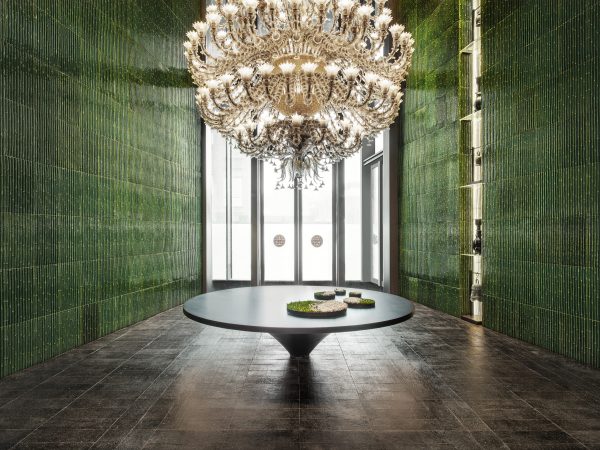
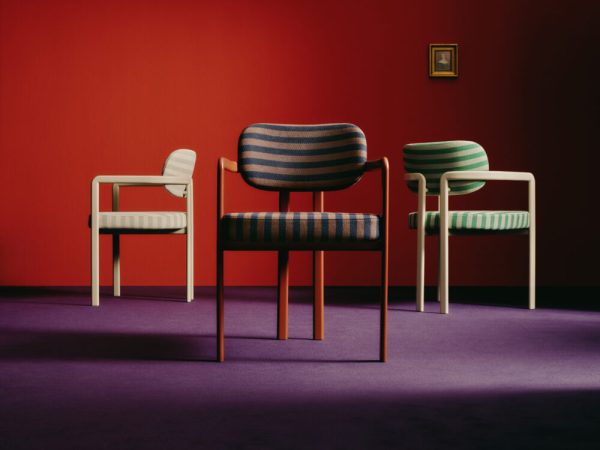
The results reward slow looking. Yohei Ito of the Fudogama kiln has worked with Australian designer David Caon on ‘Fushi’, a console whose legs are stacked from glossy green Mino Yaki ceramic, glowing like cut bamboo beneath the gallery’s ancient timber doorway. Hiroyuki Murase of Suzusan and British designer Bethan Laura Wood draw on Arimatsu Narumi Shibori, a centuries-old Japanese dip-dyeing craft, to create the glowing sculptural works of ‘Kataginu’. Close by, Mayuki Kato of Shingama and the artist Eugene Kangawa raise two slatted chairs, one washed in indigo, one traced with pale botanical brushwork, on plinths beneath a carved medieval staircase. Each piece makes the same quiet argument: that what we now call tradition was once, itself, invention.

Seto Sometsuke Yaki x Eugene Kangawa chairs. Photography. Masayuki Hayashi
the embrace | ‘lovers hold’
A few rooms on, the V&A’s own festival programme, ‘Awakenings’, gathers a younger generation around questions of consciousness, identity and the non-human world, with new work from the likes of Aziza Kadyri, Eunjo Lee and the studio Playfool. Yet it is Henry Svendsen’s ‘Lovers Hold’ that quietly stands out: two molten forms, cast in black resin and fibreglass, suspended around stainless-steel armatures. They hang heavy and wet-looking, their folds seeming to pool and drip as though caught mid-movement. The work continues Svendsen’s study of the plinth and the sculptural support, reimagining furniture built for closeness, such as the kissing chair, as something that might hold several bodies at once.
Look closer and the surfaces carry fingerprints and grab marks, the residue of everyone who has leaned in. “A lot of my work focuses on how bodies gather around objects in space, primarily through a queer lens,” says Svendsen. His sculptures read as accumulated traces of contact, a meditation on what it means to rest, lean and linger in places never designed to hold us.

‘Lover’s Hold’, Henry Svendsen. Photography. Sarah Duncan
the reflection | ‘afterimage’
From South Kensington the bus swings north to Mayfair, where Monologue London has turned its Portman Square showroom into ‘Afterimage’, an exhibition about light, memory and the moment a piece lingers in the eye. At its centre stands a monumental circular mirror, polished in stainless steel by the Italian maker Mingardo from a clouded rim to a flawless core and raised on a gridded steel platform. Move around it and the room turns with you: the furniture, the walls and the gardens of Portman Square fold into one another, then pull apart again.
Conceived by Monologue’s founder Pavel Klimczak and designed by Paraforma, the installation sets established icons beside emerging voices. The Italian house Tacchini anchors the room with Mario Bellini’s Le Mura sofa and Joe Colombo’s Additional System daybed. Around them sit 6:AM’s Murano side tables dusted with Carrara marble and Paraforma’s hand-cast resin ‘Gelo’ tables, catching the light in amber and rose. Svendsen surfaces here too, with ‘Bent’, a stainless-steel chair that balances its sitter on a few defined points. Since founding Monologue in 2015, Klimczak has built the gallery on exactly this instinct: material integrity first, and pieces meant to be lived with.

Monologue Showroom. Photography. AXIIS Studio
the shelter | the pangolin shield
The tour heads east to Strand Aldwych, the pedestrianised square behind the Indian High Commission. Here, one of the festival’s Landmark Projects has taken root: ‘The Pangolin Shield’, by architecture practice Studio Saar and structural engineers Atelier One, supported by Secure. From a distance it reads as a great scaled creature at rest. Up close it resolves into a bamboo grid shell layered with hundreds of overlapping shields: traditional Indian police shields set alongside ‘knups’, the woven cane rain shields carried by farmers in north-eastern India. Their greens, blues and sand tones are shingled like a pangolin’s armour.
The gesture is deliberate. Lifted out of their context of confrontation and set in symbiosis with the farmers’ knups, the police shields are disarmed and remade as collective shelter. The result is a canopy that plays light against shade, drawing people in to gather beneath it. Named for the world’s most trafficked mammal, it holds within its form questions of protection and vulnerability, colonial legacy and the movement of people and beings across borders. “I’m a great believer in the power of small things coming together, philosophically, politically and economically,” says Ananya Singhal, Managing Partner at Studio Saar. “Often-overlooked materials form something bigger, more powerful and more potent; The Pangolin Shield is exactly that.” The bamboo itself, drawn from three Indian states, makes a quiet case for one of the world’s most sustainable materials. As Professor Neil Thomas, founder of Atelier One, puts it: “Nature has its own rules, and it is pretty good at following them; it has been doing it for 400 million years.”

‘The Pangolin Shield’. Photography. Mark Cocksedge
the field of stars | ‘the point of unity’
The last stretch carries the tour into the city, to the steps of St Paul’s Cathedral, where Ukrainian artist Mykola Kabluka, founder of the lighting and media-art studio Expolight, has set two works against Sir Christopher Wren’s dome. By day, ‘The Point of Unity’ is a ring of mirror-polished steel that swallows the cathedral whole, bending its Baroque columns and the passing clouds across a warped surface. After dark it becomes something else entirely. Across the canopy, 3,500 fibre-optic points light up into a field of stars, while custom filters break the white light into shifting bands of colour. A soundtrack, drawn from astronomical data, moves through the space alongside them. Making its UK debut after first appearing at Burning Man, the sculpture asks visitors to feel themselves part of something larger, a meeting point of earth and sky.
Projected onto the cathedral, ‘Soul’ unfolds imagery that is never fixed in advance but emerges in the moment, through the interplay of light, glass and movement. These systems are underpinned by neurophysiological research into daydreaming and inward thought. Made by an artist whose country is living through war, both works are shaped by that reality without showing it directly. They turn instead to questions that feel newly universal: how to keep an inner light through darkness and how to turn hope into action. It is a fitting place to end, beneath a dome that has watched over the city for three centuries.

‘Point of Unity’. Photography. Mark Cocksedge
By the time the bus completes its tour, the through-line has quietly revealed itself. Across a single city, the same instinct keeps surfacing: to create things made for closeness, whether that’s a canopy of disarmed shields, a sculpture made for two or a ring of light that gathers strangers beneath a kindled sky. That, in the end, is what the city holds.
Find out more about London Design Festival here.
words. Olivia Cichero
edit. Huma Humayun