

Jan Melka by Xaysanah Phongthisouk, ‘Venus en 21 morceaux’ (2026).
What would the human body look like before it was assigned an identity? For French-American artist Jan Melka, the answer lies somewhere between figuration and abstraction, in forms that twist, fragment and resist easy interpretation.
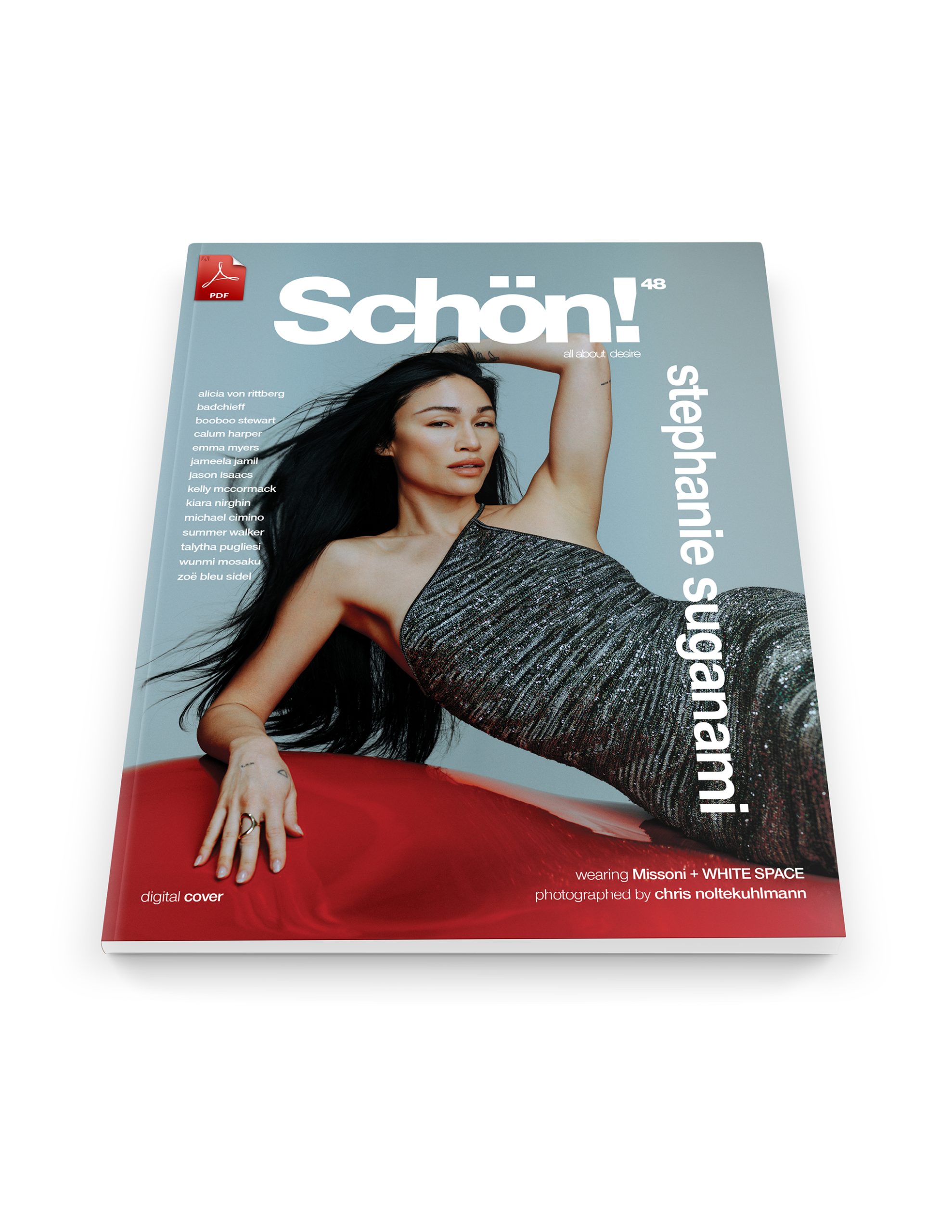
Two years after gracing Schön! 47’s art issue cover, Melka returns with a question that cuts closer to the body: what connects us before gender, identity and mythology enter the picture? Her latest solo exhibition, ‘Ni Adam, ni Ève’, presented at Paris’ Vie Projects in collaboration with ChaCha and Galerie Romero Paprocki, explores this uncertain territory through painting, drawing and textiles, imagining bodies that exist before these distinctions take hold.
Based in Paris, Melka has developed a practice spanning painting, sculpture and installation, examining how bodies occupy space and where their physical boundaries begin to dissolve. Her compositions bring together fragmented forms, distorted proportions and recurring curves, with the human figure appearing in a constant state of transformation.
The exhibition’s title questions the biblical origins of gender and the structures through which identity has historically been defined. Drawing inspiration from faded, partially erased frescoes she encountered while working in historic Italian churches, Melka builds movement through layers of pigment, subsequently scraping them away to reveal what lies beneath.

Jan Melka by Xaysanah Phongthisouk, ‘Châssis-chaise buste’ (2026) and ‘Châssis-chaise machine’ (2026), Mémoire d’une séparation (2026) and Forme Libre (2026).

Jan Melka by Xaysanah Phongthisouk, ‘Mémoire d’une séparation(2026).
In paintings such as ‘Eclipse’ (2026), made with oil and acrylic on linen, figures emerge through the interplay of colour, texture and erasure. Elsewhere, textured works such as ‘Forme libre’ (2026) and ‘Coquillage’ (2026) bring the body into closer contact with the woven surface, allowing shapes to appear as though they are gradually materialising or disappearing.
Intimate drawings on linen — including ‘Nuit Blanche’ (2026), ‘Pièce montée’ (2026) and ‘Miette’ (2026) — introduce a smaller, more personal scale to the exhibition. Nearby, experimental pieces such as ‘Châssis-chaise buste’ (2026) and ‘Châssis-chaise machine’ (2026) push the relationship between image and object further, bringing compositions in oil and black chalk into conversation with sculptural elements.

Jan Melka by Xaysanah Phongthisouk, ‘Châssis-chaise buste’ (2026) and ‘Châssis-chaise machine’ (2026).
The exhibition also features ‘Venus en 21 morceaux’ (2026), a textile work made from cotton and linen in variable dimensions — or what Melka calls her “monsters”. Here, the familiar boundaries of a framed artwork give way to a form that extends into the surrounding space, turning the room itself into part of the encounter.
A graduate of Paris’s EPSAA, where she completed her studies in 2017, Melka has exhibited internationally, with previous presentations in São Paulo, New York, Tokyo and Mexico City. Across her work, the recognisable repeatedly gives way to something more uncertain, allowing bodies to exist beyond fixed categories and conventional representations. In ‘Ni Adam, ni Ève’, this instability becomes a language of its own, with each work suggesting a form still in the process of becoming.
‘Ni Adam, ni Ève’ welcomes visitors daily from 10 am to 6 pm through its extended closing date on 8 November. Find out more here.
photography. courtesy of Xaysanah Phongthisouk
words. Gennaro Costanzo