blazer + jacket (worn underneath). Sir.
For more than half a century, ‘Star Trek’ has invited audiences to look beyond the stars — and, in doing so, to look more closely at ourselves. With ‘Star Trek: Strange New Worlds’, that tradition continues through stories that blend the spectacle of science fiction with questions of identity, morality, human connection and the possibilities of the future.
For actress Jess Bush, joining that universe offered an opportunity to explore those ideas from inside one of television’s most enduring cultural phenomena. As Christine Chapel, Bush has brought a distinctive emotional complexity to a character navigating ambition, intimacy, friendship and self-discovery. Her path to ‘Strange New Worlds’ was hardly conventional. A painter before becoming an actor, Bush was drawn to the vulnerability and collaborative nature of performance. That same curiosity now informs her approach to a demanding production where precision, spectacle and spontaneity must coexist.
Schön! spoke with Bush about her unconventional route into acting, the experience of joining the ‘Star Trek’ universe, the friendship at the heart of Chapel’s story, and what the series can teach us about connection, compassion and being human.

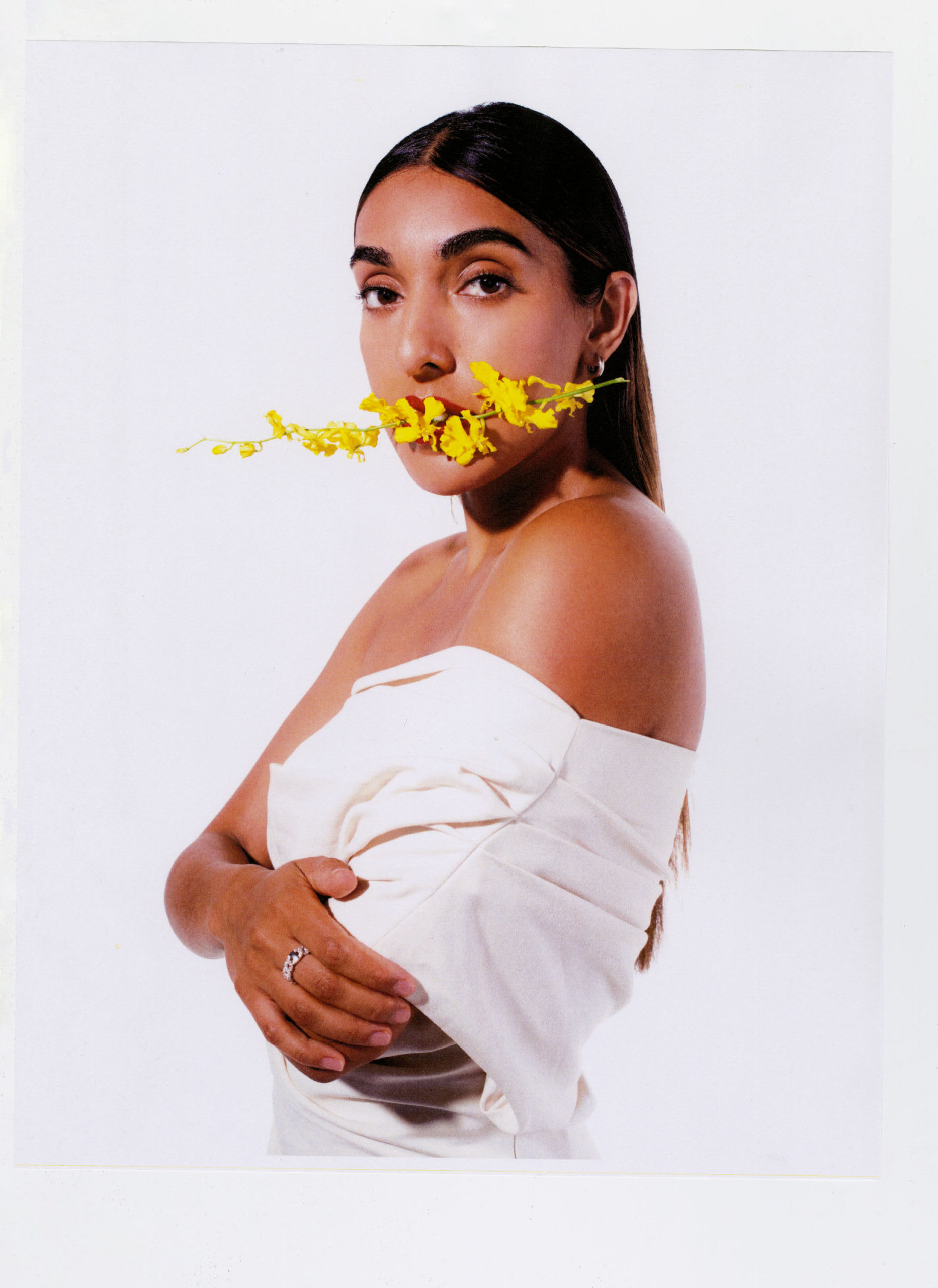
cardigan, dress + scarf. Marina Rinaldi
shoes. All Saints
ear cuff (left). Acne
ear cuff (right). Alan Crocetti
belt. Below the Belt
boot garters. Stylist’s Archive
opposite
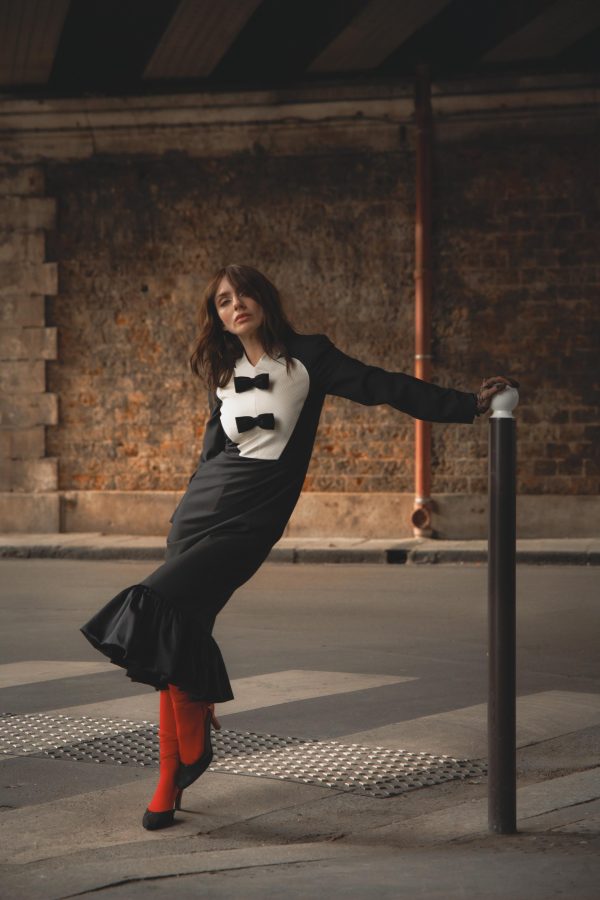
blazer + neck piece. Mariam Seddiq

jacket, sweater + skirt. Banded Together
boots. Jimmy Choo
earrings. Stylist’s Archive
opposite
blazer, bralette + trousers. Amy Cottrell
shoes. Betts
necklaces. RELIC
What first inspired you to pursue acting, and when did you realize it was something you wanted to build a career around?
Gosh, it was so long ago now, I was an entirely different person back then. What first pulled me in was that acting was a completely foreign and terrifying medium. I was a painter at the time—I’d been making my art in a private way for years. I could decide when and how my work would be seen while watching safely from behind the curtain.
But with acting you have to have your process witnessed, which felt wild and exposing. The art of it lives fleetingly in the space between you and another person, and you need other artists to pay attention and catch it. It was so new and thrilling to me—I was hooked on how uncomfortable and alive it all made me feel.
Most of us spend the majority of our lives at work. For me, it’s the active interplay between people—other actors, camera operators, directors, SFX, audiences and on and on—that drew me into acting as a career. I find it hard to resist an opportunity to plug into this collaborative superpower we have as connected, empathetic animals. It really affirms the most brilliant parts of what it means to be a human.
In white Australian culture we’re emotionally suppressed and drenched in shame—it feels both scary and good to actively work against that and make things that hopefully help people feel more connected to their emotional experience.
Looking back at your early roles, what lessons have stayed with you and continue to influence the way you approach a character?
So much more information and detail reveals itself to you when you’re playing. This was a tough lesson for me because growing up I was always taught to work hard, that worthwhile things should be a struggle. But if you’re having fun and you hold things lightly, you’ll always find something much more interesting.
I used to be crushed by imposter syndrome and I learned that the best way to get it off my back was to forget about myself and just show up and be open and curious to what’s going on, and to be unashamed to ask questions about things I don’t understand. And to expect that from everyone else. That’s all that anyone ever wants from you anyway.
How did the opportunity to work on ‘Star Trek: Strange New Worlds’ come about, and what was your reaction when you found out you had landed the role?
I had just decided to take a break from acting before the ‘Strange New Worlds’ audition. It’s crazy how often you hear that story, but it’s true. I was feeling pretty destroyed and took a step back to work on a major sculptural work for a year.
I told my managers I only wanted them to send an audition through if it was one we couldn’t turn down. When I was installing the sculpture for exhibition, the casting director requested me for ‘Star Trek’. The whole casting process was done over Zoom across a couple of months—I didn’t meet anyone from the show until I walked onto set in Canada.
I was away on holiday with my friends when I finally got the call. I lost control of my body and face-planted in the sand for a while and started to weepy-laugh. It was just the most inconceivable win to me after years of hard work, questioning, rejection and sacrifice. My body gave out under the euphoria and relief of such a massive vindication. My life completely changed in that moment.

blazer, dress + shoes. Dolce & Gabbana
earrings. Givenchy @ Constantina Vintage
ear cuffs. Stylist’s Archive
hosiery. Chusette
opposite
rollneck. ZIMMERLI
skirt (worn as dress). Mariam Seddiq
shoes. Valentino
bag. Gail Sorronda
hosiery. Chusette

dress, rollneck + sleeves. Gail Sorronda
shoes. Valentino
earrings. Monet Vintage
What can you tell us about your character, and what did you find most compelling about playing her?
What I find most compelling about playing Chapel is that she’s emotionally avoidant, career-ambitious, and commitment-phobic, which is not a feminine archetype you typically see embraced on screen, especially in a character who physically presents as “fem-sexy.”
I feel like women who don’t want a romantic relationship with anyone are often portrayed as broken or unattractive.
I love that her path to deeper intimacy and connection is told mostly through a platonic relationship. Her friendship with the doctor is super deep and loving, but it’s unmistakably a friendship. You don’t often see that story told on screen without the inferred possibility of sexual tension.
I’ve loved telling a story that centres a friendship as the most impactful relationship in her life, where she finds her most potent and enduring love and transformation.
The ‘Star Trek’ franchise carries decades of history and an exceptionally devoted audience. Did that legacy create pressure for you, or did it give you something exciting to draw upon?
I was definitely a little daunted stepping into such a massive and technically complex production—but I didn’t feel pressured by the legacy of ‘Star Trek’ or the fandom. That part felt like a massive gift.
If anything, the history of the show and the breadth of material made our mission clearer. The showrunners, producers, fans and the other actors in the ‘Star Trek’ universe have been so welcoming and supportive—it really was like entering a new family of mentors and cheerleaders who, I’ve felt, lit the way for me.
What was it like stepping onto the sets of ‘Strange New Worlds’ for the first time? Did the scale and detail of the production change the way you approached the work?
Insane. You are just a small part of something so spectacular and complex. There are so many moving parts and your performance won’t always be prioritised, so you have to get really good at energy management.
It could be three hours between shots because they’re resetting some flame cannons and you might be called in for your close-up at 3:30 a.m. after doing the scene 85 times in the past 16 hours in a spacesuit that you can’t sit down in and you can’t hear anything through the helmet.
You have to approach it like an athlete—you need mental and emotional stamina, and the ability to compartmentalise and focus on one thing in the middle of a room full of 200 people operating crazy stuff around you. I honestly love it all, though. I have a lot of energy, so I need to cut laps around the park or wrestle someone at the end of the day if I haven’t had enough stimulation. The unpredictable challenges keep me sane and level.
Is there a particular scene, episode or moment from your time on the series that remains especially memorable for you?
In Season Four, Episode Six—“Off Hour”—holds a special place for me. For the whole episode, my best friend on the ship, Dr. M’Benga, played by Babs Olusanmokun, and I are trapped alone in sickbay together after the ship gets stuck in a wormhole and is being torn apart.
He’s been lethally crushed and pinned behind a piece of equipment, and we spend the whole episode in a two-hander facing his imminent death. It was physically pretty challenging. I finished up sick and bruised like a peach, but I felt like my heart was permanently expanded after that experience with Babs.

top. Cappellazzo
bralette + shorts. Stylist’s Archive
hosiery. Chusette
opposite
dress. Bianca Spender
ear cuff. Alan Crocetti

jacket + trousers. Banded Together
rollneck. Zimmerli
boots. AQUAZURRA
earrings. Nina Ricci Vintage
opposite
camisole + skirt. Dolce & Gabbana
earrings. YSL @ Constantina Vintage
ring. Chloe
hosiery. Chusette
Science fiction often uses imagined futures to interrogate the anxieties and assumptions of the present. What do you think ‘Strange New Worlds’ is saying about the world we live in now?
So many things, but I think at the core of every story it asks us to try meeting who and what we don’t know with curiosity and compassion first, before fear.
Acting requires you to inhabit perspectives that may be profoundly different from your own. Has a role ever genuinely changed your understanding of human nature or altered the way you see the world?
I’m not sure if this directly answers your question — but in a more immediate, visceral sense, yes. This job forces you to make friends with the parts of yourself that you could hide from forever in any other line of work.
I’ve had to confront things in myself I didn’t feel capable to, over and over again, and let those parts be witnessed and held by other people. I think learning to embrace the more difficult parts of myself has grown my tolerance and capacity to hold space for other people, for ambiguity, for contradicting truths, for things I don’t fully understand.
That, and being inside celebrity culture and the public-image side of things has been bizarre, sometimes fascinating, sometimes disorienting. It’s a strange feeling when people start to look at you differently and you realise you’ve become something else to people you don’t know. No one prepares you for that part.
The ‘Star Trek’ tradition has long explored ethics, identity, technology and the possibility of a better society. Which of those ideas resonates most strongly with you as an artist?
I would say what resonates with me most artistically is the possibility for a better society. I like to make things that encourage honesty, self-acceptance and a sense of wonder. I think those things are gateways to more connection between people and a greater appreciation for life.
There’s an interesting tension between the precision of a major science-fiction production and the vulnerability and spontaneity required of an actor. How do you reconcile those two things in your work?
Honestly, it’s really a tricky skill that I’ve honed through this job. The other departments around you are operating towards a precise vision and often talk in terms of an image they want to see. As an actor, you can’t be doing that. You can’t be thinking about the end result—as I said before, you have to be in process. You learn to translate other people’s visions and directions into your own private language that you can stay present and active to, often in a split second before rolling.
You can’t just operate on raw talent and spontaneity; you need to build a strong sense of how you fit into the larger dance. And patience. You need a lot of patience and focus to stay open and alive inside precise choreography.
When you look at your career so far, do you see acting primarily as an exercise in transformation—becoming someone else—or as a process of discovering and revealing aspects of yourself?
In my career so far it has always felt like a discovering, as well as a revealing and amplification of different things that have lived in me. I feel transformation is sparked by discovery anyway—it always starts there. Every trait, no matter how outlandish or otherworldly or that feels different to what I understand as “me,” originates from something real I’ve felt.

dress. Cappellazzo
top. Cappellazzo
photography. Dean Podmore
art direction, fashion + production. Carlos Mangubat
talent. Jess Bush
hair + make up. Sylvia Ura
video. Faisal Payenda @ Valeon Studios
fashion assistants. Rini Pradhan, Kyah Purling + Ava Viscariello
studio. Valeon Studios