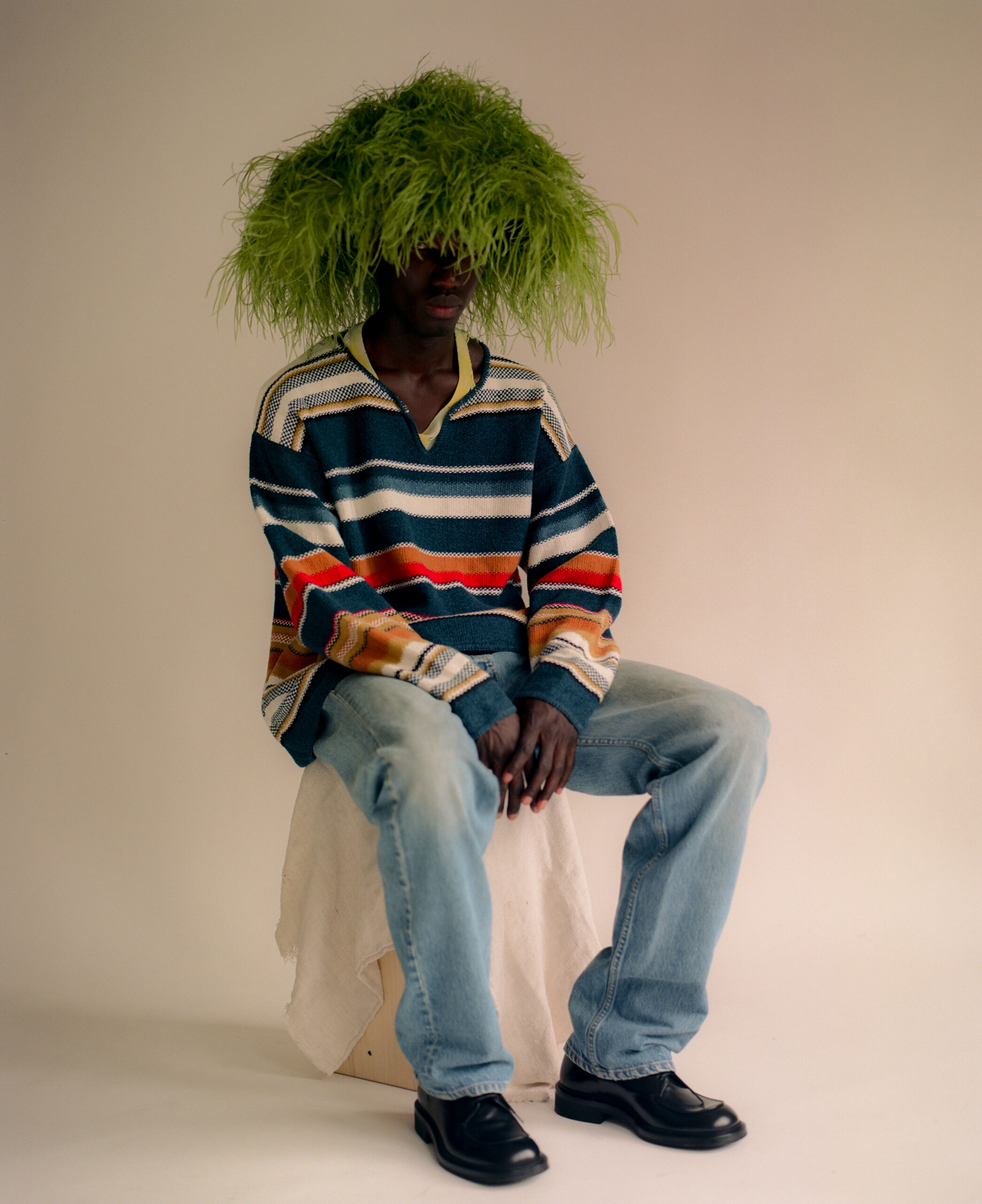
Sporting a Canadian tuxedo for the Midnight Madness premiere of his latest film ‘Vintage Violence,’ Cole Sprouse walks casually down King Street West, cutting through festivities after hopping off the 504 streetcar. His first TIFF and first time in the city of Toronto, Sprouse is taking it all in. The vibes, the people, the energy. Not your typical cinematic experience, there’s nothing quite like the feeling of screening a film at midnight and doing a Q&A with avid moviegoers at 2am. It’s electric.
Following disgraced Urban Explorer Carter (Sprouse), ‘Vintage Violence’ intertwines director Eugene Kotlyarenko’s signature use of mixed media and the stunning neon backgrounds of Japan to create a compelling thriller. When Carter meets the alluring Izumi (Kiko Mizuhara) online, their chemistry is palpable. After months of communicating, she persuades him to make the trip from the United States after he finds a cache of very expensive vintage Levi jeans, under the guise of having a buyer. Little does Carter know that the entire thing is a ruse to get the jeans and make some cash. What ensues is a series of events that become increasingly impossible to believe. And at the centre? A naïve Carter who just wants to take his jeans and go home.
Chatting with Schön!, Sprouse discusses meeting with Eugene Kotlyarenko for the first time, how he stops himself from spiralling on social media and more.
You were in Toronto for the first time, attending your first TIFF at Midnight Madness, no less! What was it like doing a Q&A at two in the morning? Was there a lot of caffeine involved?
That was my first Q&A at two in the morning, and I really, really loved Midnight Madness. First off, Peter Kuplowsky does an incredible job with the selection, and he really brought the energy up, which was nice. Because it’s midnight, everyone’s loud, having fun and excited to be there. The late-night screening naturally filters out a more casual audience, so you’re left with people who genuinely want to be there. It’s a very electric crowd. It was beautiful.
I can’t remember the exact name of the theatre we were at, but it was a beautiful old stage and theatre. Toronto was incredible, too. TIFF was electric, and the streets were filled with people who genuinely love cinema. We had great weather the entire time. I couldn’t have asked for a better TIFF experience.
It was serendipitous. And you had no delays on the streetcar, which, if you’re a Torontonian, you know is a minor miracle. You lucked out.
No, it was quick. [Laughs.] We had a bit of a wait for our vehicle, so I said, “You know, why don’t we just take the electric rail?” It seemed like the most efficient option.
I know you weren’t in Toronto for long, but were you able to check out any vintage shops while you were here?
No, and that’s the silly thing about visiting a city on a press tour: you don’t get much time to experience the city itself. I’m definitely going to have to take another trip to Toronto to see the sights and do all the things I wanted to do. Even at TIFF, I have this habit at every festival of foolishly convincing myself I’ll have enough time to see all the films and support other directors and actors. In reality, you only really manage to catch up with people at their after-parties.
Sounds chaotic. So exploring a city on a press tour isn’t exactly ideal. Moving on to Vintage Violence, I watched the film last night and really enjoyed it. Were you already familiar with Eugene Kotlyarenko’s work through Spree?
I’d seen Spree, but my involvement with the film came about pretty serendipitously. I met Eugene through a mutual friend, Kareem Rahma, the host of Subway Takes, who’s also a great actor and musician. We were out having a few beers when Kareem said, “Oh, my buddy’s going to join us,” and that was Eugene. We had a great day, just sitting around and talking about film. About three months later, he reached out and asked if we could jump on a call. He told me he’d written a script and was thinking of me for the lead. I read it, and it was incredible.
I did some more research into Eugene’s work and watched The Code, Wobble Palace and some of his earlier projects. I felt that he has a really strong creative fingerprint, so I was able to get a good sense of the tone he wanted for Vintage Violence. The prospect of shooting in Japan for two months was also incredibly alluring, so it was a no-brainer for me. The script was good, the director had a strong vision, and there was this sense of the movie gods at work in how serendipitously we’d met. The character is an urban explorer and streamer, which was compelling to me because it’s something I used to do a lot of when I first started out in photography. I just felt like all the right ingredients were there.

And it totally worked. Take me back to filming in Japan for those two months. Your camera must have gotten a good workout. Also, are the egg sandwiches as good as everyone claims?
The egg sandwiches are undeniably delicious. We were working a six-day week, which was obviously pretty intense. But I think the energy of being a tourist was so strong that I never really felt tired. The production itself was incredibly energising because the film’s tone was so energetic. We all felt that way. I’d say the biggest distinction between the Japanese team’s approach and what I was used to in North America was the level of premeditation. There was a much more deliberate, preconceived approach to how the Japanese team handled the storyboarding and narrative.
In North American cinema, I think there’s an assumption of spontaneity, both on set and in the way audiences experience a film. I don’t think that was necessarily the case on our set, so that was a significant distinction from what I was used to. But I think the beauty of the production was in the intersection of those two approaches to the natural chaos of a film set. The Venn diagram right in the middle was incredibly intriguing. Overall, the entire experience was a dream.
Carter meets Izumi (Kiko Mizuhara) through a livestream and puts his faith in her almost immediately. I think that speaks to the instantaneous relationships we form through social media and how readily we trust people through that lens. I follow you, you follow me back, and suddenly we’re mutuals. What is it about Izumi that prompts such an instinctive reaction from Carter? Why does he trust her so completely? The chemistry is immediate.
I played Carter as someone who’s quite naive, if not a little dumb at times. I think he’s hopeful. When we meet him, he’s disgraced and at a pretty low point. In one of the original scripts, although I don’t know if it’s ever really mentioned in this cut, he’d spent some time in jail. He was finally like a bird out of a cage, and the world had given him an opportunity. He was so hopeful that he followed it almost blindly.
One of the interesting things about social media is that, before Carter goes to Japan, he builds quite a substantial relationship with Izumi. And she fools him. I think that speaks to something we’re dealing with in the post-social-media age: we don’t really know someone until we’ve spent a significant amount of time with them in proximity. We can trick ourselves into believing in the version of someone they perform online, through FaceTime or other forms of long-distance communication. What you picked up on is an important theme, not just in Vintage Violence, but in some of Eugene’s other films as well.
At TIFF, you spoke about how we’re still in the Wild West of social media, only just beginning to find our bearings. For all the good it can do, there’s always a darker side, which the film explores. When you find yourself doomscrolling or spending too much time online, what do you do to pull yourself out of that spiral?
That’s an interesting question. I recently moved to New York, and I try to fill my days with as much spontaneity as possible. I think New York is a great city for that, although you can do it pretty much anywhere. First of all, you have to get up. You have to stand up. What I do is simply walk out the door. New York rewards you for doing that. It’s one of the last truly walkable cities in the United States. That’s what works for me personally. I know there are apps that can limit your screen time, but I’m 34. I grew up with the internet as it evolved, and I remember a time when we didn’t have it. Over the years, I’ve noticed a direct correlation between how much time I spend on social media and how I feel. The more time I spend on it, the worse I feel.
Thankfully, I’ve developed enough self-awareness to recognise what’s happening with my body and mental health. I can catch myself and think, “Oh, right. Maybe I don’t feel good because I’ve spent six hours on my phone today.” I think that’s a pretty common experience. Most of us don’t feel particularly good when we spend all day on our phones, on the internet or scrolling through social media. It’s important to figure out what works for you and find a way to step away. I’m a big believer that, although social media has brought quite a bit of good into the world, it isn’t ultimately a force for good. I think it has deeply complicated most of our lives in ways that aren’t necessarily beneficial.
When I talk about the “Wild West,” I mean that we’re essentially guinea pigs for these companies, trying to figure out how this technology affects us. We’re the first generation to have grown up dealing with it on this scale. Now, enough time has passed for us to start realising that we don’t necessarily enjoy it all that much. I don’t know how many people genuinely feel happy after spending an entire day online. But I also think we’re beginning to see some encouraging trends, particularly among Gen Z and younger generations. There’s a massive resurgence in the collection and appreciation of physical media. We’re seeing a renewed appreciation for going to the cinema, as well as for physical third spaces where people can gather. There’s also a return to a simpler, more natural way of living.
If you ask any of my millennial friends what they hope their lives will look like in ten years, most will say something like, “I want to farm with chickens and goats. I want a little plot of land.” I think that speaks to how we’ve split our identities in two: one rooted in our real, lived experiences and the other existing entirely in the virtual world. We’re yearning to reconnect those two sides of ourselves, and I think it’s important for all of us to find ways to do that.

photography. Mallory Turner
talent. Cole Sprouse
editor. Kelsey Barnes
interview. Dana Reboe