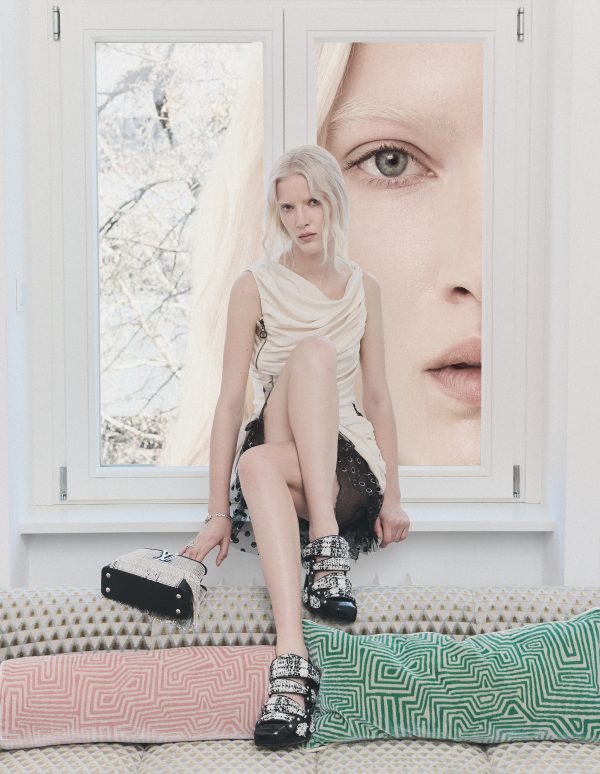
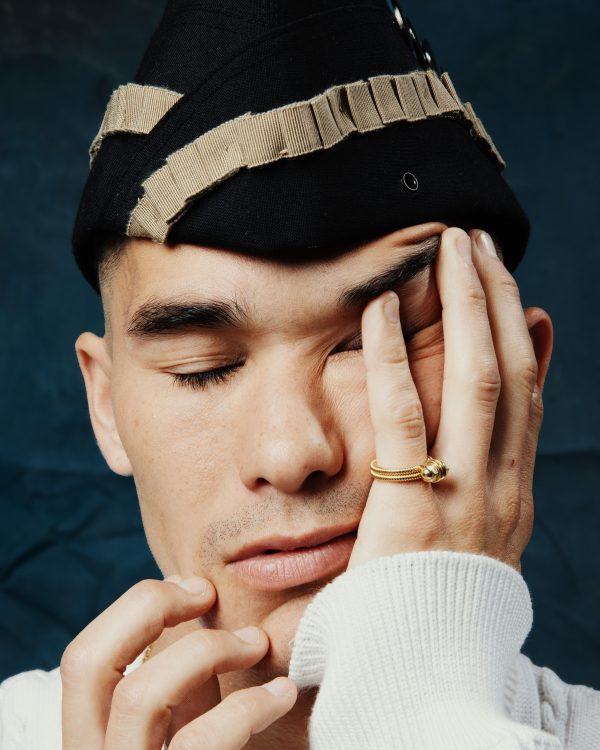
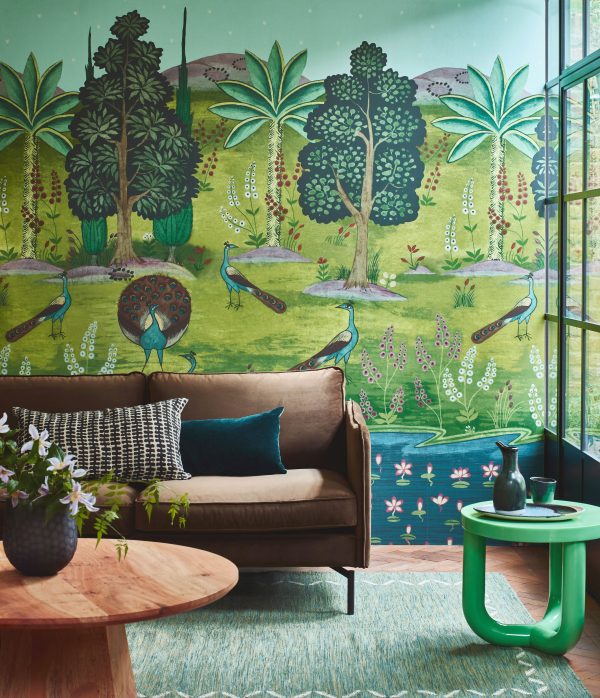
Irene Cattaneo + ‘Queen of the Night coffee table’, ‘Il Gardino Segreto’, 2026. Photography. Enrico Fiorese
For the German-Italian artist Irene Cattaneo, art is made to be lived with, a form that holds feeling long after the moment has passed. That conviction has never been more tender than in ‘Il Giardino Segreto’ (The Secret Garden): an immersive installation hidden within a walled Venetian garden, where a bronze swing hangs low over the greenery and sunlight filters through the leaves. Produced by Lo Studio – Nadja Romain, the Venetian studio that represents her alongside Paris’s Galerie Gastou, it is her most personal work to date.
Cattaneo’s work grows out of lived experience: emotion, memory and the cities that shaped her. She was raised in Rome and later trained at Central Saint Martins in London. “I’m hyper-emotional, a little bit of an oversharer. That’s very Italian,” she shares. That side of her feeds an instinct for craft and material; the German half tempers it, tying each feeling back to an idea. Her work often begins with a word: a pun, a phrase turned over until it yields a shape. The cloud recurs as her signature motif, a form that never holds still. “I express my emotion without it being about me,” she says, the feeling carried through a myth, a novel or a line of verse.
It all converges in her latest installation. Born of her new motherhood, ‘Il Giardino Segreto’ unfolds as a dream-like garden where the real and the imagined quietly blur. The instillation turns on a single centre: the ‘Effie Briest’ swing set, a seat hung by chains from sinuous, root-like arms of patinated bronze. The title borrows from Theodor Fontane’s ‘Effi Briest’, which opens on a girl mid-swing, her fate already sealed by the reader’s foreboding. To Cattaneo, it is “the hard balance of fun and risk, freedom and fall”. She made it in the first months of motherhood, and it holds both halves of that feeling at once.

‘Effie Briest swing set’ at ‘Il Gardino Segreto’, Irene Cattaneo, 2026. Photography. Enrico Fiorese
The rest of the garden turns on the same tension of early motherhood, the instinct to shield a child against the wish to let them go out and grow. A well of solid stone, set in dialogue with the garden’s old Venetian well-head, draws the eye downward to an illuminated inscription at its base: the phrase “well, well, well”, lighting the dark it might otherwise keep. Snowdrops, cast in glass and bronze, stand as a tribute to her own mother. The first flower to break through frozen ground; they are an emblem of resilience and new beginnings. In a pair of tables she calls ‘Pareidola’, the cloud returns to earth. Named for the child’s game of finding shapes in the sky, they turn ‘cloud’ into ‘could’, possibility made solid. Everything here is made by hand, in the workshops of the lagoon. “There’s nowhere like Venice,” Cattaneo says. “Here you can turn what you feel into something you can hold.”

‘Les Bienfaits de la Lune’, Irene Cattaneo at Galerie Gastou, 2025. Photography. Enrico Fiorese
Two people have been central to Cattaneo’s work. In Venice, that is Nadja Romain. Before founding Lo Studio, Romain spent years producing film and art, working with Matthew Barney, Philip Glass and Harmony Korine. Lo Studio operates as a gallery, an advisory and a salon, dedicated to keeping craft traditions alive. It was Romain who gave Cattaneo the nerve to attempt something this ambitious. “Nadja gave me my first carte blanche,” says Cattaneo. But the work of realising it was far from straightforward. Coaxing the installation into a private garden, in a city that resists at every step, took three years. “Venice is complex,” Romain explains. “It rains, and the city stops.” Romain reads Cattaneo’s work more closely than anyone. “I saw the motherhood before she was even pregnant,” Romain tells us. “She was expressing something that was really there; she just wouldn’t talk about it.” That instinct is the foundation on which everything else is built.

‘Les Bienfaits de la Lune’, Irene Cattaneo at Galerie Gastou, 2025. Photography. Édouard Auffray
If Nadja Romain gave Cattaneo the room to create, Victor Gastou has given it to the world. With his father Yves, he leads Galerie Gastou, a Paris house that has championed the meuble-sculpture for four decades. It is the gallery that has taken her name beyond Venice, to Paris and an international stage. “Victor brought it to another level,” Cattaneo says, “thanks to the historical credibility the gallery has, and it brought me outside of Venice, to Paris.” Her inaugural solo show there, ‘Les Bienfaits de la Lune’, drew on Baudelaire’s prose poem of a child blessed by the moon: the same literary instinct that runs through all of her work.
The alliance is a natural one: the gallery has long prized precisely what she makes, objects poised between sculpture and use. Gastou frames it almost as Cattaneo does. “They hold such power,” he explains. “They elevate us, they inspire us. These objects, this beauty, help us live.” Between a producer who grants her freedom and a gallerist who lends her lineage, Cattaneo has both liberty and a bar to clear. “Freedom and trust,” as she puts it, “but also an unspoken standard I have to keep”: the rare scaffolding an ambitious young artist needs.

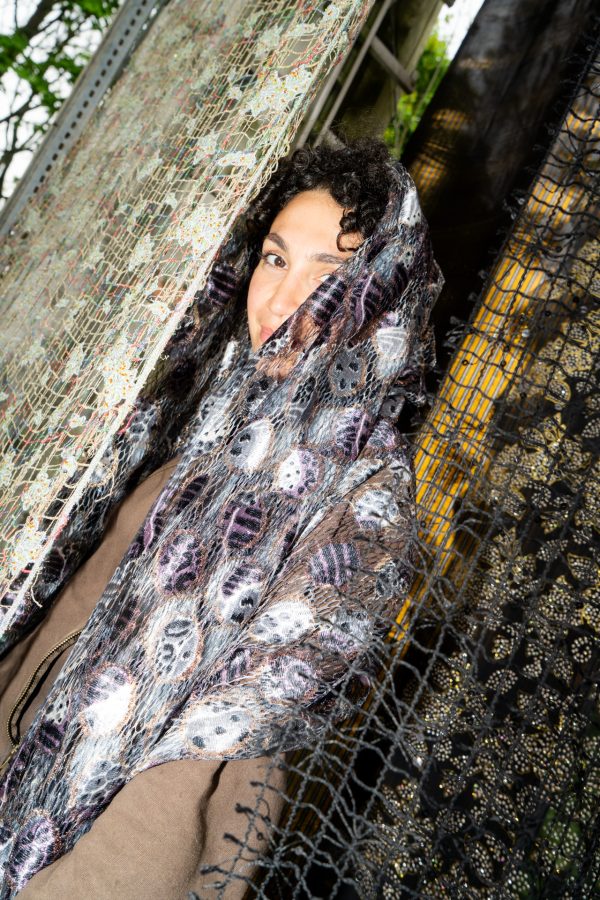
Left. ‘Les Bienfaits de la Lune’, Irene Cattaneo at Galerie Gastou, 2025. Photography. Enrico Fiorese. Right. Irene Cattaneo. Photography. Ilaria Zago
That scaffolding is already carrying her onward. Before the year is out, Galerie Gastou is set to present her work at Design Miami Paris, PAD London and NOMAD Abu Dhabi, three of the fairs where collectible design makes its name. ‘Il Giardino Segreto’ marks a turning point, and Cattaneo knows it. “The biggest step for me is simply that now I’m aware of what I want to make.” Romain, who shares that conviction, sees the same horizon. “What we’re seeing now,” she says, “is just the beginning.”
Find out more about Irene Cattaneo here.
words. Olivia Cichero
edit. Huma Humayun