rose arch pumps. CHINCHIN
At the intersection of sculpture, technology and footwear, CHINCHIN founder Xue Qin is reimagining what footwear can be. With a background in Design Products from the Royal College of Art, Qin approaches the shoe not simply as an accessory, but as an object with the power to shape how we move, feel and present ourselves. Her work brings together the structural logic of industrial design, the expressive freedom of sculpture and the visual language of fashion, resulting in forms that feel at once familiar and unexpectedly futuristic.
For CHINCHIN’s latest collection, Digital Botanica, nature becomes both a visual reference and a starting point for experimentation. Petals, stems and branching systems are translated through digital modelling and 3D printing into sculptural footwear, where organic forms take on new structural possibilities. A rose can become an architectural focal point, a curved arch can suggest the gradual unfolding of a petal, and an internal lattice can be adjusted to support the body in different ways. Throughout the collection, the natural and the artificial exist in dialogue: delicate botanical references are transformed through contemporary technologies into objects that feel surreal, industrial and alive.
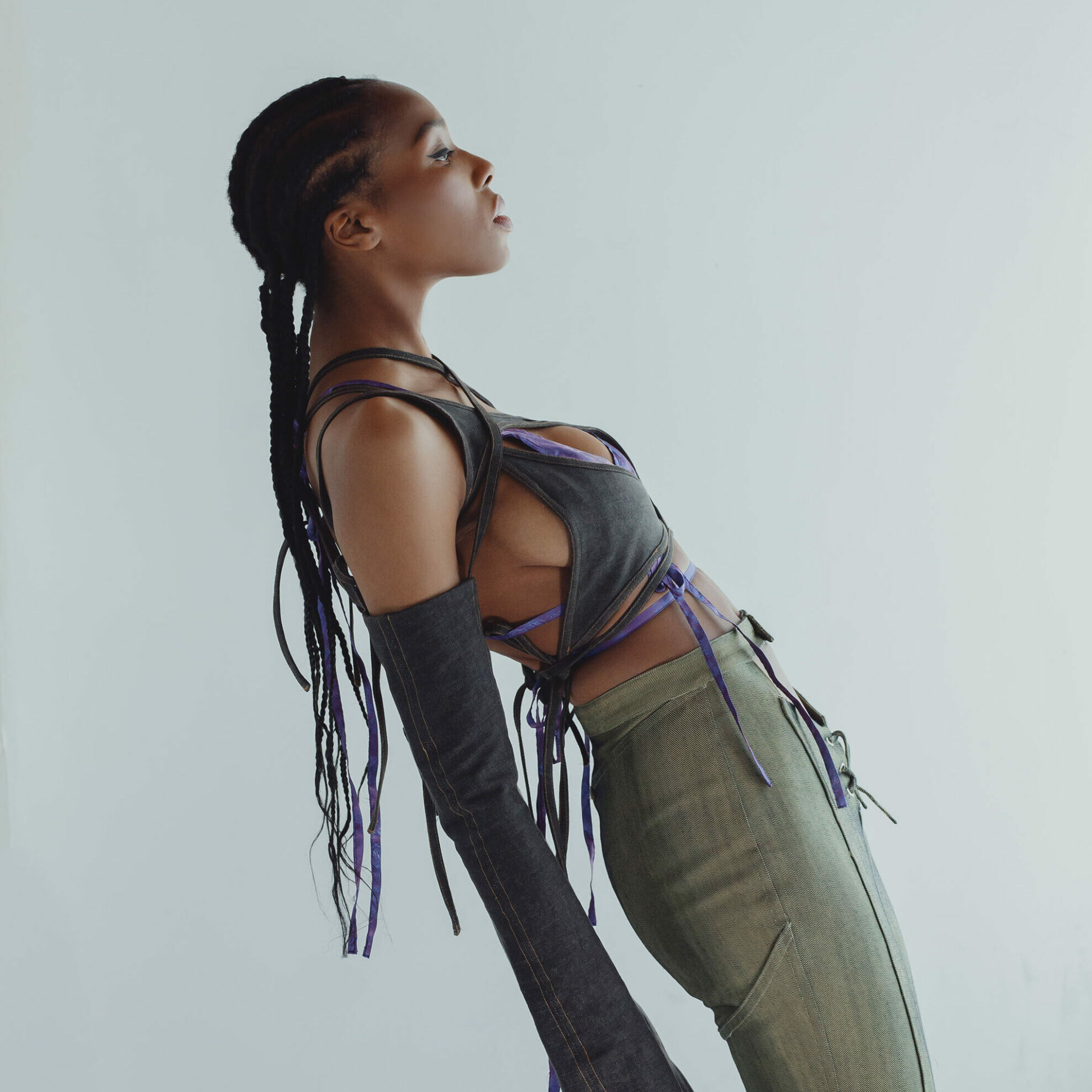
The visual world surrounding Digital Botanica extends this exploration further. Saturated colours, blurred movement and exaggerated silhouettes create images that sit somewhere between reality and imagination, drawing on the optimism and playful futurism of 1990s digital culture while looking towards new possibilities for making and design.
In conversation with Schön!, Xue Qin discusses her path from product design to footwear, the botanical memories that continue to shape her work and the challenge of translating sculptural ideas into objects made for the body.

ribbon pumps. CHINCHIN
opposite
ribbon pumps. CHINCHIN

ribbon pumps. CHINCHIN
You studied Design Products at the Royal College of Art. What drew you towards footwear, and how does that background shape the way you look at a shoe?
I’ve always been fascinated by objects that have a close relationship with the human body. Footwear brings together several things I love about design: the structural logic of industrial products, the freedom of sculpture and the expressive qualities of fashion. It’s a small object, yet it can change how someone looks, moves and feels.
Studying Design Products at the Royal College of Art encouraged me to think beyond the boundaries of a particular discipline. That background still shapes my aesthetic instincts. I’m naturally drawn to fluid surfaces, continuous forms and clearly defined structural lines—qualities often found in industrial and furniture design. I tend to consider the overall volume, proportions and construction of a shoe before its more conventional details. What excites me is that a sculptural idea has to become something a person can actually wear and live in. Finding that balance between form and the body is both the challenge and the attraction.
‘Digital Botanica’ turns petals, curves and branching forms into footwear. What was the first observation or experiment that gave this collection its direction?
I’ve been drawn to botanical forms for as long as I can remember. I grew up in Guangzhou, a city often called the “City of Flowers”. Even the old house I grew up in had floral motifs in its tiles, wooden carvings and decorative glass. Those images have stayed with me, perhaps more than I realised at the time.
My early Brass Collection was one of my first explorations of this interest through footwear. I worked with plum blossoms, orchids, bamboo and chrysanthemums, combining sculpted brass with black suede. I loved the contrast between these delicate botanical references and the strength of metal, as well as the unexpected connection with European decorative arts. What fascinates me about plants is their sense of movement and life: how petals fold, stems branch and forms gradually unfold as they grow.
When I began experimenting with digital modelling and 3D printing, these observations became even more interesting. The technology allowed me to explore botanical forms at different scales and with much greater structural freedom. I was curious about how something so organic could take on an industrial, almost futuristic character. ‘Digital Botanica’ grew out of that continuing dialogue between nature, materials and ways of making.

rose arch pumps. CHINCHIN
opposite
sunflower sneakers. CHINCHIN

rose arch pumps. CHINCHIN
opposite
rose arch pumps. CHINCHIN
In the Rose Arch Pumps, the flower shapes the shoe’s silhouette. Could you take us through one design decision that helped you capture the character of a rose without simply reproducing it?
I began with the image of a rose, but I wanted to simplify it into something almost architectural. What fascinated me was the way its petals turn, overlap and unfold, and the rhythm created by those movements. One important decision was to keep the rose at the toe, almost as though it were being held within the surrounding surface. The curved forms open around it, gradually revealing the flower. I like working with a clear focal point and allowing the rest of the design to develop around it.
I wanted the continuous arch beneath the foot to carry a similar sense of movement, like a petal slowly unfolding, while keeping the silhouette clean and elegant. The rose itself is recognisable, but I deliberately kept the main structure relatively simple. I spent a lot of time adjusting the proportions, especially the balance between the open space beneath the arch and the solid parts of the shoe. For me, that empty space is just as important as the material around it.
Working with generative and parametric design can produce many possible forms. How do you recognise the one that feels like yours, and what makes you reject a technically successful design?
I usually look at the overall silhouette first, and then the rhythm of the form. I’m attracted to shapes that suggest movement, where curves and volumes follow a certain flow and have a sense of order. Generative and parametric tools can create incredibly complex lattices, branching systems and almost endless variations. Some of these structures are technically useful, particularly when openings help reduce material use and weight. But complexity alone doesn’t interest me.
I’ve considered densely branching or highly repetitive forms that work technically but feel too busy visually. There can be too many elements competing for attention, and the shape loses its focus. I prefer something with a sculptural or architectural clarity. I like order, but not everything needs to feel completely controlled. A little irregularity can bring a sense of life to a form. I think knowing what to leave out is just as important as knowing what to create. Technology offers an enormous number of possibilities, but it can’t make those aesthetic decisions for me.

rose arch pumps. CHINCHIN

sunflower sneakers. CHINCHIN
opposite
sunflower sneakers. CHINCHIN
Which part of your process needs to happen through touch? What can handling a material or working on a physical prototype tell you that the digital model cannot?
There are things you can understand visually, and others you only really understand through touch. I enjoy that part of making because materials don’t always behave exactly as you expect. With leather, its thickness, flexibility and resistance all influence how a surface can be shaped. A curve that looks effortless on screen may behave very differently once you try to make it physically. Sometimes you need to change the form to work with the material rather than forcing it into a predetermined shape.
The same is true of 3D-printed prototypes. You can study the geometry and predict certain properties digitally, but holding and wearing the object tells you something different about its weight, balance and flexibility. I think the physical prototype is where a design begins to have a life beyond the screen. It’s often when I discover something unexpected, or realise that a decision I was convinced about needs to change.
Your lookbook describes adjusting the internal lattice to create different kinds of support. How do you test those decisions on a moving body, and can you share a fitting that changed the design?
Developing the 3D-printed footwear collection involved nearly two years of experimentation, prototyping and fitting. We tested different printing materials, degrees of hardness and variations in lattice thickness and density. One challenge was that the forefoot, arch and heel all needed different levels of support. With a one-piece printed shoe, we had to achieve much of that variation through geometry and internal structure rather than combining different materials.
A particularly useful fitting experience came with the Sunflower Sneakers. The original curve at the back of the shoe pressed against the heel during walking, causing friction and discomfort. We reshaped the rear collar so that it curved outward, creating a smooth, continuous surface where the shoe meets the heel. That relatively small change resolved the rubbing problem. I spend a lot of time wearing my own prototypes in everyday life. Sometimes a shoe feels fine at first, but after walking for a while, you begin to notice things that weren’t obvious before. Those experiences have been essential to refining the fit and cushioning. I’m particularly pleased with the comfort we’ve achieved in the Rose Arch Derbies and Sunflower Sneakers.

sunflower sneakers. CHINCHIN
opposite
rose arch pumps. CHINCHIN

sunflower sneakers. CHINCHIN
Since founding CHINCHIN in 2016, you have explored new approaches to footwear through traditional craftsmanship and digital fabrication. How has your design practice evolved, and what do you hope to contribute to the future of footwear design?
When I founded CHINCHIN in 2016, I was already interested in how footwear could become something more expressive, almost sculptural, while remaining part of everyday life. Over time, I have developed a recognisable design language rather than approaching each collection through a particular trend or technology.
Working with digital fabrication has opened up possibilities that would be difficult to achieve through conventional shoemaking, particularly in creating continuous forms and structures. But it has also made me appreciate traditional craftsmanship more. Leather, for example, has a warmth and familiarity that I don’t always find in digitally produced materials. I increasingly enjoy exploring what happens when these different processes meet.
Looking ahead, I’d like to continue challenging the familiar boundaries of footwear without losing its relationship with the body. I’m interested in shoes that can be visually unexpected, even a little surreal, yet feel natural when worn. I see my contribution as offering a different perspective on what footwear can be—somewhere between fashion, function and sculpture.
What do your current making methods change about material use, sampling and the life of a shoe? Where are the most difficult compromises still being made?
Traditional footwear production involves many components, materials and specialised processes. Producing a wide range of sizes can also create considerable inventory pressure. For an independent studio, 3D printing offers some interesting alternatives. We can test complex structures without investing in expensive moulds and produce certain designs in small quantities or on demand. Integrating different functions into a single printed structure can also simplify production. But I don’t think digital manufacturing automatically means sustainability. Material durability, energy consumption, repairability and recycling all need to be considered. Different printing processes have different limitations.
After several years of wearing my own designs, I’ve found some of our DLP-printed shoes remarkably durable, even outlasting certain conventionally made shoes. FDM printing can present different challenges with abrasion resistance and long-term wear, depending on the material and construction. I’m also interested in the sensations materials bring. Printed polymers often have a smooth, distinctly synthetic feel, while leather has the warmth and familiarity of a natural material. Neither is inherently better; they suggest different forms and ways of experiencing an object.
For me, the challenge is balancing creative freedom, production costs, comfort and the life of a shoe. I don’t want to be limited to one way of making things. Each process offers different possibilities, and I prefer to choose the method according to the character I want the design to have.

rose arch pumps. CHINCHIN
opposite
left to right
sunflower sneakers. CHINCHIN
ribbon sneakers. CHINCHIN

rose arch derby shoes. CHINCHIN
opposite
rose arch derby shoes. CHINCHIN
The ‘Digital Botanica’ images place the shoes in a world of saturated colour, blurred movement and exaggerated silhouettes. What did you want that world to reveal about the collection?
I’ve always been drawn to saturated colours and images that feel slightly removed from reality. There’s a certain romance in that sense of artificiality, where something familiar can suddenly become strange or dreamlike. I’m particularly fascinated by the visual culture of the 1990s, when digital technology was opening up new possibilities, and there was so much imagination surrounding the future. I love the bold colours, the playfulness and even a certain naivety in the imagery of that period.
In some ways, I feel we’re experiencing a similar moment today, with new technologies once again changing how we imagine and create things. What interests me is how something real and natural can be transformed through an artificial lens, becoming something surreal, romantic and unexpected. I think this also connects to my design process. I often begin with forms found in nature, but through digital processes and material experimentation, they gradually become something that exists somewhere between reality and imagination.
Your work has received recognition through the VOGUE China Fashion Fund and FNAA China, alongside collaborations with Disney. How have these experiences shaped your approach to bringing experimental footwear design into a wider fashion context?
These experiences have helped me see how an experimental design language can connect with people in different ways. Being recognised by the VOGUE China Fashion Fund and FNAA China was encouraging, particularly because I’ve always approached footwear from a slightly unconventional perspective. It confirmed that this approach could operate within a wider fashion context.
Collaborating with Disney offered a different kind of creative challenge. I was interested in how familiar icons of popular culture could be reinterpreted through my own design language. These characters carry a sense of nostalgia, playfulness and collective memory, which I find quite fascinating. The challenge was to preserve something instantly recognisable while transforming it into a new sculptural form. I also enjoyed the contrast between the innocence of these familiar characters and the more experimental, futuristic qualities of the footwear.
It reminded me that experimental design doesn’t necessarily have to feel distant or difficult to understand. It can also be playful and emotionally familiar while offering something unexpected. As CHINCHIN continues to expand, I want to maintain that openness without compromising the ideas behind the work. For me, reaching a wider audience isn’t about making the designs less experimental, but about finding different ways for people to connect with them.

rose arch derby shoes. CHINCHIN
opposite
rose arch derby shoes. CHINCHIN

rose arch pumps. CHINCHIN

sunflower sneakers. CHINCHIN
creative direction + fashion. Xue Qin
interview. Kelsey Barnes